
For B2B customers specifying building materials, there are many factors to juggle.
Performance, compliance and aesthetics all play a part, often on projects with tight turnarounds. That’s where aluminium doors come in. For commercial and residential projects, they’re a reliable, fast-to-market solution. They provide the strength and quality required in any building, while also offering the flexibility modern building projects need.
Aluprof’s aluminium door systems have been created with architects, developers and contractors in mind. Their systems have been designed for a host of projects, from office blocks to large residential developments.
Built for Performance and Compliance
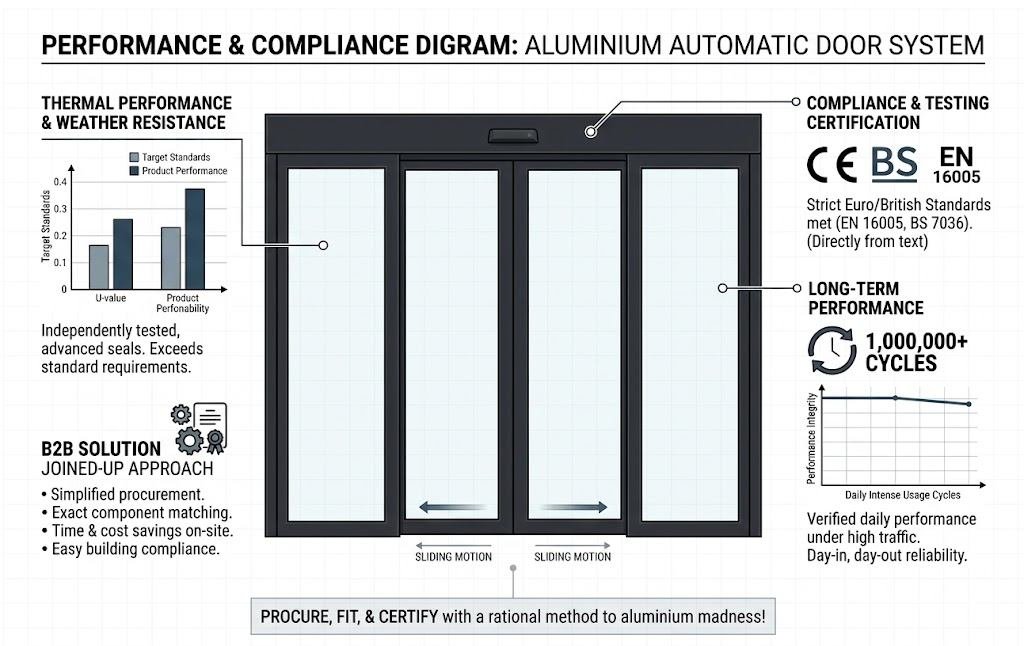
Aluminium doors are required to meet strict European and British standards set down for areas including thermal performance, weather resistance and long-term performance. Aluprof products are independently tested to meet and exceed all required standards, so you can be confident they’ll perform day in and day out, no matter how intense the usage or the environment.
Specifying B2B clients can use a more joined-up approach to door choice. Instead of trying to put together many disparate components to form a door, aluminium systems offer a solution that is way more joined-up and makes achieving building compliance easier. In addition, it simplifies the approach by procuring and then fitting it on site, saving time and money, almost as if there is a method in the aluminium madness!
Strength Without Excess Bulk
One of the benefits of aluminium in architecture is its strength-to-weight ratio. It’s strong enough for most applications yet light enough to allow slimmer profiles that don’t take away a building’s structural soundness. This is particularly helpful in projects where larger glass surfaces are important, such as bars, shops, and offices.
Advanced Aluprof systems work with large glass panes framed by minimal profiles. This permits architects to design a clean, sleek building look that doesn’t compromise stability or require a more complicated design.
Thermal Efficiency That Supports Energy Targets
As energy performance is a mandatory requirement for most building projects today, aluminium door systems feature thermal break technology, multi-chamber profile construction, and options for high-performance glazing to improve overall insulation.
Through the capabilities of systems like the MB-86, which is engineered with energy saving in mind by utilising wider glazing units and better sealing to achieve minimal heat loss, course projects can provide the requisite energy performance whilst also benefiting from reduced energy running costs in the long term.
Versatility Across Applications
Aluminium doors can be specified to offer a wide range of capabilities. Besides hinged systems, sliding, lift-and-slide, folding and automatic doors are available. This allows the contractor to use the same material to meet different requirements in different areas of the building.
Sliding and lift-and-slide doors are useful where the separation between indoors and out is to be minimised, offering smooth, consistent operation, robustness and a clean, contemporary finish. Hinged doors are functional as ever, serving entrances, access routes and back offices. Using the same material, sustainable solutions and various configurations wherever possible is contributing to maximising the integrity of the building envelope and increasing its longevity.
Long-Term Durability and Low Maintenance
Among its lifecycle benefits, first up is the ability to withstand environmental changes without compromising the material’s nature. There would be no rust to deal with, no warping of the door and no decaying in the material. This makes aluminium doors perfect for large residential areas, where maintenance could become a massive chunk of the expenditure over the decades.
Besides, if one considers the multipurpose use of aluminium (both indoors and outdoors), the maintenance of the doors is unlikely to be a matter of concern all too often. 10 years down the line, maintenance will always be an issue. In the case of aluminium, repair budgets would be well under control.
Design Flexibility for Contemporary Architecture
Aluminium systems are available in a wide range of finishes, colours and configurations. With the ability to powder coat profiles in practically any colour, including dual colour options to meet an internal aesthetic and external residential or office branding requirements.
For architects to maintain a consistent look throughout a project, aluminium framing systems can be specified to match and finish requirements in the factory, meeting the project’s design specification. From a minimal, industrial feel through to a refined architectural finish, aluminium can be adapted.
A Reliable Specification for Large-Scale Projects
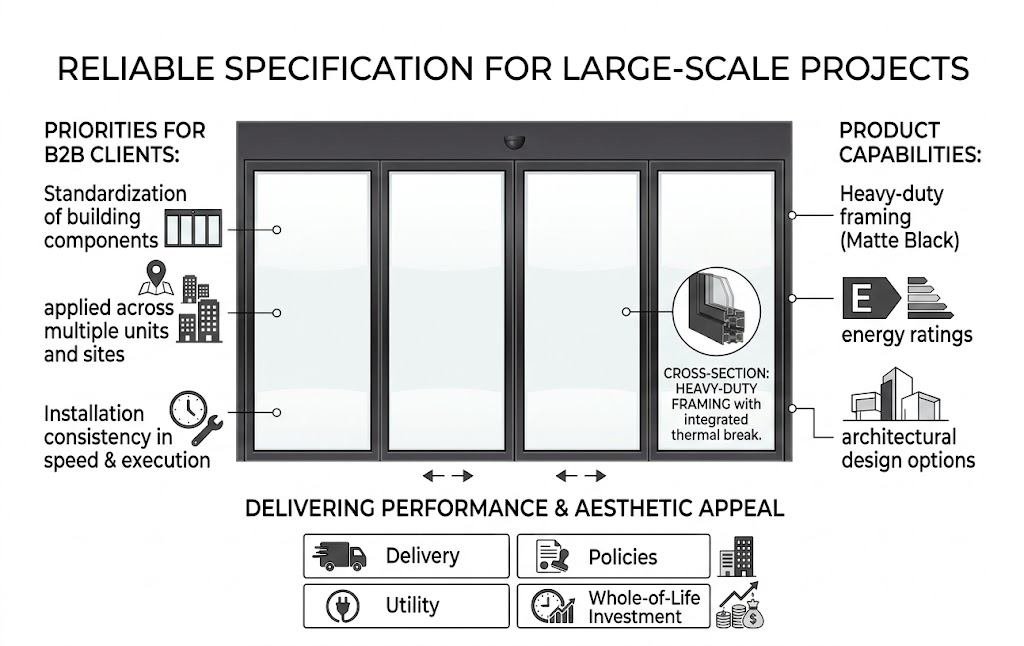
For B2B clients, several factors need to be prioritised in the decision-making process. When it comes to aluminium door solutions, these can be easily met without compromising the finished product’s quality, including the specification and standardisation of building components that can be applied across multiple units and sites, as well as installation consistency in terms of speed and execution.
Heavy-duty framing, energy ratings and architectural design options make an aluminium-framed door a user-friendly product capable of delivering performance and aesthetic appeal. Framed doors are not designed solely for cost savings; rather, they are part of a building system that operates for delivery, utility, policies and whole-of-life investment.
Conclusion
Aluminium doors offer a balanced solution for performance-driven commercial and residential projects. Their strength, thermal efficiency, compliance with standards, and low maintenance requirements make them a dependable choice for long-term use. Combined with design flexibility and ease of installation, they support both functional and aesthetic goals. For B2B stakeholders, aluminium door systems represent a practical investment that aligns with modern construction demands, sustainability targets, and lifecycle cost efficiency.
References
- European Committee for Standardization. (2016). EN 14351-1: Windows and doors – Product standard. https://doi.org/10.3403/30333764
- International Organization for Standardization. (2018). ISO 10077-1: Thermal performance of windows, doors and shutters. https://doi.org/10.3403/30346816
- Building Research Establishment. (2020). Thermal performance of building components. https://doi.org/10.1680/bre.2020.9781785092581
- U.S. Department of Energy. (2021). Energy efficiency in commercial buildings. https://doi.org/10.2172/1783526
- Ashby, M. (2011). Materials Selection in Mechanical Design. Butterworth-Heinemann. https://doi.org/10.1016/C2009-0-64219-0
- World Green Building Council. (2019). Bringing embodied carbon upfront. https://doi.org/10.13140/RG.2.2.23409.86886