
The cost of living crisis has touched nearly every household in the UK, and for families juggling childcare, school costs, groceries, and mortgage payments, rising energy bills have been one of the most painful pinch points. But it is not just home budgets feeling the squeeze. If you run a small business, whether that is a home-based enterprise, a local shop, or a family-run operation, commercial energy costs have climbed just as sharply. The good news is that using a service like Utility Bidder to compare energy tariffs can make a genuine difference, often saving hundreds of pounds a year that could go back towards your family instead.
Why Energy Bills Have Hit Families So Hard
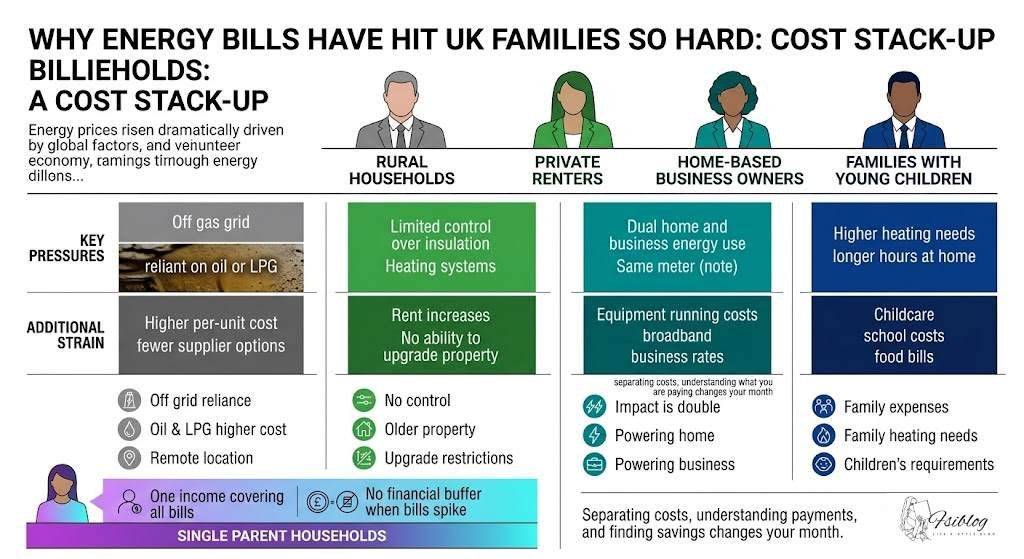
Energy prices in the UK have risen dramatically in recent years, driven by global gas prices, supply chain disruptions, and geopolitical uncertainty. The table below shows how the key cost pressures stack up for different types of households:
| Household Type | Main Energy Pressure | Additional Financial Strain |
|---|---|---|
| Families with young children | Higher heating needs, longer hours at home | Childcare, school costs, food bills |
| Home-based business owners | Dual home and business energy use | Equipment running costs, broadband, business rates |
| Private renters | Limited control over insulation and heating systems | Rent increases, no ability to upgrade property |
| Single parent households | One income covering all bills | No financial buffer when bills spike |
| Rural households | Often off the gas grid, reliant on oil or LPG | Higher per-unit costs, fewer supplier options |
For parents running a business from home, the impact is double. You are paying more to heat and power your home and more to keep your business running, often from the same meter. Separating those costs, understanding what you are actually paying, and finding savings on both sides can free up cash that genuinely changes your month.
Comparing Energy Deals: Not Just for Big Corporations
There is a common misconception that energy comparison services are only for large businesses with enormous utility bills. A business energy comparison tool is designed to help operations of every size. Here is how the process works at each stage:
| Stage | What You Do | What Happens Next |
|---|---|---|
| Gather your details | Find your current unit rate, standing charge, and annual usage from your latest bill | You have everything needed for a meaningful comparison |
| Use a comparison tool | Enter your details into a business energy comparison service | You see alternative tariffs from multiple suppliers side by side |
| Review your options | Compare unit rates, standing charges, contract lengths, and exit terms | You identify the best deal for your usage pattern |
| Switch supplier | Accept a new tariff through the comparison service | Your new supplier handles the switch with no interruption to supply |
| Track your savings | Monitor your first few bills under the new tariff | You see the saving in real terms each month |
Unlike domestic energy, business energy is not subject to the same price cap, which means the variation between suppliers can be substantial. Switching at the right time can deliver far larger savings on the commercial side than most people expect.
Real Cost of Doing Nothing
Most families and small business owners who have not reviewed their energy tariff in the past twelve months are almost certainly overpaying. Consider what staying on the wrong tariff could be costing you across a full year:
| Annual Overpayment | What That Money Could Cover Instead |
|---|---|
| £200 | A full term of after-school swimming lessons for two children |
| £350 | A family short break in the UK, including accommodation |
| £500 | Six months of weekly grocery top-ups or a new household appliance |
| £750 | A year of broadband, or clearing a small credit card balance |
| £1,000 or more | A family holiday abroad, or a meaningful contribution to an ISA or savings pot |
These figures are not hypothetical. For families who have never switched their business energy supplier and are on an auto-renewed contract, savings in this range are genuinely achievable.
Practical Steps to Cut Home Energy Costs
Rather than a long list, here is a breakdown of home energy saving actions organised by cost and effort so you can prioritise what makes sense for your situation:
| Action | Upfront Cost | Difficulty | Estimated Annual Saving |
|---|---|---|---|
| Switch to LED bulbs throughout | Low, around £20–£40 | Very easy | £40–£70 |
| Draught-proof doors and windows | Very low, under £20 | Easy | £30–£60 |
| Install a smart thermostat | Low to medium, often free via the supplier | Easy | £75–£150 |
| Run appliances during off-peak hours | None | Easy | £50–£100 |
| Insulate your loft if not already done | Medium to high, grants available | Requires professional | £150–£250 |
| Upgrade to a more efficient boiler | High, but the ECO scheme may cover it | Requires professional | £200–£400 |
| Switch energy supplier | None | Easy, about 10 minutes online | £150–£400 depending on tariff |
Start with the zero-cost changes and work down the list. The cumulative savings across several actions can be significant over the course of a year.
Reducing Energy Costs in Your Small Business
If you run a business from home or from separate premises, commercial energy deserves its own attention. The following actions apply whether you are a sole trader working from a spare room or a family running a small shop or studio:
- Review your contract before it auto-renews. Many business energy contracts roll onto expensive out-of-contract rates if you do not act before the renewal date. Diarise your contract end date now and begin comparing at least six weeks before it arrives.
- Audit your equipment. Old desktop computers, inefficient printers, and ageing commercial appliances consume far more power than their modern equivalents. A laptop uses roughly 80 percent less energy than a desktop PC doing the same work.
- Claim what you are entitled to. For home-based businesses, HMRC allows a proportion of household energy bills to be offset against business income. The exact amount depends on how many rooms you use and for how many hours, but it effectively reduces your net energy cost.
- Check your VAT rate. Business energy is usually charged at 20 percent VAT, but businesses using energy primarily for non-business purposes, or charitable organisations, may qualify for the reduced 5 percent rate. It is worth confirming with your supplier.
- Consider a half-hourly meter. For businesses with higher energy consumption, a half-hourly meter gives you detailed data on exactly when and how you are using energy, which makes it far easier to identify waste and shift usage to cheaper periods.
Understanding Your Energy Bill: A Quick Reference
Many people find their energy bill confusing, which makes it harder to compare deals or spot errors.
| Term | What It Means | Why It Matters |
|---|---|---|
| Standing charge | A fixed daily fee paid regardless of usage | It varies between suppliers and affects your total bill even if you use very little energy |
| Unit rate | The price per kilowatt hour (kWh) of energy consumed | The main figure to compare between tariffs |
| Annual consumption (kWh) | Total energy used over twelve months | Needed to make a like-for-like comparison between tariffs |
| Climate Change Levy | Environmental tax applied to business energy | Can sometimes be reduced or exempted for certain qualifying businesses |
| Direct debit estimate | Monthly payment based on predicted usage | May be set too high or too low depending on how the supplier estimated your needs |
| VAT rate | 5% for domestic energy, 20% for business energy | Some businesses qualify for the lower rate even on commercial contracts |
| Exit fee | Penalty for leaving a fixed contract early | Important to check before switching mid-contract to ensure savings outweigh the cost |
Take ten minutes to locate your latest bill, find these figures, and write them down. Armed with those numbers, you can make a genuine comparison and know instantly whether you are overpaying.
Fixed vs Variable Tariffs: Which Is Right for You
Choosing between a fixed and variable tariff is one of the most important energy decisions a family or small business can make. Here is how they compare across the factors that matter most:
| Factor | Fixed Tariff | Variable Tariff |
|---|---|---|
| Price stability | Unit rate locked for the contract term | Fluctuates with the wholesale market |
| Budget predictability | High – easier to forecast monthly costs | Low – bills can change significantly |
| Benefit when prices fall | None – you stay on the agreed rate | Yes – your rate drops with the market |
| Risk when prices rise | None – you are protected | High – bills rise with the market |
| Best suited to | Families on tight budgets, small businesses needing cost certainty | Those with financial flexibility and confidence in market timing |
| Typical contract length | 1–3 years | Rolling monthly or annual |
| Exit flexibility | Limited – exit fees usually apply | Higher – easier to switch |
For most UK families managing a household budget carefully, the predictability of a fixed tariff is worth the trade-off. For small businesses, a fixed tariff also simplifies financial forecasting and makes it easier to price products and services with confidence.
Government Support Worth Checking Right Now
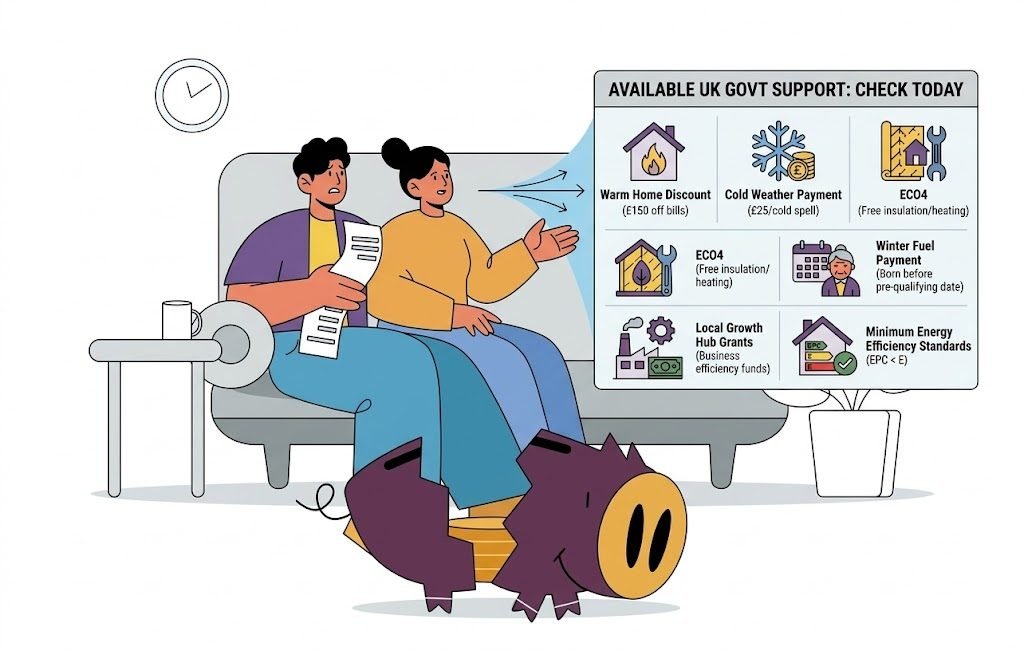
Many families and small business owners are not claiming the support they are entitled to. Here is a summary of the main schemes currently available in the UK:
| Scheme | Who It Is For | What It Provides |
|---|---|---|
| Warm Home Discount | Low-income households and those on qualifying benefits | One-off reduction of around £150 on electricity bills each winter |
| Cold Weather Payment | Those on qualifying benefits | £25 paid automatically for each seven-day cold spell |
| Energy Company Obligation (ECO4) | Low-income and vulnerable households, including homeowners | Funded insulation, heating upgrades, and draught-proofing |
| Winter Fuel Payment | People born before a qualifying date | Annual payment to help with winter heating costs |
| Local Growth Hub grants | Small businesses investing in energy efficiency | Partial funding for audits, equipment upgrades, and efficiency improvements |
| Minimum Energy Efficiency Standards | Private renters in properties below EPC E rating | Right to request improvements from the landlord, enforceable by the council |
Even if you have assumed you do not qualify for any of these, it is worth checking. Eligibility criteria change, and many households miss out simply because they never applied.
Teaching Children About Energy and Money
The cost-of-living crisis, difficult as it is, can also be a genuine teaching moment for the whole family. Children who understand the connection between behaviour and bills develop financial awareness that stays with them far beyond childhood.
Start by showing older children your actual energy bill and explaining what the standing charge and unit rate mean in plain terms. Seeing a real number makes the lesson land far more effectively than a general conversation about not wasting electricity. From there, some practical ideas that families have found genuinely effective:
- Turn it into a challenge. Set a target to reduce the monthly bill by a specific amount and involve children in tracking whether you hit it. When you do, use a portion of the saving on something the family enjoys together, which directly connects the behaviour to a positive outcome.
- Make the invisible visible. Plug-in energy monitors cost very little and show in real time how much power different appliances are drawing. Children are often surprised to discover that a games console on standby or a phone charger left plugged in with nothing attached still costs money every day.
- Delegate a responsibility. Give each child one specific energy-saving job, such as being in charge of turning off lights in rooms nobody is using, or making sure the back door is closed properly in winter. Ownership of a task tends to produce better habits than general reminders.
Every Pound Saved Is a Pound for Your Family
The cost of living crisis is not going away overnight, but families and small business owners are far from powerless. The most impactful actions you can take right now come down to four things:
- Compare. Use a business energy comparison service and a domestic comparison tool to see what you are currently paying against what is available. Do this for both your home and your business.
- Switch. If the numbers make sense, switch. The process takes minutes, and your supply is never interrupted.
- Reduce. Work through the practical steps in this article from the easiest and cheapest upwards. Small changes compound into meaningful annual savings.
- Claim. Check every government scheme and grant relevant to your situation before assuming you do not qualify.
- That saved money could fund a family holiday, cover a term of swimming lessons, clear a credit card balance, or take the edge off a tough month. And that is genuinely worth ten minutes of your time.
Conclusion
The cost of living crisis has forced millions of UK families and small business owners into a position nobody asked for, making difficult choices between essentials that should never have to compete with each other. But within that pressure, there is also an opportunity, because energy is one of the few major household and business costs where taking action yourself can produce a real, measurable saving in a matter of days.
Whether you start by comparing your business tariff through a service like Utility Bidder, running a business energy comparison for the first time, draught-proofing your home office, or simply sitting down with your energy bill and actually understanding what you are paying, every step moves you in the right direction. None of it requires a large upfront investment. Most of it requires nothing more than time and the decision to look.
For families, the reward is money redirected back to the people and experiences that matter. For small business owners, it is cost certainty, better forecasting, and profit that stays in the business rather than disappearing into an inflated energy contract. For parents who are both, it is both.
The crisis is real. So is your ability to fight back against it.