
Engineering plastics are materials designed to perform reliably in demanding environments where standard plastics often fail. Across the UK, from factory floors in the Midlands to refurbishment projects in London and public sector buildings in Scotland, these materials are chosen for their strength, stability, and ability to cope with mechanical stress, moisture, and repeated daily use.
Unlike everyday plastics used for packaging or household products, engineering plastics are developed for performance-focused roles. When durability, precision, and reliability matter more than appearance, businesses turn to engineering plastics for dependable results.
What Are Engineering Plastics?
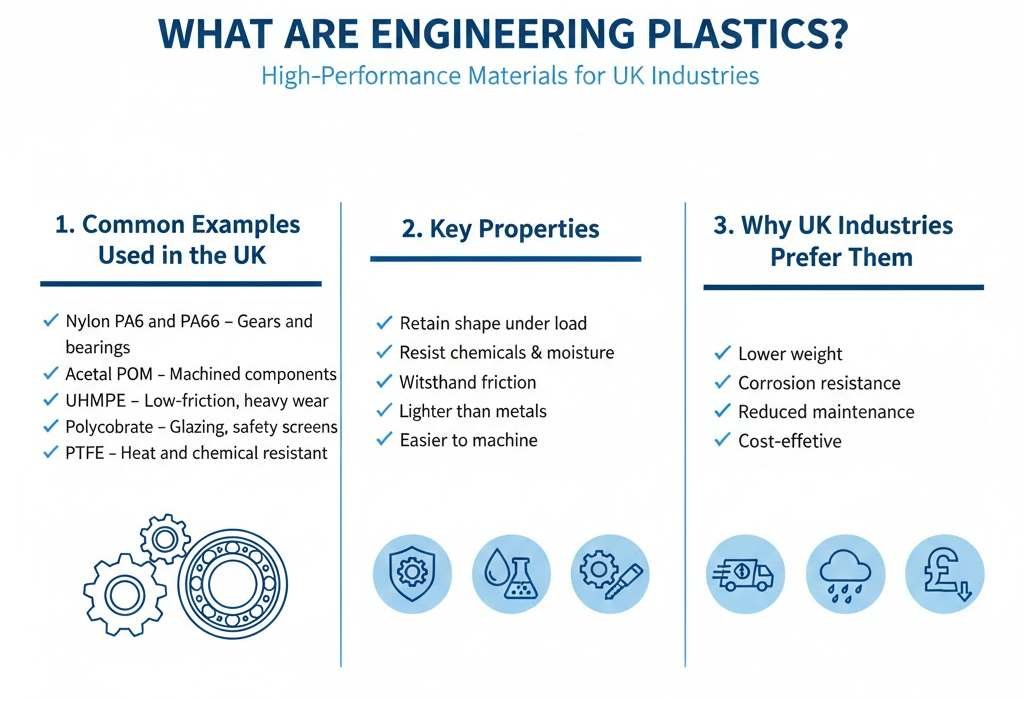
Engineering plastics are high-performance polymers designed for structural or mechanical applications. They are usually supplied in sheets, rods, and tubes, which can then be machined into finished parts.
Common Examples Used in the UK
- Nylon PA6 and PA66 – Strong and wear-resistant, often used for gears and bearings
- Acetal POM – Stable and precise, ideal for machined components
- UHMWPE – Excellent for low-friction and heavy wear environments
- Polycarbonate – Impact-resistant and clear, used for glazing and safety screens
- PTFE – Highly resistant to heat and chemicals
These materials retain their shape under load, resist chemicals and moisture, and withstand ongoing friction. Compared with metals such as steel or aluminium, they are lighter and easier to machine while still offering reliable structural performance.
Why UK Industries Prefer Them
- Lower weight reduces transport and installation costs
- Corrosion resistance suits damp British weather
- Reduced maintenance compared to metal alternatives
- Cost-effective for both large and small production runs
Core Properties That Set Them Apart
Understanding why engineering plastics are useful means looking at how they perform in real working conditions.
1. High Strength-to-Weight Ratio
- Strong enough for structural roles
- Lighter than metal, reducing strain on equipment
- Easier to install in retrofit projects
2. Low Friction and Wear Resistance
- Ideal for sliding or moving parts
- Reduces the need for lubrication
- Extends machinery lifespan
3. Dimensional Stability
- Retains shape under load
- Resists moisture expansion
- Handles temperature changes in UK industrial settings
4. Chemical and Moisture Resistance
- Withstands cleaning agents
- Suitable for food-processing environments
- Performs well in outdoor applications
Manufacturing and Engineering Applications in the UK
Manufacturing remains a strong sector in regions such as the West Midlands, Yorkshire, and the North West. Engineering plastics play an important part in modern production systems.
Typical Uses
- Machine guides and rails
- Rollers and conveyor components
- Gears and bushings
- Spacers and insulators
- Protective guards and covers
Because engineering plastics can be CNC machined with precision, they are ideal for:
- Custom-built machines
- Replacement parts
- Prototypes
- Short production runs
Practical Example
A UK food packaging facility might replace metal guide rails with UHMWPE. The result:
- Smoother product movement
- Less noise
- Reduced corrosion risk
- Lower long-term maintenance costs
Construction and Building Projects
The construction industry across England, Wales, Scotland, and Northern Ireland increasingly uses engineering plastics for both structural and finishing applications.
Where They Are Used
- Wall cladding panels
- Glazing alternatives
- Fabricated fittings
- Weather-resistant covers
- Safety barriers
Benefits for UK Projects
- Do not rust in damp environments
- Suitable for coastal areas
- Lightweight, easy installation
- Durable for refurbishment work
For builders working on older properties, the reduced weight can lower stress on existing frameworks. In commercial renovations, plastic panels provide a clean finish with minimal upkeep.
Retail, Education, and Public Sector Use
High-traffic environments such as shopping centres, schools, hospitals, and council buildings require materials that are tough but safe.
Common Applications
- Protective screens
- Signage backing boards
- Display structures
- Wall protection panels
- Desk and counter surfaces
Why They Suit Public Spaces
- Impact resistance improves safety
- Smooth edges reduce injury risk
- Easy to clean and maintain
- Long lifespan reduces replacement costs
For example, UK schools often choose polycarbonate sheets for protective screens because they are far more impact-resistant than standard glass.
Food Production and Hygiene-Sensitive Industries
The UK food and beverage sector relies heavily on materials that meet hygiene standards.
Engineering Plastics in Food Settings
- Conveyor wear strips
- Chopping boards
- Machine components
- Washdown-resistant parts
Key Advantages
- Non-corrosive
- Moisture resistant
- Easy to sanitise
- Long-lasting under repeated cleaning
These materials help facilities meet UK food safety standards while maintaining efficiency.
Cost and Long-Term Value
While initial material costs may be similar to or slightly higher than basic plastics, engineering plastics often save money over time.
Long-Term Benefits
- Fewer breakdowns
- Reduced maintenance
- Lower energy use due to lighter weight
- Less frequent replacement
UK businesses focused on efficiency often calculate the total cost of ownership rather than just the upfront material price. In many cases, engineering plastics provide better long-term value.
Sustainability and Environmental Responsibility
Sustainability is increasingly important across UK industries.
Environmental Advantages
- Many types are recyclable
- Long lifespan reduces waste
- Lightweight materials lower transport emissions
- Some suppliers offer recycled grades
When materials last longer and require fewer replacements, projects become both cost-effective and environmentally responsible.
How to Choose the Right Engineering Plastic
Selecting the correct material depends on the working environment.
Ask These Questions
- Will the part face constant friction?
- Is moisture or cleaning chemical exposure likely?
- Does the component carry structural load?
- Is temperature variation a concern?
- Are hygiene standards required?
Consulting a UK materials specialist or plastic fabricator can help match the correct grade to your application.
Final Thoughts
Engineering plastics play a vital role across UK industries by offering reliable performance where standard materials fall short. From manufacturing plants and building projects to public sector facilities and food production environments, they provide strength, precision, and durability.
As UK businesses focus more on efficiency, safety, and sustainability, engineering plastics remain a practical, proven, and forward-looking material choice.