



Whether you are a single mum running an online shop from the kitchen table, a couple managing a family business together, or someone who has built a side hustle into a genuine income stream, there comes a point where you need to know what it is all actually worth. You may be thinking about retirement. You may be considering selling. Maybe you want to know that the years of hard work have built something tangible for your family’s future. Tools like a SaaS Valuation Calculator can give you a clear, data-driven starting point, even if your business is not a tech company. The principles behind business valuation apply far more broadly than most people realise.
Why Knowing Your Business Value Matters for Families
For many parents, especially those who have built a business while raising children, the business is not just a job. It is woven into the fabric of family life. Knowing what it is worth gives you real power over your financial future. Here is why it matters:
- It funds the everyday things that keep family life running, from the mortgage and school uniforms to childcare and family holidays.
- It gives you leverage when speaking to banks, investors, or potential buyers, because you have a number with a rationale behind it rather than a vague estimate.
- It helps single parents in particular, since the business may be both the primary income and the primary asset, making its value central to every major financial decision.
- It allows you to make smarter choices about when to reinvest profits and when to take money out of the business.
- It ensures your family has a financial foundation to fall back on if circumstances change unexpectedly.
Basics of Business Valuation in Plain English
Business valuation does not have to be intimidating. At its core, it answers one question: if someone wanted to buy your business tomorrow, what would they pay? The answer depends on a few key things:
- How much money the business makes and how reliably it makes it.
- How likely is income to continue and grow in the future?
- The strength of your profit margins, customer retention, and growth trends.
- A multiplier applied to your annual revenue or profit, which reflects how stable and scalable the business is.
- For subscription-based or service businesses, online calculators are particularly accurate because the income is predictable and easy to model.
Understanding revenue adjustments is an equally important part of this process. These account for income or expenses that are unusual or unlikely to repeat:
- A one-off government grant that inflated last year’s revenue would be adjusted out.
- A below-market salary you paid yourself to keep costs down would be added back in.
- Any personal expenses run through the business would be stripped out.
- Seasonal spikes or one-time contracts that are unlikely to recur would be treated separately.
Getting your adjusted revenue figure right is what makes a valuation genuinely useful rather than simply flattering.
How This Connects to Retirement Planning

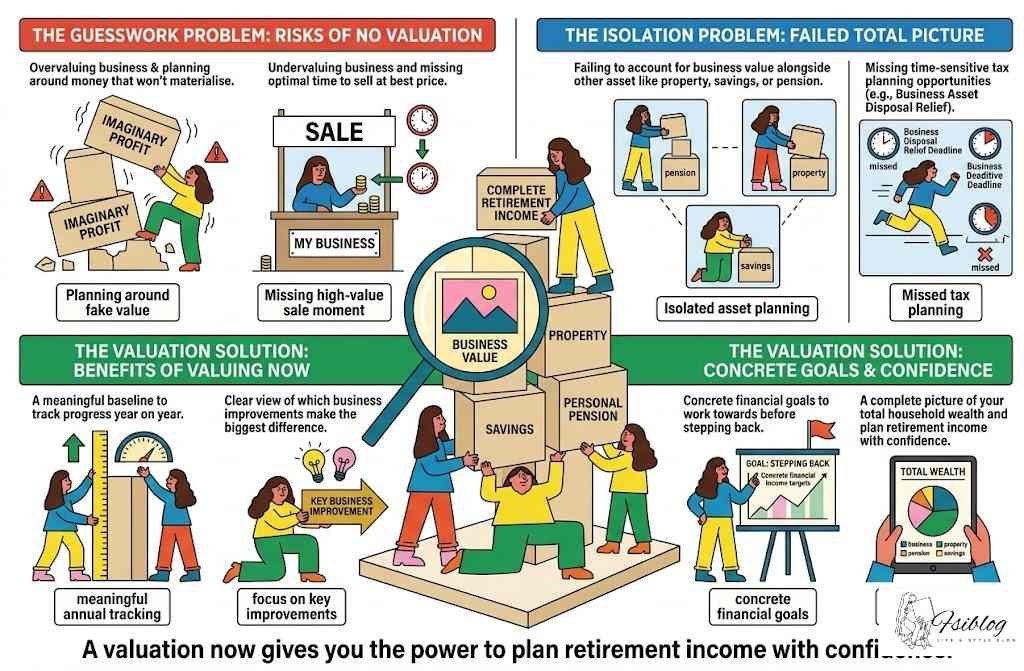
For parents without a workplace pension or with gaps in their National Insurance record, the family business often becomes the retirement plan. Without a clear valuation, you risk making major decisions based on guesswork. The key risks are:
- Overvaluing the business and planning around money that will never materialise.
- Undervaluing it and missing the right moment to sell or restructure at the best price.
- Failing to account for the business value alongside other assets like property, savings, or a personal pension.
- Missing time-sensitive tax planning opportunities, particularly around Business Asset Disposal Relief, which can reduce the Capital Gains Tax rate significantly when you sell a qualifying business.
Running a valuation now, even years before any planned exit, gives you:
- A meaningful baseline to track progress against year on year.
- A clear view of which business improvements make the biggest difference to your eventual sale price.
- Concrete financial goals to work towards before stepping back.
- A complete picture of your total household wealth that lets you plan retirement income with confidence.
Simple Steps to Increase Your Business Value Before You Sell or Step Back
Many of the things that make a business more valuable also make it easier and less stressful to run, which is good news for any parent juggling work and family life. Here are the most impactful changes you can make:
- Reduce owner dependency. If the business cannot run without you for two weeks, buyers will price that risk in heavily. Document your processes, train team members or contractors, and build systems that operate independently of you.
- Diversify your income streams. Relying on one client, one product, or one platform is a vulnerability. Adding even modest secondary revenue streams makes the business more resilient and more attractive to buyers.
- Build recurring revenue where possible. Monthly retainers, subscription models, service contracts, and maintenance agreements all increase income predictability, which directly increases your valuation multiplier.
- Keep your books clean and current. Messy or incomplete financial records derail valuations and put off buyers faster than almost anything else. Ensure your accounts are up to date, expenses are properly categorised, and revenue adjustments are clearly documented.
- Grow and protect your customer base. Businesses with strong customer retention, positive reviews, and a loyal following are worth significantly more than those constantly chasing new clients. Small investments in customer relationships pay real dividends at valuation time.
- Protect your intellectual property. Trademarks, proprietary processes, unique branding, and exclusive supplier relationships all add measurable value and should be properly documented and legally protected where possible.
- Strengthen your online presence. For UK small businesses, a well-ranked website, active social media, and a strong local reputation all contribute to perceived brand value, which buyers and investors will factor in.
What to Do When a Business Partner Is Also a Co-Parent
When a couple builds a business together, and the relationship changes, valuation becomes urgent and emotionally charged. Here is what to keep in mind:
- In England and Wales, courts treat business assets as part of the matrimonial pot when dividing finances on divorce, so a credible valuation is not optional; it is essential.
- An independent, data-driven valuation removes much of the argument from what can already be a painful process by grounding everything in facts rather than feelings.
- If one partner wants to buy out the other, the valuation is the only fair basis for calculating what that buyout figure should be.
- Getting a formal valuation early, before negotiations begin, protects both parties and prevents either side from being disadvantaged by an assumption made in a difficult moment.
- Consider using a jointly appointed valuer rather than each commissioning separate reports, as this saves money and tends to produce a figure both parties are more likely to accept.
Teaching the Next Generation About Business Value
One often-overlooked benefit of the valuation process is the financial education it provides to your children. Involving older teenagers or young adults in understanding how the business is valued can:
- Show them that a business is a real asset with logic and evidence behind its worth, not just a place where a parent spends their time.
- Help them understand the connection between recurring income and long-term value.
- Teach them why customer loyalty, financial records, and business systems matter in practical terms.
- Give them confidence in financial conversations they will face in their own working lives.
- Plant the seed for future entrepreneurship by showing them what building something valuable actually looks like from the inside.
Whether or not they ever take over the business, the financial literacy they develop through this process will shape how they think about money and work for the rest of their lives.
Planning the Handover to Family
If your long-term plan is to pass the business to your children or another family member, a proper valuation is just as important as in any commercial sale. Key considerations include:
- Setting fair expectations early so no one enters the handover process with a wildly different idea of what the business is worth.
- Structuring any buyout arrangement based on an independently verified figure rather than a family estimate.
- Protecting sibling relationships by ensuring the transfer is treated as a proper business transaction with clear documentation.
- Exploring whether the transfer can take advantage of Business Property Relief, which, in certain circumstances, can significantly reduce the inheritance tax burden on business assets passed to the next generation.
- Giving yourself enough time to plan, since a rushed handover almost always results in a lower value being realised and more stress for everyone involved.
Getting Professional Help Without Breaking the Bank

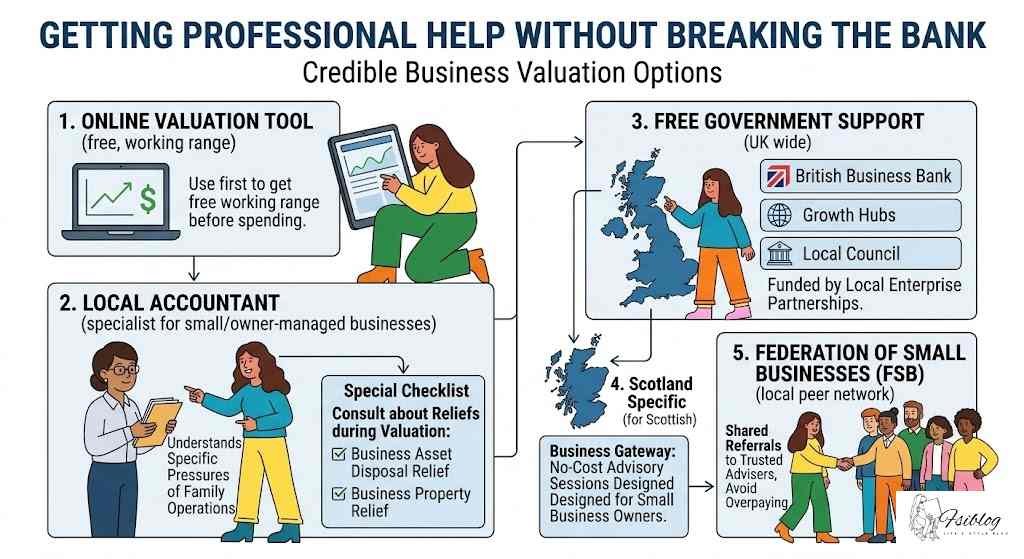
You do not need to hire an expensive City broker or accountant to get a credible starting point. There are accessible options at every budget level:
- Use an online valuation tool first to get a working range based on your actual figures before spending anything on professional advice.
- Speak to a local accountant who specialises in small or owner-managed businesses, as they will understand the specific pressures of running a family operation.
- Access free support through the British Business Bank, local Growth Hubs funded by local enterprise partnerships, or your local council business advisory service.
- If you are based in Scotland, Business Gateway offers no-cost advisory sessions specifically designed for small business owners.
- Join a local Federation of Small Businesses group, where members often share referrals to trusted advisers and can help you avoid paying over the odds for professional services.
- Ask your accountant specifically about Business Asset Disposal Relief and Business Property Relief at the same time as your valuation conversation, so you understand the tax implications before making any decisions.
Conclusion
Your business is likely one of the most significant things you will ever build, and for most family business owners, it is deeply personal. But sentimentality alone cannot fund your retirement, protect your children, or ensure a fair outcome if your circumstances change. The most important steps to take right now are:
- Start with an honest look at your revenue and run a valuation using the tools available to you.
- Understand how revenue adjustments affect your true figure and make sure your books reflect reality.
- Identify two or three specific improvements that will move your valuation in the right direction.
- Get professional advice at the right moment, not just when a sale or dispute forces you to.
- Involve your family in the conversation so the business value is understood and planned around, not discovered too late.
Whether you are years away from any major decision or closer than you think, having a real valuation gives you something solid to stand on. The hard work deserves a real number.