



Nobody decides to spend forty minutes on their phone. The forty minutes happen, and then you look up. This is the central fact of modern digital entertainment, and it is almost never discussed honestly, because the people building these products have no incentive to explain how they work and the people writing about them usually settle for calling everything immersive.
Interactive entertainment in 2026 is not simply television that answers back. It is a category of product designed around a single measurable goal, which is the length and frequency of your sessions. Understanding how that goal gets pursued is genuinely useful, whether you play strategy games, watch other people play them, or open something with reels and a balance in the corner.
What Britain Actually Does With Its Screen Time
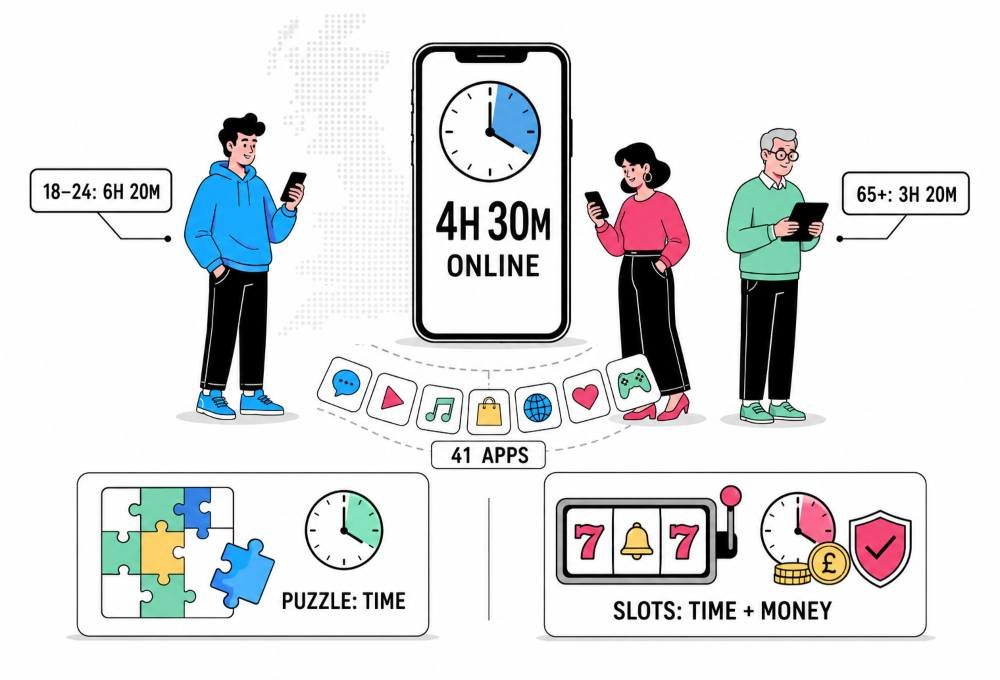
Start with the numbers, because the ones that circulate in articles on this subject are usually invented or hopelessly vague.
Ofcom’s Online Nation report puts the average UK adult at four and a half hours online per day outside work, ten minutes up on the previous year, with 18-to 24-year-olds at six hours twenty and the over-65s at three hours twenty. The typical smartphone user opens around forty-one apps a month. Most of that time is spent on a handful of very large services.
Notice what that figure does not tell you. Four and a half hours online is not four and a half hours of gaming, and lumping video games, streaming, social feeds and gambling apps into one statistic about “interactive entertainment” hides the only distinction that matters. A puzzle game and a slots app can look almost identical on a screen. One takes your time. The other takes your time and your money, and it is regulated differently for exactly that reason.
Reward Schedule Is The Product
The mechanism underneath most compelling digital entertainment is old and well understood. Rewards delivered on an unpredictable schedule produce more persistent behaviour than rewards delivered reliably. It is why a fruit machine holds attention in a way that a vending machine never will.
The more interesting research concerns what happens when you nearly win. A Cambridge team led by Luke Clark ran a simplified slot machine task inside a brain scanner and found something counterintuitive: near misses were experienced as less pleasant than clear losses, yet they increased the desire to keep playing. They also activated some of the same reward circuitry as actual wins. The effect was strongest when participants had chosen their own play icon, which is to say when they felt they were in control of an outcome that was entirely random.
That single finding explains an enormous amount of what you see on screen. The reel that stops one symbol short. The animation that lingers on the almost. The choice of which card to flip, which changes nothing about the odds but changes a great deal about how the moment feels. None of this is accidental, and none of it is unique to gambling. Loot boxes, streak counters and daily login rewards in mainstream video games run on the same logic.
Where the mainstream lifestyle framing goes wrong is in dressing this up as cognitive benefit. Strategy games probably do sharpen certain skills. Spinning reels does not make anyone better at their job, and the claim that it does is marketing wearing a lab coat.
The Welcome Offer Is A Contract, Not A Gift
If the reward schedule is the engine, the welcome bonus is the ignition, and it is the part of the industry where British consumers have the most concrete rights and the least awareness of them.
A bonus with a wagering requirement is not free money. It is money you must stake repeatedly before any of it becomes yours. A twenty-pound bonus with a thirty times requirement means six hundred pounds of turnover before a withdrawal is possible, and at typical house margins a fair amount of that six hundred will not survive the journey. Promotions pages are where this becomes concrete, and the questions worth asking are the same everywhere. Look at any welcome package, the Rocket casino sign up bonus included, and check four things: the multiplier attached to the bonus, whether it applies to the bonus alone or to the deposit as well, how long you have to clear it, and whether there is a cap on what you can withdraw from bonus winnings.
British regulation has moved on this. Following the 2023 white paper, the Gambling Commission’s response on socially responsible incentives capped wagering requirements at ten times for operators licensed in Great Britain, in force from 19 December 2025. It banned mixed product promotions, which took effect on 19 January 2026. That second rule ends the practice of requiring someone to bet on football to unlock casino spins, on the evidence that gambling across several products at once raises the risk of harm.
The important caveat is that the cap binds Commission licensees. An operator licensed elsewhere is not covered by it, is outside the British complaints route, and does not take part in the national self-exclusion scheme. The Commission’s public register is free to search and settles the question in under a minute.
None of this appeared out of goodwill. It followed years of pressure, beginning with the Competition and Markets Authority’s investigation into online gambling, which ran from 2016 and secured formal undertakings from major operators over promotions that trapped players’ own deposits behind bonus conditions. Reading the CMA’s findings is a fast education in which terms to look for.
Borrowed From The Wellness Aisle
Open a modern platform of almost any kind and the visual language is remarkably consistent: muted palette, generous spacing, rounded sans-serif type, your first name at the top, a gentle haptic tap when something resolves. It could be a meditation app, a banking app or a running tracker.
This convergence is not a coincidence and not a conspiracy. Products designed to be opened daily borrow from whatever else people open daily, and the aesthetics of calm keep sessions comfortable. Sound design does similar work. A rising tone on a partial result reads as progress even when the balance has gone down.
The honest way to hold this is that good design is not evidence of good conduct, and it is not evidence of bad conduct either. It is simply neutral information about how much was spent on the interface. What tells you about conduct is the licence, the terms and the regulator’s public record of enforcement.
Part The Lifestyle Framing Leaves Out
Most articles in this genre stop at the design compliment, which is precisely where they stop being useful.
Gambling harm in Britain is real, unevenly spread and largely invisible from outside. The NHS guidance on problems with gambling includes a short self-assessment that takes two minutes and is worth answering honestly rather than optimistically, and specialist NHS clinics now operate across England. GAMSTOP is free and blocks every operator licensed in Great Britain for a period you set, from six months upwards. The National Gambling Helpline, run by GamCare, is on 0808 8020 133, free, around the clock, and is there for people worried about someone else’s gambling as much as their own. GambleAware hosts the wider support network and explains in plain language what treatment actually involves.
Five Minutes Before You Sign Anything
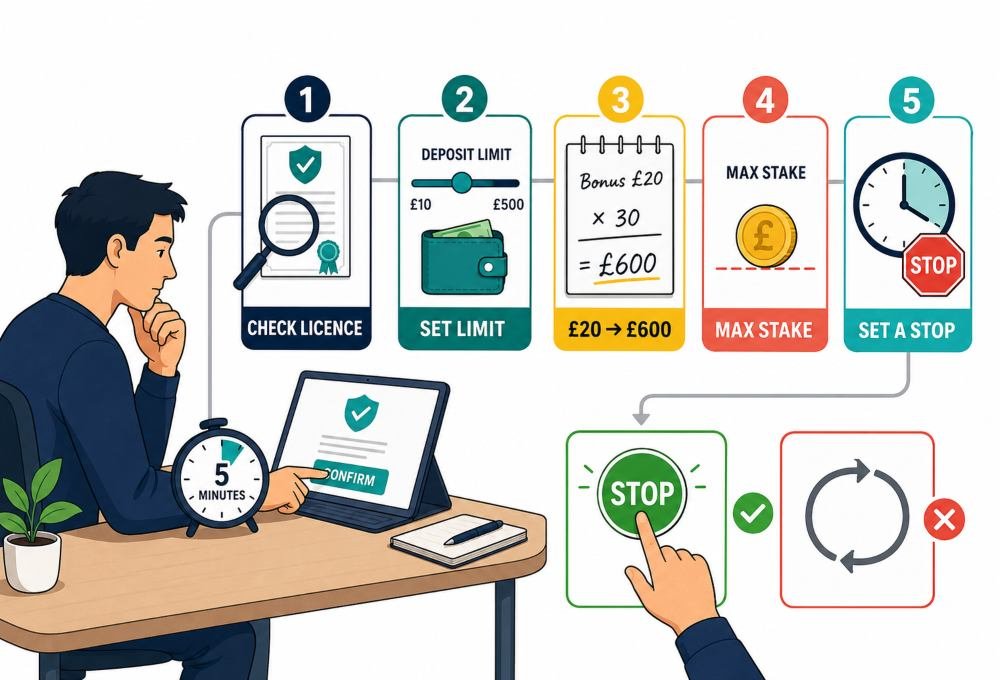
The habits that hold are the ones that do not depend on willpower at eleven at night.
Check the licence before the deposit. Set deposit limits during sign-up rather than later, since reductions apply immediately while increases carry a cooling-off period, which is the entire point of the tool. Do the wagering arithmetic on paper once, because seeing six hundred pounds written down changes how twenty pounds of bonus feels. Find the maximum stake permitted while bonus funds are active, as breaching it is the most common reason people lose a balance they thought they had earned. And decide in advance what ends the session, whether that is a clock, a figure or the end of an episode of something.
The pleasure in interactive entertainment is genuine, and nothing is embarrassing about wanting an hour that responds to you at the end of a long day. The only thing worth protecting is the difference between choosing to play and not having chosen to stop.
Disclaimer: This article is for general information and is intended for readers aged 18 and over. It is not financial, legal or medical advice, and nothing here is a recommendation to gamble or to use any particular operator. Gambling involves risk, and losses should be expected. Regulations, promotional terms and support services change, so confirm current details directly with the relevant organisation. If you are concerned about your own gambling or someone else’s, contact the National Gambling Helpline on 0808 8020 133 or speak to your GP.
References
- Clark L, Lawrence AJ, Astley-Jones F, Gray N. Gambling near-misses enhance motivation to gamble and recruit win-related brain circuitry. Neuron. 2009;61(3):481–490. https://doi.org/10.1016/j.neuron.2008.12.031
- Wardle H, Degenhardt L, Marionneau V, Reith G, Livingstone C, Sparrow M, et al. The Lancet Public Health Commission on gambling. The Lancet Public Health. 2024;9(11):e950–e994. https://doi.org/10.1016/S2468-2667(24)00167-1
- Tran LT, Wardle H, Colledge-Frisby S, Taylor S, Lynch M, Rehm J, et al. The prevalence of gambling and problematic gambling: a systematic review and meta-analysis. The Lancet Public Health. 2024;9(8):e594–e613. https://doi.org/10.1016/S2468-2667(24)00126-9
- Gambling Commission. Autumn 2023 consultation: proposed changes to LCCP and RTS. Socially responsible incentives: consultation response. Birmingham: Gambling Commission; published 26 March 2025, last updated 30 June 2025. Available at: https://www.gamblingcommission.gov.uk/consultation-response/autumn-2023-consultation-proposed-changes-to-lccp-and-rts-socially
- Competition and Markets Authority. Online gambling: consumer protection case. CMA case page, investigation launched October 2016, closed April 2019. Available at: https://www.gov.uk/cma-cases/online-gambling
- Ofcom. Online Nation 2025 Report. London: Office of Communications; published 10 December 2025. Available at: https://www.ofcom.org.uk/media-use-and-attitudes/online-habits/from-apps-to-ai-search-how-the-uk-goes-online-in-2025
- National Health Service. Help for problems with gambling. NHS website, Live Well: Addiction support. Available at: https://www.nhs.uk/live-well/addiction-support/gambling-addiction/
- GAMSTOP (National Online Self-Exclusion Scheme Ltd). Self-exclusion for online gambling in Great Britain. Available at: https://www.gamstop.co.uk/
- GamCare. National Gambling Helpline. London: GamCare. Available at: https://www.gamcare.org.uk/
- GambleAware. Information, advice and support for anyone affected by gambling harms. Available at: https://www.gambleaware.org/