



There is a particular gap in the British day that did not exist twenty years ago. It is the ninety seconds while the kettle boils, the eleven minutes on a delayed Northern line train, the stretch between putting the tea in the oven and calling everyone to the table. Nobody planned for these gaps to become entertainment slots. They just were, and then the phone filled them.
Ofcom’s annual survey of how the country uses the internet puts a number on it. UK adults now spend an average of four hours and thirty minutes a day online outside of work, ten minutes more than the year before. Roughly 77 per cent of that time happens on a smartphone, and the typical user opens around 41 different apps in a month. That is not a niche behaviour. That is the national default.
For a lifestyle audience, this matters more than it might sound. The same handset that holds your recipe bookmarks, your running route, your bank and your group chat also holds whatever you do to switch off. Those things now sit within a thumb’s reach of each other, and the boundaries between them have quietly dissolved.
Why The Short Session Won
The most interesting shift in digital entertainment over the past decade has nothing to do with graphics. It is the collapse of the session.
Console gaming assumed a commitment: sit down, boot up, give it an hour. Mobile entertainment made a different bet, which was that people would rather have twelve small moments than one large one. That bet paid off spectacularly. Newzoo’s industry forecast put the global games market at around $188.8 billion for 2025, with mobile generating roughly $103 billion of it and holding a 55 per cent share of the whole industry, ahead of PC and console combined. Phones did not win because they are better machines. They won because they are the machine you already have in your hand.
This suits British life rather well. We are a nation of interrupted evenings. The design that works here is the design you can put down mid-sentence without losing anything, which is exactly what mobile-first products are built for.
Design Language Is Borrowed From Your Shopping Apps
Open a modern gaming platform, and you will notice something familiar before you notice anything else. The swipe gestures, the card layouts, the “recommended for you” row, the tabbed navigation along the bottom edge. None of it originated in gaming. It came from retail and social apps, and it was imported deliberately.
That familiarity is doing real work. It removes the tutorial, which removes the friction, which removes the moment where a casual visitor decides this is not for them. The same logic explains why a supermarket app and a fashion app increasingly look like siblings. There is now a shared visual grammar for “things you do on a phone”, and every category has converged on it.
It is worth being clear-eyed about the trade-off. Interfaces designed to feel effortless are also interfaces designed to keep you there. The absence of friction is a feature for the developer and a question for the user, and it is a fair one to ask of a shopping app, a video feed or a gaming platform alike.
Rules Quietly Changed Around You
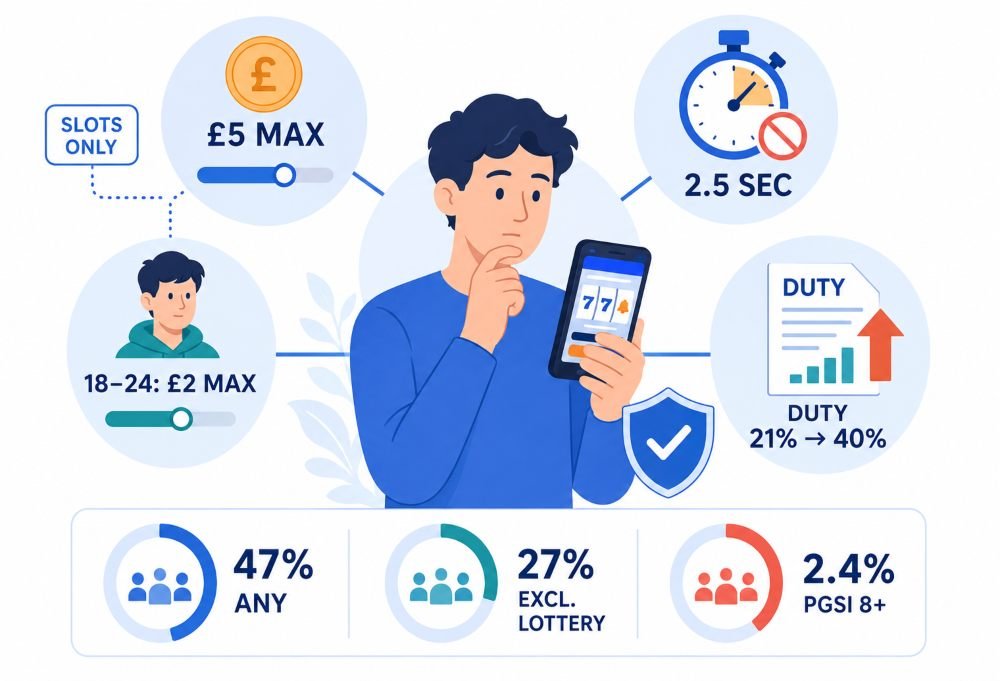
If you have played anything casino-style on a British-licensed site recently and felt that it behaved differently, you were not imagining it. The past two years have brought the most substantial rewrite of online gambling regulation in Great Britain since the Gambling Act 2005.
The headline change is a hard ceiling on stakes. Under the Gambling Commission’s online slots stake limit guidance, a £5 maximum stake per game cycle came into force on 9 April 2025, followed by a £2 limit for adults aged 18 to 24 on 21 May 2025. Separately, a minimum of 2.5 seconds must now elapse between the start of one game cycle and the beginning of the next, a pacing rule intended to prevent rapid repeat play. These limits apply to slots specifically and not to other casino products such as roulette or blackjack.
Then there is the money. Remote Gaming Duty, the tax on operator profits from online games of chance, rose from 21 per cent to 40 per cent on 1 April 2026, and Bingo Duty was abolished on the same date. The government’s stated reasoning was that remote gaming carries lower operating costs and greater risk of harm than other formats, and that the tax system should discourage operators from steering customers towards the riskier end of the catalogue. Whatever your view of the policy, it tells you where British regulatory thinking has landed.
The participation picture underneath all this is steadier than the headlines suggest. The Gambling Commission’s Gambling Survey for Great Britain found that 47 per cent of adults had gambled in some form in the previous four weeks during 2025, falling to 27 per cent once people who only played lottery draws are excluded. Of those adults, 38 per cent had gambled online and 28 per cent in person, and the proportion scoring 8 or above on the problem gambling severity index held stable at 2.4 per cent. Most people are not doing very much. A small minority are doing a great deal, and the rules are increasingly written with that minority in mind.
Licence Is The Part Nobody Reads
Here is the practical distinction that gets lost in glossy comparison articles. Everything described above applies to operators licensed by the Gambling Commission. It does not apply to anyone else.
That is why the same brand can behave like two entirely different products depending on which market it serves. A platform built for Canadian or Australian players answers to a different regulator, sets its own stake ceilings, prices in its own currency and has no obligation to connect to the British self-exclusion system. The Winspirit casino Canada site is a straightforward illustration of that contrast: it runs on a Curaçao licence rather than a British one, which means a UK visitor browsing it is standing outside the protections set out above rather than inside them. The stake caps, the pacing rule and the mandatory self-exclusion register do not travel with you.
None of that is hidden. It is usually in the footer, in small grey type, and it takes about eight seconds to check. Whether a site holds a British licence is genuinely the single most useful thing a UK reader can establish before doing anything else.
Bonuses, Clubcards, And The Same Piece Of Psychology
Reward mechanics are not a gambling invention. They are a retail invention that gambling adopted, and if you have a Clubcard in your wallet or a Nectar app on your phone, you are already fluent in the grammar.
The structure is identical across categories. A small immediate reward to establish the habit, a larger deferred reward to sustain it, and a visible progress indicator so you always know how close you are to the next thing. Coffee loyalty stamps work this way. Step-count badges work this way. Airline tiers work this way. Welcome offers and reload promotions work this way.
The difference is what happens when the reward does not arrive. A missed Clubcard threshold costs you nothing. A missed outcome in a gambling context costs you the stake, and that asymmetry is the entire reason one category is regulated and the other is not. Treating a bonus as an entertainment budget rather than an investment strategy is not a moralising point. It is just an accurate description of what the product is.
Deciding Your Limits Before The App Decides For You
The most useful thing about the current British system is that the tools are free, national and take minutes to set up.
GAMSTOP is the national online self-exclusion register. One registration blocks your access across every operator holding a Gambling Commission licence, for six months, one year or five years, and it cannot be reversed early. The NHS guidance on gambling-related harm also recommends installing a device-level blocker such as Gamban and asking your bank to block payments to gambling sites, both of which work alongside self-exclusion rather than instead of it. Most major British banks now offer that card block free in their app, usually under a couple of taps.
If you want to talk to somebody, GamCare runs the National Gambling Helpline on 0808 8020 133, free and open around the clock. One note on currency: GambleAware, the charity many older articles still signpost, ceased operations on 31 March 2026 when its work transferred to NHS-led commissioning under the new statutory levy. If you find a resource page pointing there, it needs updating.
Pocket Sized Venue Is Here To Stay

Mobile entertainment did not arrive with a launch event. It accumulated, gap by gap, until the phone had absorbed most of the small spaces in the day where we used to do nothing in particular. That is a genuinely convenient thing and also a thing worth being deliberate about.
The technology will keep improving. Screens will get sharper, connections faster, recommendations more precise. What will not change is that the decisions worth making are the ones you make before you open the app rather than during it: what this is for, how long it gets, and how much it is allowed to cost. Those three answers travel with you regardless of which platform you are on, which is more than can be said for the regulations.
Disclaimer: This article is intended for readers aged 18 and over and is provided for general information only. It is not financial, legal or medical advice, and nothing here should be read as a recommendation to gamble or to use any particular platform. The regulatory requirements described apply to operators licensed by the Great Britain Gambling Commission and may differ in other jurisdictions. If gambling is causing difficulty for you or someone close to you, the National Gambling Helpline is available free on 0808 8020 133, 24 hours a day.
References
- Ofcom. Online Nation 2025 Report. Published 10 December 2025. Available at: https://www.ofcom.org.uk/siteassets/resources/documents/research-and-data/online-research/online-nation/2025/online-nations-report-2025.pdf
- Newzoo, reported in PocketGamer.biz. Newzoo: Global games market set to hit $188.8bn in 2025. Available at: https://www.pocketgamer.biz/newzoo-global-games-market-set-to-hit-1888bn-in-2025/
- Gambling Commission. Gambling Survey for Great Britain (Annual Report 2025): Official Statistics. Available at: https://www.gamblingcommission.gov.uk/statistics-and-research/publication/gambling-survey-for-great-britain-annual-report-2025-official-statistics
- Gambling Commission. Online Slots Stake Limit Guidance. Published 30 January 2025, last updated 16 June 2025. Available at: https://www.gamblingcommission.gov.uk/licensees-and-businesses/guide/online-slots-stake-limit-guidance
- House of Commons Library. Budget 2025: Gambling Taxation. Research Briefing CBP-10440. Available at: https://researchbriefings.files.parliament.uk/documents/CBP-10440/CBP-10440.pdf
- NHS. Help For Problems With Gambling. Available at: https://www.nhs.uk/live-well/addiction-support/gambling-addiction/
- GamCare. Get Support. National Gambling Helpline, 0808 8020 133. Available at: https://www.gamcare.org.uk/get-support/
- GAMSTOP (National Online Self-Exclusion Scheme Limited). Available at: https://www.gamstop.co.uk/