



Marketing content rarely becomes expensive at the idea stage. The money disappears during production: arranging a shoot, briefing several suppliers, waiting for edits, resizing files and repeating the process for every channel. AI tools are changing that structure by shortening the distance between an approved concept and a usable creative asset.
Content Costs Usually Hide in the Handoffs
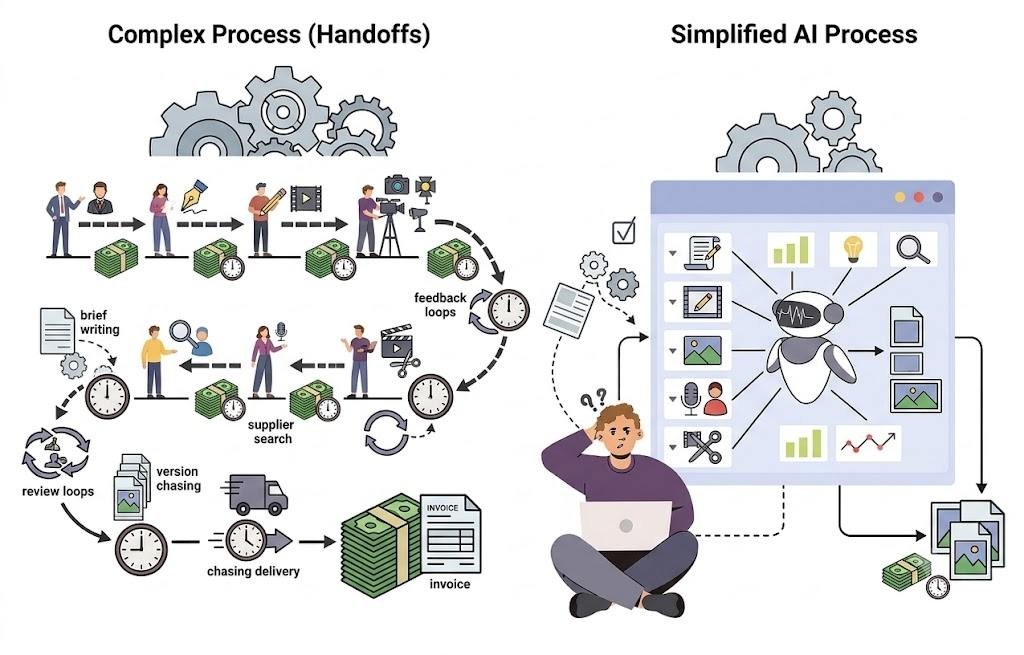
A marketing manager may describe a campaign as “one short product video”, but the production list often tells a different story.
Someone has to write the script. A designer may need to prepare a storyboard. Products must be photographed or filmed. A presenter, location or voice artist may be required. An editor then assembles the footage, adds captions and exports several versions.
None of these stages is unreasonable. The problem is that every handoff introduces another cost, another diary to coordinate and another opportunity for delay.
Consider a small retailer in Birmingham preparing a seasonal promotion. The original request might be a 30-second video for social media. By the time the team has arranged photography, approved a voiceover and requested vertical, square and landscape versions, the campaign has become a small production project.
The visible invoice is only part of the expense. Internal staff may spend hours:
- Writing and rewriting the brief
- Finding available suppliers
- Sending brand assets
- Checking product details
- Collecting feedback from managers
- Correcting captions and prices
- Requesting alternative file sizes
- Chasing final delivery
AI content tools reduce costs largely because they remove or compress some of these handoffs. The saving is not simply “AI is cheaper than a camera crew”. It is also that fewer people must move the same idea through a long chain before it can be published.
UK Businesses Are Moving From Curiosity to Practical Use
AI adoption is still uneven, but its use in everyday business work is becoming more visible.
The UK Government’s research into business adoption of artificial intelligence found that marketing and administration were among the most common business areas using or planning to use AI. The research also found that efficiency and productivity were stronger motivations than direct cost reduction, which reflects how many firms first experience the benefit: work moves more quickly before the savings appear clearly in the accounts.
More recent Office for National Statistics analysis of AI in UK businesses is also tracking how the technology is being integrated into ordinary business activity rather than treating it as a separate technology experiment.
For a small marketing department, this distinction matters. The most useful AI tool may not be the one that promises the most advanced output. It may be the one that removes a regular bottleneck, such as producing social media variations, translating a voiceover or turning an approved article into a short visual summary.
Video Production Without Rebuilding the Whole Production Chain

Traditional filming still has a clear place. A major television advert, customer case study or brand film may require real locations, professional lighting and experienced direction.
Many day-to-day marketing videos do not require that level of production.
A short feature introduction, product walkthrough, event reminder or internal training clip often needs clear information more than cinematic originality. For these formats, an AI Video Maker can turn an approved written brief into scenes, captions, narration and music without requiring a separate filming day.
This can remove several common costs:
- Location hire
- Camera and lighting equipment
- Travel expenses
- Presenter or voiceover bookings
- Large editing packages
- Reshoots caused by small wording changes
The ability to make corrections is particularly valuable. In a traditional shoot, discovering that a product name, date or offer has changed may require new footage. In an AI-assisted workflow, the team may be able to update the source text and regenerate only the affected scene.
That does not mean every generated video is ready to publish immediately. Timing, pronunciation, product accuracy and visual consistency still need checking. The cost advantage comes from reducing the amount of specialist labour needed for routine work, not from removing quality control.
Visual Variations Become Less Expensive to Produce
A single campaign rarely needs a single image.
A UK ecommerce business might require:
- A homepage banner
- A square Instagram post
- A vertical Story
- A LinkedIn graphic
- A newsletter header
- A paid social advert
- A marketplace image
- A version for a regional branch
Under a traditional model, the marketing team either pays for every variation or tries to stretch one master asset across incompatible spaces. The result is often a campaign that looks polished in one location and awkward everywhere else.
An AI Image Maker makes it less expensive to create early concepts and channel-specific versions. A brand can test different settings, compositions, product arrangements and aspect ratios before asking a designer to refine the strongest direction.
This is where the human designer’s role becomes more valuable rather than less important. Instead of spending most of the budget resizing routine files, the designer can concentrate on art direction, visual hierarchy, accessibility and consistent brand recognition.
The best savings usually come from dividing the work sensibly:
| Production task | Suitable approach |
|---|---|
| Early mood and composition tests | AI-generated concepts |
| Routine size variations | Templates or AI-assisted resizing |
| Major campaign identity | Experienced designer or creative team |
| Product claims and pricing | Human verification |
| Final typography and brand consistency | Human design review |
| High-value photography | Professional production where justified |
The aim is not to automate every design decision. It is to stop paying premium creative rates for repetitive production tasks that do not require premium judgement.
Faster Drafts Make Weak Ideas Cheaper to Reject
Traditional production encourages teams to commit early.
When a filming day, photographer or external studio has already been booked, it becomes harder to abandon a concept that is not working. People continue because money and time have already been invested.
AI changes the cost of the first draft.
A team can produce three rough campaign directions before committing to one:
- A product-led version focused on features
- A customer-led version built around a common frustration
- A results-led version showing the intended outcome
These drafts do not all need to be publishable. Their purpose is to expose problems while those problems are still inexpensive.
Perhaps the product-led version feels too technical. The customer story may sound exaggerated. The results-led concept may be strong but requires clearer evidence. Finding this out during a short internal review is far cheaper than finding it out after a full shoot.
This is one of the less obvious production savings. AI does not only make assets faster. It makes it financially easier to reject an average idea.
Cost Should Be Measured Per Approved Asset
A platform may appear inexpensive because it can generate hundreds of images or videos each month. That number is not useful on its own.
Finance and marketing teams should measure the cost per approved, published asset.
Suppose a tool produces 100 graphics, but only 12 meet the company’s quality standard. Staff then spend several days correcting those 12. The subscription may still be worthwhile, but the true cost includes:
- Subscription fees
- Staff prompting time
- Review and approval time
- Manual editing
- Rejected outputs
- Storage and asset management
- Compliance checks
- Training and workflow development
A more useful calculation is:
Total monthly AI production cost ÷ number of approved assets published
This can then be compared with the cost of producing equivalent work through freelancers, agencies or an internal studio.
Businesses should also track time saved. A reduction from five working days to one may be commercially valuable even when the cash saving appears modest, particularly for promotions linked to changing stock levels, events or local demand.
AI Is Most Valuable in Hybrid Workflows
The strongest production model is rarely fully traditional or fully automated.
A furniture retailer might organise one professional shoot for its new collection, then use AI-assisted tools to:
- Create shorter edits for paid social media
- Add captions and alternative voiceovers
- Prepare regional versions
- Replace background settings
- Turn still photographs into simple motion graphics
- Produce variations for different customer groups
A software company in Bristol might record one genuine product demonstration, then use automation to create shorter tutorials for individual features.
A hospitality group could photograph its real rooms and food, while using AI for layout variations, seasonal graphics and draft campaign concepts.
This blended approach protects authenticity where it matters while reducing repetitive production work. It also avoids a common weakness of fully generated campaigns: polished content that does not feel connected to the actual product, premises or customer experience.
Small Teams Gain More Than Cheap Assets
For a large organisation, AI may reduce supplier costs. For a small company, it can make certain formats possible for the first time.
A three-person marketing team may not have enough budget for regular video production. It may also lack a full-time motion designer, editor or voice artist. AI tools give that team a way to produce useful first versions without creating a new department.
This can support:
- Regular product explainers
- Recruitment videos
- Event promotions
- Customer onboarding
- Internal training
- Localised campaign content
- Social media testing
- Rapid responses to seasonal events
The practical benefit is not simply that each asset costs less. The company can maintain a steadier publishing schedule without using most of its budget on one large campaign.
However, higher output can create a new problem. Producing more content is useful only when the work serves a clear purpose. Publishing ten weak videos because they were inexpensive is not better than publishing two useful ones.
Production capacity must still be guided by audience need, brand strategy and measurable business goals.
Human Review Cannot Be Treated as an Optional Extra.
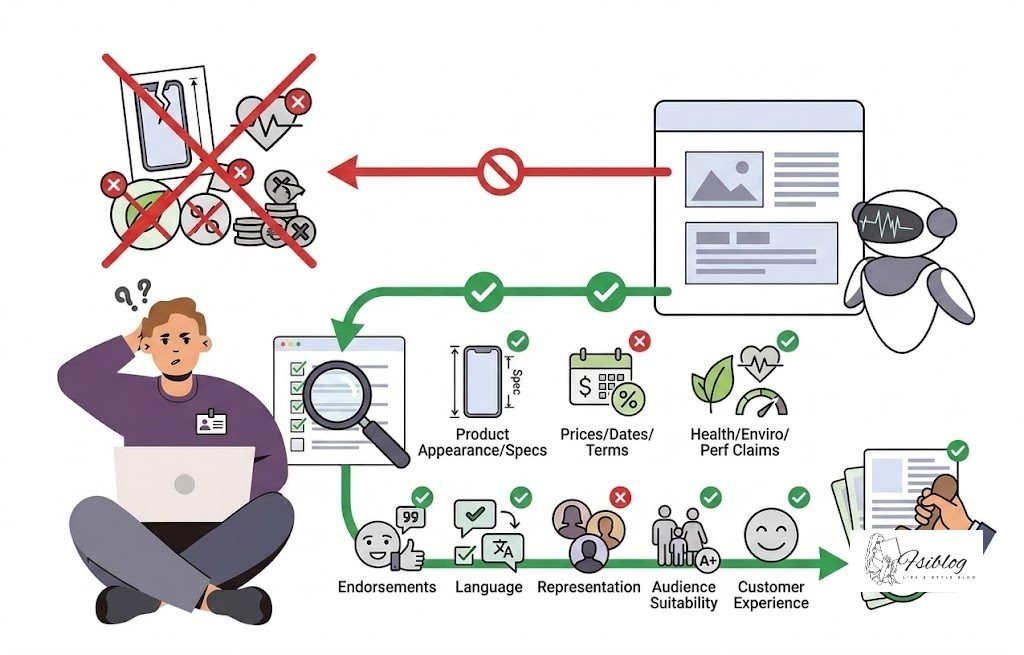
AI can lower execution costs, but poor oversight can create expensive mistakes.
A generated advert might include an inaccurate product, an unrealistic result or a person who appears to endorse the business without permission. Text can sound convincing while containing unsupported claims. A visual may introduce stereotypes that nobody noticed during a rushed approval.
The Advertising Standards Authority’s guidance on AI-generated advertising makes clear that using automated systems does not transfer responsibility away from the advertiser. UK advertising rules still apply regardless of how the content was produced.
Every business using generative content should therefore assign a named person to check:
- Prices, dates and promotional terms
- Product appearance and specifications
- Health, environmental or performance claims
- Customer quotations and endorsements
- Captions and spoken language
- Representation of people and communities
- Suitability for the intended audience
- Consistency with the actual customer experience
The final approval should never come from the same tool that created the content.
Customer Information Should Not Be Used Carelessly
Marketing teams often hold valuable material, including customer interviews, mailing lists, sales reports and unpublished product plans. Staff may be tempted to place this information into a public AI platform to create more personalised content.
That can create data protection and confidentiality problems.
The Information Commissioner’s Office provides detailed guidance on AI and data protection, including expectations for organisations using systems that process personal data.
Before staff upload material, the business should understand:
- Whether prompts are stored
- Whether uploaded information is used for model training
- Where data is processed
- Who can access generated projects
- Whether personal information can be removed
- What contractual protections the provider offers
Customer names, private sales figures, unreleased campaign plans and confidential supplier information should not be placed into an unapproved system simply because it makes content production convenient.
The National Cyber Security Centre’s advice on AI and cyber security is a useful starting point for businesses considering how AI services fit into their wider security arrangements.
Copyright Risk Does Not Disappear With Generation
An image being generated rather than downloaded does not automatically make it free from intellectual property concerns.
Prompts that ask a tool to reproduce a living artist’s work, copy a recognisable campaign or imitate protected characters can create avoidable risk. The same applies to generated music, celebrity likenesses, logos and voice imitations.
UK Government material on copyright and artificial intelligence explains that AI-generated output may infringe copyright when it reproduces a substantial part of a protected work.
Marketing teams should keep records of:
- The tool and account used
- The original prompt
- Reference materials uploaded
- Human edits made
- Licences attached to the service
- Approval dates
- Where the asset was published
These records are especially useful when several staff members or external agencies are producing content through different platforms.
Start With One Controlled Pilot
Rolling a new platform across the entire marketing programme may create more confusion than savings.
A better approach is to choose:
- One product or service
- One audience
- One marketing channel
- One campaign cycle
- One measurable production problem
For example, a company could test whether AI-assisted video reduces the time needed to produce four monthly LinkedIn clips. It could compare the pilot with the previous process using five measures:
- Total production cost
- Staff hours required
- Number of revision rounds
- Time from brief to publication
- Audience performance
The pilot should also record what the tool could not do well. Perhaps it struggled with accurate product rendering, natural voice delivery or brand typography. Those limitations help the company decide where human support remains necessary.
The Government’s AI Management Essentials framework provides practical prompts covering AI policies, system records, impact assessments, risk management, data protection and internal responsibilities.
For organisations that need a broader international framework, the US National Institute of Standards and Technology offers a voluntary AI Risk Management Framework for identifying and managing risks according to an organisation’s goals and priorities.
Finance Teams Should Separate Savings From Shifted Costs
Moving from production suppliers to AI subscriptions changes the shape of the budget.
Traditional production is often treated as a project expense. A campaign receives approval, suppliers quote for the work, and the cost appears as a clear one-off line.
AI tools are more likely to appear as recurring software costs. This can make forecasting easier, but it can also hide duplicated subscriptions across departments. One team may pay for video generation, another for design automation and another for a platform offering many of the same features.
Finance and marketing should review:
- Which tools are actively used
- How many employees need paid access
- Whether different subscriptions overlap
- How much human editing remains necessary
- Which traditional supplier costs have genuinely fallen
- Whether increased output is producing useful results
The correct question is not, “How many assets did the tool generate?”
It is, “Which costs disappeared, which costs moved elsewhere and what useful work did the business publish?”
Strategy Remains the Expensive Part Worth Keeping
AI can draft, resize, animate and translate. It cannot decide what a business should be known for.
Someone still needs to understand the customer, choose the message, check the evidence and decide what not to publish. Those decisions become more important when production becomes cheap because the temptation to fill every channel with average material increases.
The most sensible use of AI is not to remove people from marketing. It is to remove avoidable production friction so people can spend more time on work that requires judgement.
That means more time for:
- Customer research
- Campaign positioning
- Stronger offers
- Better distribution
- Performance analysis
- Brand development
- Editorial judgement
- Genuine creative direction
When AI content tools are used well, the budget does not simply become smaller. It becomes better balanced.
Less money is spent moving routine assets through a long production chain. More attention can go towards deciding what deserves to be made, how it should represent the business and whether it produces a meaningful result.
For UK companies working with limited teams and cautious budgets, that is the real change. Video, graphics and campaign variations no longer need to be treated as occasional luxuries. They can become practical, repeatable formats, provided the business keeps human judgement, legal responsibility and brand standards firmly inside the workflow.