



Somewhere in Britain right now, a WhatsApp group called something like “Wales?? 🏴” is dying quietly. It opened in February with eleven people and real enthusiasm. By April, three have gone silent, two want to move the dates, one has been invited to a wedding on the Saturday, and the person who started it has begun to resent all of them.
That is not evidence that group trips are impossible. It is evidence that most of them are run by a single well-meaning volunteer who is improvising a logistics operation in their spare time, with no budget, no deadline, and no authority to make anyone do anything. The trips that work are rarely the ones with the best destination. They are the ones where somebody made a handful of unglamorous decisions early, wrote them down, and then stopped asking for opinions.
Why Group Trips Collapse Long Before Anyone Leaves The House
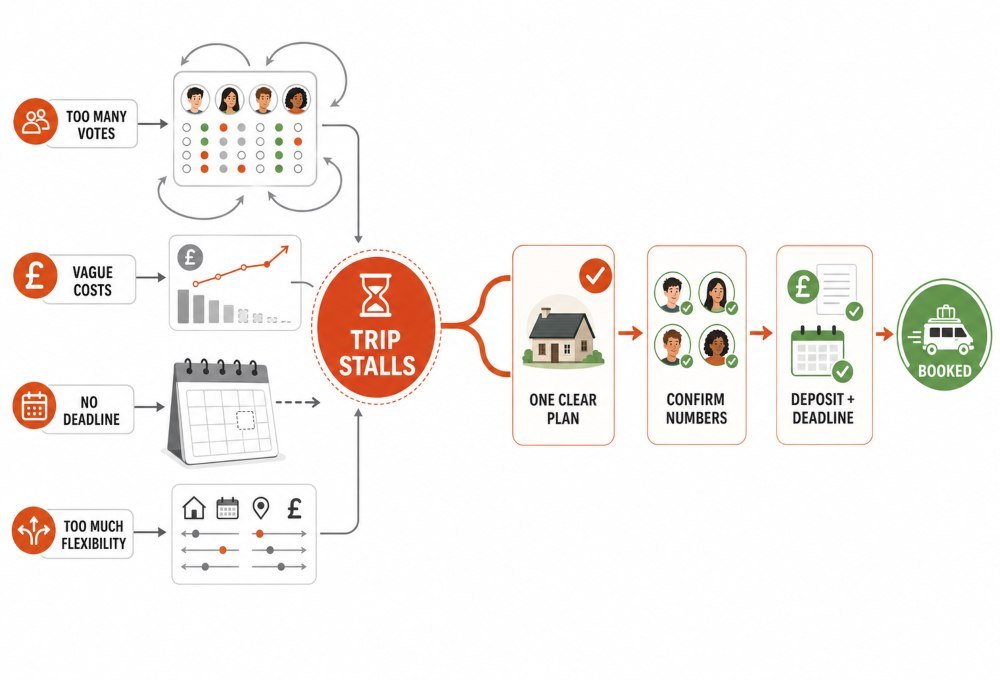
The failure point is almost never the destination. Nobody abandons a weekend in the Peak District because the Peak District turned out to be disappointing. They abandon it because the group spent six weeks debating cottages, never confirmed numbers, watched the good places sell out, and then quietly agreed to “do it in the autumn instead”.
Groups stall for a small number of predictable reasons. Too many decisions are put to a vote. Costs stay vague until the total is large enough to frighten people. Nobody is willing to name a deposit deadline. And the organiser, wanting to be fair, keeps the plan flexible long past the point where flexibility helps anyone.
The fix is unfashionable but reliable. Reduce the number of live decisions, attach money and dates to them early, and let people opt in or out of something concrete rather than contribute to something formless.
Decide The Shape Of The Group Before You Decide Where To Go
Twelve people going away for a weekend and twelve people going out for a day are entirely different projects, and the difference is not simply duration. Overnight trips introduce accommodation, sleeping arrangements, sharing preferences and the delicate question of who is willing to be on a sofa bed. Day trips introduce none of that, which is why they succeed far more often.
Before you look at a single location, settle three things. How many people are you actually planning for, as a range rather than a wish, whether this is a day out, one night, or a full weekend. And what the realistic ceiling is on what each person can spend.
That last one is worth asking directly and privately rather than in the group chat, because people will not say “I can afford £70, not £200” in front of eleven others. A quick one-to-one message to each person, or an anonymous form, will give you a far more honest number than any group discussion ever will.
Once you have a headcount and a price ceiling, most destinations rule themselves out without argument, which is exactly what you want.
Transport Is The Decision That Quietly Controls Everything Else
For groups above roughly eight people, transport stops being an afterthought and becomes the decision that determines the cost, the timings, and the mood of the entire day.
Convoys of private cars look cheaper on paper and almost never are. Fuel, parking and the inevitable third car that leaves forty minutes late add up quickly, and popular destinations have made car access genuinely difficult. Several honeypot car parks in Eryri and the Lake District now operate pre-booking or timed entry, city centres such as York, Bath and Oxford restrict where large vehicles can stop, and a group that arrives in five separate cars will spend its first hour of the day looking for spaces rather than being together.
Public transport works well for some routes and poorly for others. Sunday engineering work is a recurring problem, and if your group needs to be somewhere at a fixed time on a Sunday morning, checking the route in advance through Traveline, which covers bus, coach and tram services across Great Britain, will save you an unpleasant discovery on the platform.
For most groups of ten or more heading to a single destination, hiring a coach or minibus is the option that solves the largest number of problems at once. Everyone leaves together, everyone arrives together, luggage and kit are not a negotiation, and the person who would otherwise have driven can enjoy the day. Booking through a coach travel company that brokers across a network of vetted operators is usually simpler than ringing round local firms individually, since one enquiry can return options across several vehicle sizes and price points rather than committing you to whichever operator happened to answer the phone first.
What To Ask Before You Sign Anything
Coach hire is a regulated business, and a few minutes of checking separates a professional operator from a cheap quote you will regret.
Confirm that the operator holds a valid PSV operator licence. The government maintains a public register of licensed lorry and bus operators that you can search by name, address or licence number, and any legitimate firm will happily give you their licence details if you ask.
Check the arithmetic on your itinerary. Professional coach drivers work under drivers’ hours rules for passenger vehicles, which govern how long they can drive, when they must take breaks, and how much daily rest they need. If you are planning a long return journey with a late finish, ask directly how the operator intends to stay within those limits. A second driver or a revised schedule is a good answer. Vagueness is not.
Get the pickup points, timings, drop-off arrangements, waiting time and cancellation terms in writing before you take a penny from anyone. Ambiguity about where the coach will actually stop is a surprisingly common source of trouble on the day.
Give The Trip One Anchor, Not Twelve Options
The most consistent difference between a group day out that people talk about afterwards and one they politely forget is whether it had a spine. One booked, paid-for, time-stamped thing that the rest of the day arranges itself around.
That anchor does not need to be expensive or elaborate. A guided walk, a distillery tour, a heritage railway, a boat trip, a stadium tour, a cathedral, a booked table at a decent pub. What matters is that it exists, that it has a start time, and that it has already been paid for, because a group with somewhere to be at two o’clock behaves very differently from a group that is “going to have a wander and see what we fancy”.
Booking platforms such as GetYourGuide are useful here precisely because they make availability and group capacity visible before you commit, which spares you the round of emails to find out whether a venue can take fourteen people on a Saturday. Many listings offer free cancellation up to a set point before the start time, though this varies by supplier, so read the terms on each booking rather than assuming.
Heritage and outdoor sites are often the best value anchor in the UK. The National Trust and its equivalents across the nations run properties that can absorb a large group comfortably, and many have group booking arrangements worth enquiring about in advance rather than turning up and hoping.
Resist the urge to fill the rest of the day. Two fixed points and a long lunch is a better shape than six activities that will run late from the second one onwards.
Sort The Money Early, In Writing, And In Public
Money is where friendships actually fray, and it almost always frays over ambiguity rather than amounts. Nobody minds paying £48. People mind not knowing whether they owe £48 or £85, and they mind more when they have to ask.
Publish a single figure as early as you can, even if it is a slightly padded estimate. “£62 per person, covering the coach, the tour and the tip, food and drinks on top” is a sentence that lets someone decide. “Probably about sixty quid each, maybe a bit more” is a sentence that guarantees three follow-up questions and one dropout.
Collect a deposit with a real deadline attached, and make the deadline mean something. Most coach and venue bookings are priced on numbers, so late changes cost everyone. If you are working out what the trip should cost per head across transport, tickets, food and a contingency, MoneyHelper’s free budget planner, run by the government-backed Money and Pensions Service, is a straightforward way to lay the figures out before you commit.
For everything that accumulates during the trip itself- the shared coffee rounds, the taxi someone covered, the parking- use a shared ledger rather than memory. Splitwise is the obvious tool for this because it records who paid for what, works out the net position across the whole group, and settles everything in a handful of transfers instead of eleven awkward individual ones. The genuine benefit is not the arithmetic, which most people could manage. It is that the record is visible to everyone, so nobody has to be the person chasing debts in the group chat.
Plan Around British Weather And British Roads
Two forces will disrupt a UK group trip more reliably than anything else, and both are checkable in advance.
The first is weather. A forecast from the Met Office a few days out will not let you change the weather. Still, it will let you change the plan, and having a stated wet weather alternative decided in advance prevents the miserable half hour where fourteen damp people stand in a car park debating options. Warning: if your anchor activity is outdoors and exposed, decide the cancellation threshold before you go, not on the morning.
The second is traffic. Bank holiday weekends turn the M6 around Birmingham and the A303 past Stonehenge into car parks with striking consistency, and a coach caught in that will eat your entire schedule. National Highways’ live traffic service shows current conditions and planned closures on England’s motorways and major A roads, and checking it the evening before lets you agree a revised departure time while people are still awake to read the message.
School holiday dates are worth a second look too, especially for cross-border trips, because Scottish school holidays typically begin several weeks earlier than English ones. A late June weekend that feels quiet in Manchester can be considerably busier in the Highlands.
Requirements Nobody Volunteers
Ask the group, once, in writing, whether anyone has access requirements, dietary requirements or anything else you should build around. Do it early and do it as a matter of routine rather than as a special enquiry, because people are far more likely to answer a standard question than to raise a hand.
If anyone needs a wheelchair accessible vehicle, confirm it with the operator in writing at the point of booking rather than assuming a coach will have it. If anyone needs step-free access at the destination, check the venue’s own accessibility page rather than trusting a general assumption. And if the itinerary involves a long stretch without a break, say so in advance, because a three-hour leg with no stop is a problem for more people than will tell you unprompted.
Understand What You Are And Are Not Protected By
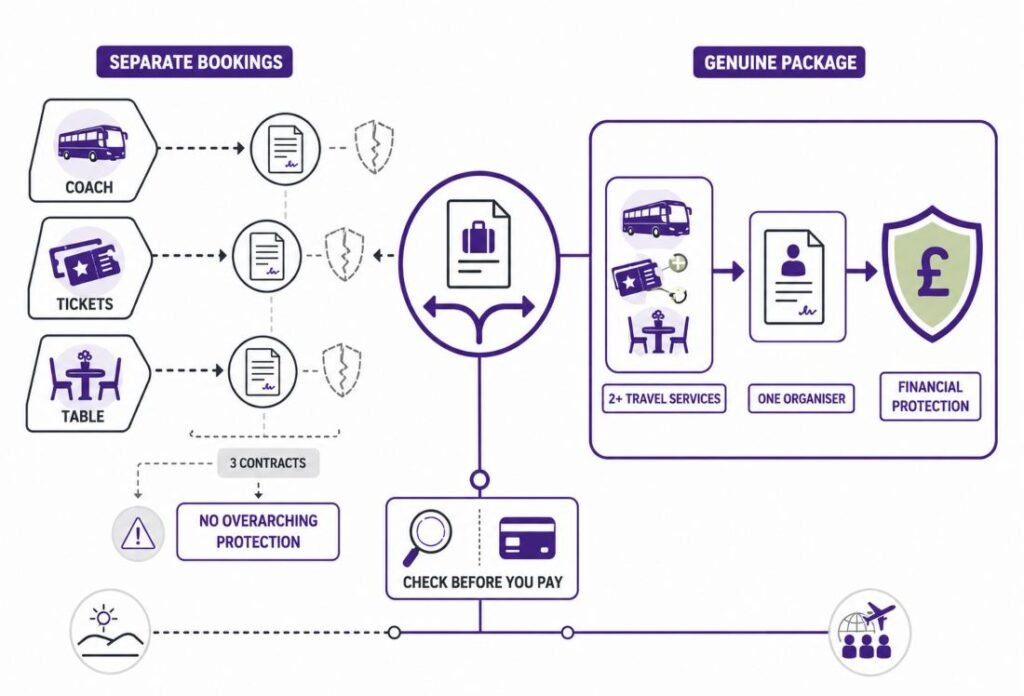
This is the part most organisers skip, and it matters when something goes wrong.
Booking a coach, a set of tickets and a table separately, from three different businesses, generally leaves you with three separate contracts and no overarching protection. Buying a genuine package, where two or more travel services are combined and sold together by one organiser, brings you within the Package Travel and Linked Travel Arrangements Regulations 2018, which impose obligations on the organiser and provide financial protection if things fail. Which? explains what package holiday protection actually covers in plain terms, and it is worth ten minutes of reading before you decide how to structure a more expensive trip.
For a domestic day trip, the distinction may not matter much. For a multi-day trip abroad with a group of twenty, it matters a great deal, and knowing which category you are in before you pay is considerably better than finding out afterwards.
A Timeline That Actually Works
For a UK day trip with a group of ten to twenty, a realistic run of play looks roughly like this. Eight to ten weeks out, agree the date and get a soft headcount. Six to eight weeks out, quote and book the transport, since coach availability tightens fastest around weekends, bank holidays and the summer. Six weeks out, publish the price and the deposit deadline. Four weeks out, book the anchor activity against confirmed numbers. Two weeks out, share the full itinerary with pickup points and times. The day before, check the traffic and the forecast, and send one short message confirming where and when.
Weekend and overnight trips want that timeline stretched by a month, mostly because accommodation for groups disappears earlier than anything else.
Part That Makes The Difference On The Day
Bring the details down to one message that people can screenshot. Pickup point, departure time, return time, what to bring, and a phone number that will actually be answered.
Then let the plan carry the day. The organiser who has already made the difficult decisions gets to enjoy the trip alongside everyone else, which is, after all, the point of going.
Disclaimer: This article is provided for general information only and does not constitute legal, financial, or professional travel advice. Regulations, operator requirements, booking terms, and consumer protections change over time and vary by circumstance. Always confirm current requirements with the relevant authority, operator, or venue before making a booking, and seek professional advice where your situation warrants it. Third-party services and websites referenced here are independent of the publisher, and their inclusion does not constitute an endorsement.
References
- Driver and Vehicle Standards Agency. Find lorry or bus operators. GOV.UK. Available at: https://www.gov.uk/find-vehicle-operators
- Driver and Vehicle Standards Agency. Drivers’ hours: passenger carrying vehicles. GOV.UK guidance. Available at: https://www.gov.uk/guidance/drivers-hours-passenger-vehicles
- National Highways. Traffic England: live traffic information for England’s motorways and major A roads. Available at: https://www.trafficengland.com/
- Traveline. Public transport journey planner for Great Britain. Traveline Information Ltd. Available at: https://www.traveline.info/
- Which? Package holidays: your consumer rights. Which? Limited, Consumer Rights. Available at: https://www.which.co.uk/consumer-rights/travel/package-holidays
- Money and Pensions Service. Budget planner: free online budget planning tool. MoneyHelper. Available at: https://www.moneyhelper.org.uk/en/everyday-money/budgeting/budget-planner
- Met Office. UK weather forecasts and warnings. Met Office, Exeter. Available at: https://www.metoffice.gov.uk/
- National Trust. Days out and places to visit. National Trust for Places of Historic Interest or Natural Beauty. Available at: https://www.nationaltrust.org.uk/ (Accessed: 28 August 2026).
- The Package Travel and Linked Travel Arrangements Regulations 2018, SI 2018/634. Available at: https://www.legislation.gov.uk/uksi/2018/634/contents