


Every October, facilities managers across the UK get the same phone call. The first cold Monday arrives, staff come in wearing coats, and the boiler that ran quietly all summer refuses to fire. By then, every heating engineer in the area is booked solid, and a simple fault becomes a week of portable heaters and unhappy tenants.
This winter carries more at stake than usual. Refrigerant prices are climbing, the rules on air conditioning equipment keep tightening, and the Government has now set a clearer direction on energy standards for commercial property. For many businesses, the way heating and cooling plant is maintained has moved from a routine overhead to a genuine commercial decision.
Here is what is worth checking now, before the cold sets in.
Why Autumn Is The Moment That Matters
A commercial boiler or heating plant can sit largely idle from May to September. Seals dry out, debris settles in the system, and controls drift out of calibration. None of this shows until the system is asked to work hard again.
Booking an inspection in October, rather than waiting for the first breakdown, gives engineers time to find worn parts, order replacements and fit them before demand peaks. It also means any remedial work can be planned around the business, rather than forced on it at the worst possible time.
Legal Duty Behind Winter Servicing
There is a legal side too. The Gas Safety (Installation and Use) Regulations 1998 require gas appliances in workplaces to be kept in a safe condition, and only Gas Safe registered engineers may work on them. A planned programme of commercial gas servicing and maintenance is the most straightforward way to show that duty is being met, with records to prove it.
Winter Checklist For Commercial Heating
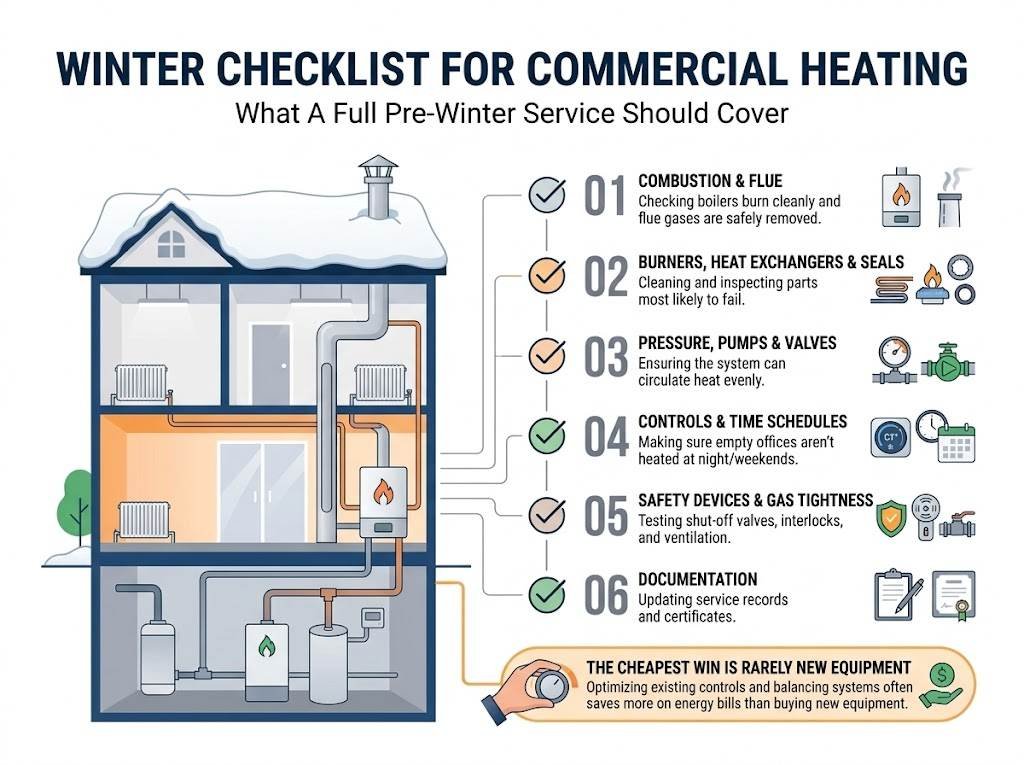
What A Full Pre-Winter Service Should Cover
A thorough pre-winter service should go well beyond a quick visual check. As a minimum, businesses should expect their engineer to cover:
- Combustion and flue performance: checking that boilers are burning cleanly and that flue gases are being safely removed.
- Burners, heat exchangers and seals: cleaning and inspecting the parts most likely to fail after months of inactivity.
- Pressure, pumps and valves: confirming that the system can circulate heat evenly across every floor and zone.
- Controls and time schedules: making sure the building is not heating empty offices at 3am or over the weekend.
- Safety devices and gas tightness: testing shut-off valves, interlocks and ventilation, particularly in plant rooms and kitchens.
- Documentation: updating service records and certificates so they are ready for insurers, landlords and auditors.
Cheapest Win Is Rarely New Equipment
Roselands Heating often finds that the cheapest win in a commercial building is not new equipment at all. Poorly set controls and unbalanced systems quietly add to energy bills for years, and a good service visit should flag them.
Don’t Forget The Air Conditioning
It is easy to think of air conditioning as a summer problem. In practice, many modern commercial systems are reverse-cycle units or heat pumps that provide heating in winter as well as cooling in summer. If they are neglected, the building loses comfort and efficiency all year round.
Refrigerant Costs Are Rising Sharply
The economics of air conditioning are also shifting fast. In May 2026, the UK’s largest refrigeration wholesaler, Beijer Ref UK, announced a 60% price rise on R410A refrigerant. That matters because a leak on an older R410A system is now considerably more expensive to put right, and repeated top-ups can quickly outweigh the cost of an upgrade.
What The Current Rules Allow
Regulation is moving in the same direction. Great Britain has banned new single split air conditioning systems holding less than 3kg of refrigerant with a global warming potential of 750 or more from being placed on the market since 1 January 2025, and regulators issued updated guidance on the ban in August 2026. Existing systems can still be serviced, but businesses planning replacements need equipment built around lower-GWP refrigerants such as R-32.
Choosing The Right Installer
This is where choosing experienced commercial air conditioning installers pays off. The right installer will size equipment to the building, select a compliant refrigerant and hold the F-gas certification the law requires.
Bigger Picture: Energy Standards For Commercial Buildings
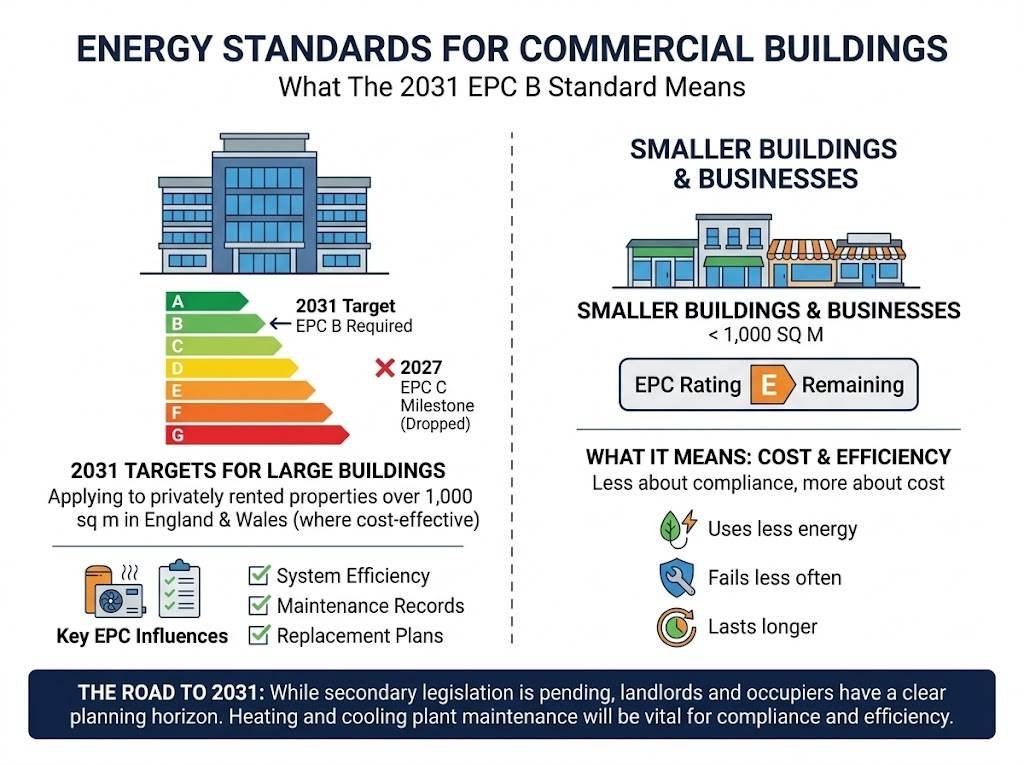
What The 2031 EPC B Standard Means
On 18 June 2026, the Government confirmed its direction on Minimum Energy Efficiency Standards (MEES) for rented commercial property in England and Wales. Privately rented non-domestic buildings over 1,000 square metres are expected to need an EPC rating of B from 2031, where cost-effective. Smaller buildings remain at the current minimum of EPC E, and the previously proposed EPC C milestone for 2027 has been dropped.
The 2031 standard still needs secondary legislation before it becomes law. Even so, landlords and occupiers of larger buildings now have a clear planning horizon. Heating and cooling plant has a strong influence on a building’s EPC, so maintenance records, system efficiency and replacement plans will all feed into that assessment.
What It Means For Smaller Businesses
For smaller businesses, the message is less about compliance and more about cost. A well-maintained system uses less energy, fails less often and lasts longer, regardless of what the EPC threshold says.
Repair, Maintain Or Replace?
Five Questions Worth Asking
Autumn is a good time to make an honest assessment of ageing equipment. A few questions help frame the decision:
- Has the system needed more than one emergency call-out in the past year?
- Is the boiler or air conditioning unit more than 15 years old?
- Does the air conditioning run on R410A or an older refrigerant with frequent top-ups?
- Are energy bills rising faster than tariffs alone would explain?
- Will the building need to meet a higher EPC rating within the next lease cycle?
If the answer to two or more is yes, a costed replacement plan is usually worth requesting alongside the winter service. Phased upgrades, carried out during quieter months, are far less disruptive than a failure in January.
Frequently Asked Questions
How Often Should A Commercial Boiler Be Serviced?
At least once a year, ideally before the heating season begins. Buildings with high demand, such as care homes, schools and hospitality venues, may benefit from more frequent checks.
Does Commercial Air Conditioning Need Servicing If It Is Only Used In Summer?
Yes. Many systems also provide heating, and refrigerant leaks, blocked filters and drainage faults develop whether the unit is running or not. Systems above certain refrigerant thresholds also have legal leak-checking requirements.
Can Older R410A Air Conditioning Systems Still Be Used?
Existing systems can continue to operate and be maintained. However, rising refrigerant costs mean repeated leak repairs are becoming expensive, so replacement planning makes sense for older units.
Will My Building Need An EPC Rating Of B?
Under the Government’s June 2026 direction, the EPC B requirement from 2031 is expected to apply to privately rented non-domestic buildings over 1,000 square metres in England and Wales. It still requires secondary legislation.
Final Thoughts
Winter will always test commercial heating and cooling systems. The difference between a smooth season and an expensive one usually comes down to what happens in October. Businesses that book their servicing early, review ageing air conditioning and keep one eye on the energy standards ahead will be in a far stronger position than those waiting for the first breakdown.
For organisations that want a single point of contact for gas heating and air conditioning, Roselands Heating provides planned maintenance, installation and compliance support for commercial buildings across the UK.