


Vitamin C supplements occupy an unusual corner of the health market. A basic tub of ascorbic acid may cost only a few pounds, while a liposomal liquid containing the same vitamin can cost several times more. The premium product promises better absorption, but absorption is only one part of the story. The more useful question is whether that difference is likely to matter to you.
What Vitamin C Actually Does

Vitamin C is essential because the human body cannot manufacture it. We must obtain it from food or supplements.
Its best-established roles include:
- Supporting normal immune function
- Helping the body produce collagen for skin, blood vessels, cartilage and bones
- Protecting cells from oxidative stress
- Improving the absorption of iron from plant-based foods
- Supporting normal wound healing
These are important functions, but phrases such as “immune support” are sometimes stretched into claims the evidence cannot carry. Vitamin C contributes to the normal operation of the immune system, but it does not make someone impervious to winter infections.
According to the NHS guidance on vitamin C, UK adults need approximately 40 mg each day. That is a modest amount. A red pepper, a serving of broccoli or a couple of kiwifruit can comfortably supply it.
For a more detailed account of its biological roles, absorption and dietary sources, the US National Institutes of Health vitamin C fact sheet provides a useful evidence-based overview.
British Diet Is Not Always As Balanced As We Imagine
The familiar advice is to eat at least five portions of fruit and vegetables a day. In practice, there is often a sizeable gap between knowing the rule and following it.
The UK Government’s healthy-eating guidance recommends at least 400 grams of fruit and vegetables daily. Yet the latest National Diet and Nutrition Survey found that UK adults averaged approximately 3.3 to 3.7 portions a day, with only 17% reaching the five-a-day target.
That does not mean most people need an expensive supplement. It means the foundations deserve attention. Frozen peas, cabbage, potatoes, berries and supermarket own-brand frozen vegetables all count. Vitamin C does not need to arrive in a tiny bottle with a scientific-looking label.
People whose diets are highly restricted, those who smoke and anyone with a medical condition affecting nutrient absorption may have different requirements. In those circumstances, advice from a GP, dietitian or pharmacist is more valuable than simply buying the strongest product available.
What Is Conventional Vitamin C?

Most standard supplements contain ascorbic acid, the form used in the majority of vitamin C research. It is available as tablets, capsules, chewables, effervescent tablets and powders.
Other products may use mineral ascorbates, such as calcium ascorbate or sodium ascorbate. These are sometimes described as buffered vitamin C because they are less acidic, although they also supply the accompanying mineral.
Conventional vitamin C has several practical advantages:
- It has been studied extensively.
- It is inexpensive.
- Its dosage is easy to check.
- It works well for correcting an inadequate intake.
- It is widely available from British pharmacies and supermarkets.
The body absorbs ordinary vitamin C through transporters in the intestine. At moderate intakes, this process works efficiently. As the dose rises, however, the proportion absorbed falls. The body also limits how much vitamin C remains in circulation, with surplus amounts leaving through the urine.
This is why a 1,000 mg tablet does not provide ten times the usable vitamin C of a 100 mg tablet. The label records what you swallow, not what your tissues retain.
What Makes Liposomal Vitamin C Different?
Liposomal vitamin C places ascorbic acid inside, or alongside, microscopic structures made from phospholipids. These substances resemble some of the fats found in human cell membranes.
The theory is attractive. The phospholipid layer may protect part of the vitamin during digestion and alter how it crosses the intestinal barrier. In principle, this could produce a higher concentration in the blood than the same amount of ordinary ascorbic acid.
The difficulty is that liposomal vitamin C is not a single, standard formulation. Products vary in particle size, composition, manufacturing method, stability and the proportion of vitamin C that is genuinely encapsulated.
Two bottles carrying the same prominent word on the label may perform quite differently.
Storage matters too. A poorly stabilised liquid can separate or deteriorate, while a product advertised as liposomal may offer little information about how its structure was verified.
Does Liposomal Vitamin C Absorb Better?
The cautious answer is that it can.
A recent systematic review of oral liposomal vitamin C studies found that most of the included trials reported greater vitamin C bioavailability from a liposomal formulation. However, the formulations, doses and study methods differed considerably. This makes it difficult to assign one reliable absorption advantage to every liposomal product on the market.
One frequently cited randomised crossover study involved only 11 participants. Each participant received a placebo, conventional oral vitamin C, liposomal vitamin C and intravenous vitamin C on separate occasions.
A four-gram liposomal dose produced higher circulating concentrations than ordinary oral vitamin C, but considerably lower concentrations than intravenous administration.
That finding is interesting, but it needs perspective:
- Eleven participants constitute a very small study.
- Four grams is far above normal daily nutritional requirements.
- A higher blood concentration does not automatically produce a better health outcome.
- Results from one formulation cannot be assumed to apply to every brand.
- Oral liposomal vitamin C should not be presented as equivalent to intravenous treatment.
The evidence supports the possibility of improved absorption. It does not establish that a generally healthy person will experience better immunity, skin health or long-term wellbeing meaningfully from paying more for a liposomal product.
Bioavailability Is Not The Same As Benefit
This is the distinction that much supplement advertising quietly steps around.
Bioavailability describes how much of a substance reaches the circulation and how it behaves once there. Clinical benefit asks whether it improves something people can feel or measure, such as correcting a deficiency, shortening an illness or improving a diagnosed condition.
A formulation can produce a taller line on a blood-concentration graph without changing an otherwise healthy person’s daily life.
If someone already obtains enough vitamin C, raising their blood level briefly may offer little additional value. Nutrients are not reward points. Once the body’s needs are met, progressively larger quantities do not necessarily produce progressively larger benefits.
What About Colds And Immunity?
Vitamin C is often purchased at the first hint of a sore throat. The evidence is less dramatic than the packaging.
A major Cochrane review of vitamin C and the common cold found that regular supplementation did not reduce the number of colds in the general population. It produced a modest reduction in cold duration, while taking vitamin C only after symptoms began did not show a consistent benefit.
There may be particular value for people exposed to short periods of extreme physical exertion, but that is rather different from the average British commuter encountering the annual office cold.
There is even less evidence that liposomal vitamin C prevents or treats colds better than a conventional supplement. Its absorption data should not be quietly converted into a claim of superior clinical protection.
Digestion And Tolerability
Large doses of ordinary ascorbic acid can cause diarrhoea, abdominal discomfort and wind. The NHS advises that taking more than 1,000 mg a day may produce these effects.
Some people report that liposomal or buffered products are easier on their stomachs. That may be a legitimate reason to choose one, particularly if a clinician has recommended a substantial dose.
It is still sensible to check the amount per serving. A gentler formulation does not make an unnecessarily large dose essential.
Taking a smaller conventional dose with food, or splitting it across the day, may also improve tolerability at a much lower cost.
People with kidney disease, a history of certain kidney stones, iron-overload disorders or ongoing medical treatment should seek professional advice before taking high-dose vitamin C.
A Practical Comparison
| Consideration | Conventional Vitamin C | Liposomal Vitamin C |
| Form | Usually ascorbic acid or a mineral ascorbate | Vitamin C associated with phospholipid particles |
| Evidence Base | Extensive nutritional and clinical research | Promising but smaller and formulation-specific evidence base |
| Absorption | Efficient at moderate doses, but the proportion absorbed falls as doses rise | May produce higher blood concentrations in some formulations |
| Proven Added Health Benefit | Corrects or prevents inadequate intake | No clear evidence of superior everyday outcomes for healthy adults |
| Digestion | High doses may cause stomach or bowel symptoms | Some users may tolerate it better |
| Price | Usually inexpensive | Usually considerably more expensive |
| Product Consistency | Straightforward to formulate and compare | Quality depends heavily on manufacturing methods and stability |
| Best Fit | Most people who want a simple supplement | People who value possible absorption or tolerability advantages and accept the additional cost |
Who Might Reasonably Consider A Liposomal Product?
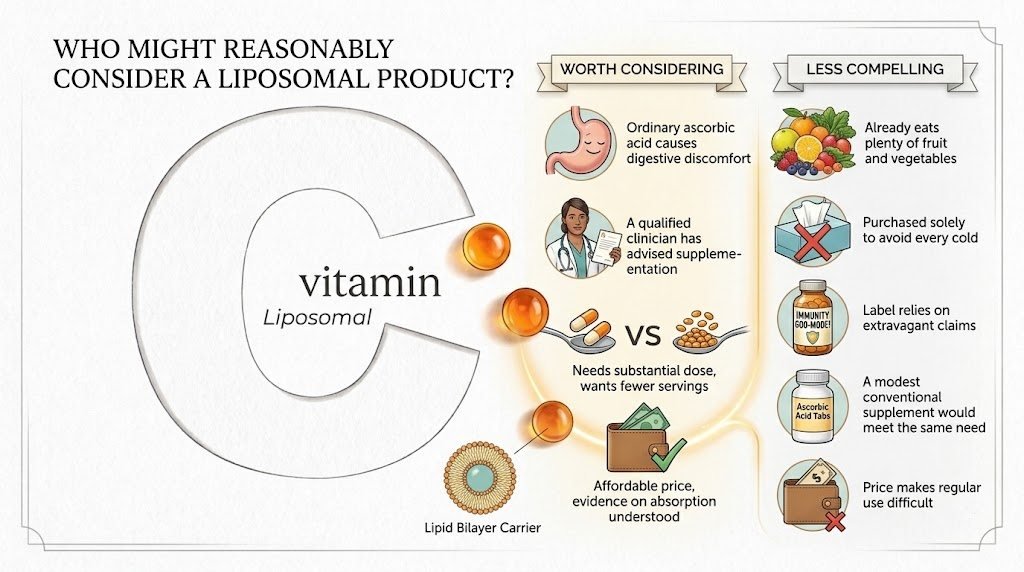
Liposomal vitamin C may be worth considering when:
- Ordinary ascorbic acid repeatedly causes digestive discomfort.
- A qualified clinician has advised supplementation for a specific reason.
- A person needs a substantial oral dose and wants to reduce the number or size of servings.
- The higher price is affordable, and the buyer understands that the evidence concerns absorption more than proven additional benefits.
It is less compelling when:
- A person already eats plenty of fruit and vegetables.
- The product is being purchased solely to avoid every cold.
- The label relies on extravagant claims rather than useful manufacturing information.
- A modest conventional supplement would meet the same nutritional need.
- Its price makes regular use difficult.
Consistency also matters. An affordable supplement taken as advised is more useful than an elaborate one that remains in the cupboard because its price makes every spoonful feel ceremonial.
Why Product Categories Should Remain Clear
Vitamin supplements and botanical materials are not interchangeable categories. Each needs to be assessed according to its identity, intended purpose, provenance, processing method and applicable UK rules.
For example, someone researching a Wholesale MHRB supplier is looking at a bulk botanical material rather than a vitamin C supplement. A specialist mimosa hostilis shop likewise belongs to a separate botanical-sourcing discussion.
Neither type of product provides evidence about vitamin C absorption, and Mimosa hostilis should not be described as an alternative source of liposomal or conventional vitamin C. Keeping these categories separate helps readers avoid drawing nutritional conclusions from unrelated ingredients.
For any botanical product, buyers should consider accurate species identification, country of origin, batch traceability, contaminant testing, lawful intended use and current UK import requirements. A natural origin alone does not establish safety, quality or suitability for consumption.
How To Judge A Vitamin C Supplement In The UK
Begin with the unglamorous details.
Check The Amount Per Serving
More is not automatically better. A supplement containing several thousand milligrams may look impressive, but most healthy adults do not need such a large quantity.
Check whether the stated dose applies to one capsule, several capsules or a full measuring spoon of liquid.
Read The Complete Ingredients List
Liposomal liquids may contain sweeteners, flavourings, preservatives or common allergens such as soya-derived lecithin.
Some products use sunflower lecithin instead. Neither source automatically proves that the formulation is more effective, but it may matter to people with allergies or particular dietary preferences.
Look For Clear Storage Instructions
Storage is particularly important for liquids. Vitamin C can deteriorate through exposure to heat, air and light, while phospholipid mixtures may become unstable if they are stored incorrectly.
Some products need refrigeration after opening. Others must be consumed within a stated number of weeks.
Check The Use-By Date
Do not assume that a discounted product is a bargain without checking its remaining shelf life. This matters particularly when buying several bottles at once.
Be Suspicious Of Disease Claims
A vitamin supplement should not promise to prevent, treat or cure an illness. Claims about eliminating infections, reversing chronic disease or replacing prescribed treatment should be treated as serious warning signs.
Look For Traceable Manufacturing Information
Prefer products that identify the manufacturer or responsible UK business, provide batch information and explain their testing procedures.
Laboratory imagery, gold packaging and vague phrases such as “medical grade” are not substitutes for verifiable details.
Compare The Daily Cost
A £25 bottle may look reasonably priced until you notice that it contains only ten daily servings. Compare the cost per recommended serving with an ordinary ascorbic acid supplement.
The difference can be substantial.
Ask What Problem You Are Trying To Solve
If there is no identified dietary gap, digestive concern or clinical reason for supplementation, the product may be unnecessary.
Marketing claims made for supplements are not a free-for-all. The Government’s guidance on nutrition and health claims explains that health claims used in Great Britain must be authorised and must satisfy their stated conditions.
Is More Vitamin C Always Better?
A common mistake is to assume that an extremely large dose automatically produces a stronger effect.
The body regulates how much vitamin C it absorbs and retains. Absorption becomes less efficient at high doses, while excess vitamin C is removed through the urine.
Large quantities are therefore more likely to increase cost and digestive discomfort than to produce a noticeable health advantage in someone who already has an adequate intake.
The objective should not be to consume as much vitamin C as possible. It should be to obtain enough to meet the body’s needs.
Can Food Provide Enough Vitamin C?
For most people, yes.
Useful sources available throughout the UK include:
- Red and green peppers
- Broccoli
- Brussels sprouts
- Cabbage
- Potatoes
- Oranges and other citrus fruits
- Kiwifruit
- Strawberries
- Blackcurrants
- Tomatoes
- Frozen peas
Cooking and storage can reduce vitamin C levels because the vitamin is sensitive to heat and water. Steaming vegetables briefly, microwaving them with little water or eating some produce raw can help preserve more of it.
This does not mean boiled vegetables are nutritionally worthless. A varied diet eaten regularly matters much more than trying to preserve every last milligram.
The Verdict
Liposomal vitamin C is not nonsense, but neither is it a nutritional revolution.
There is credible evidence that certain liposomal formulations can raise circulating vitamin C concentrations more than conventional oral ascorbic acid. The research is still limited by small trials, inconsistent formulations and a shortage of evidence showing that this pharmacokinetic advantage improves ordinary health outcomes.
For most UK adults, food remains the best starting point. If a supplement is wanted, a modest conventional product is affordable, well studied and usually sufficient.
A liposomal formulation becomes a reasonable personal preference when digestion, dose convenience or a clinician-identified need makes its possible absorption advantage relevant. It should be chosen with clear expectations, not because a gleaming bottle has managed to make an inexpensive vitamin sound newly invented.
Disclaimer: This article provides general information and is not a substitute for individual medical advice. Speak to a GP, registered dietitian or pharmacist before taking high-dose vitamin C if you have a medical condition, use prescribed medicines, are pregnant or have concerns about your nutritional status.