



Most people in Britain judge their health based on how they feel day to day. If there are no obvious symptoms, no persistent pain, and no urgent reason to visit a doctor, it is easy to assume that everything is fine. A routine GP appointment, often brief and focused on immediate concerns, rarely challenges that assumption.
But modern health data is beginning to tell a very different story.
Beneath the surface of everyday wellbeing, subtle biological changes can develop silently for years. Early signs of metabolic dysfunction, chronic inflammation, and nutritional imbalance often remain invisible, sitting within “normal” clinical ranges while gradually increasing long-term risk. By the time symptoms appear, the opportunity for simple, preventive action may already be reduced.
This disconnect between perceived health and actual biological condition is at the heart of a growing concern in the United Kingdom. While the healthcare system remains highly effective at diagnosing and treating established disease, it is less equipped to detect the early warning signals that come before it.
Emerald’s large-scale biomarker analysis offers a rare window into this hidden layer of population health. Drawing on over 25,000 detailed blood tests, the data reveals not just isolated issues, but consistent patterns that challenge common assumptions about what it means to be “healthy” today.
Overweight and Obese: A National Baseline That Refuses to Shift

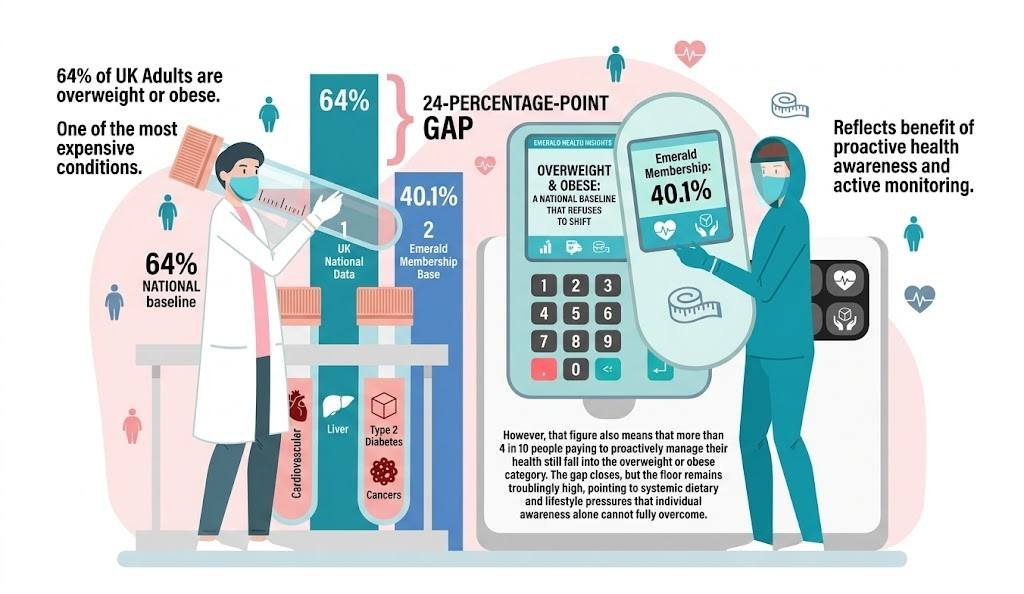
- The headline figure at the centre of Emerald’s findings has persisted stubbornly across public health reporting for years.
- According to national data, 64% of UK adults are overweight or obese. Obesity is a primary driver of type 2 diabetes, cardiovascular disease, liver disease, and a growing list of cancers. In public health terms, it is also one of the most expensive conditions a population can carry.
- Among Emerald’s own membership base, that figure drops to 40.1%. The 24-percentage-point gap reflects the measurable benefit of sustained health awareness and active monitoring.
- However, that figure also means that more than 4 in 10 people paying to proactively manage their health still fall into the overweight or obese category. The gap closes, but the floor remains troublingly high, pointing to systemic dietary and lifestyle pressures that individual awareness alone cannot fully overcome.
Cholesterol Problem That Awareness Is Not Solving
- If the weight data raises eyebrows, the cholesterol findings should prompt a more urgent conversation.
- Nationally, 53% of UK adults have raised cholesterol. Among Emerald users, that figure is 50.9%. For a marker as widely discussed and routinely tested as cholesterol, that near-identical rate across a health-engaged population is striking.
- Dr. Yiannis Balanos, who led Emerald’s analysis, noted that elevated cholesterol “remains common and often requires substantial lifestyle changes or medical intervention” even among individuals actively monitoring their health.
- Raised cholesterol is a primary, modifiable risk factor for heart disease and stroke. Cardiovascular disease continues to be one of the leading causes of death in the United Kingdom, despite being largely preventable. These figures suggest that for a significant proportion of the population, information alone is not translating into the clinical change needed to reduce risk.
Inflammation Blind Spot at the Heart of UK Screening
- Where Emerald’s dataset becomes particularly instructive is in the markers that standard NHS screening does not routinely include.
- High-sensitivity C-reactive protein, commonly referred to as hs-CRP, is a well-established measure of systemic inflammation and a recognised predictor of long-term cardiovascular risk. It was elevated in 32.3% of Emerald users, representing roughly 1 in 3 of those tested.
- There is no national benchmark against which to compare this figure, because routine testing in the UK does not include it.
- That absence is not a minor administrative gap. Chronic low-grade inflammation has strong associations with cardiovascular disease, metabolic dysfunction, insulin resistance, and accelerated biological ageing. For millions of British adults, a meaningful early warning signal is going entirely undetected, year after year.
- Emerald’s analysis identifies this as one of the most consequential blind spots in routine UK healthcare. “Preventive testing, which incorporates the full picture, offers an opportunity to intervene earlier, when changes in diet, activity, sleep, and alcohol intake can have the greatest impact,” the report states.
Lean Does Not Mean Metabolically Healthy
- One of the more counterintuitive findings from the dataset concerns the relationship between body weight and metabolic health.
- Emerald’s results include documented cases of raised HbA1c, a marker used to assess blood sugar regulation over time, and undiagnosed diabetes in lean individuals. This directly challenges the assumption, still prevalent in clinical practice, that weight is a reliable proxy for metabolic risk.
- A growing body of clinical literature has examined the profile of metabolically unhealthy individuals who fall within a normal weight range. What Emerald’s data adds is real-world prevalence evidence at scale.
- It raises serious and practical questions about whether BMI-centric screening thresholds are causing clinicians to overlook early-stage metabolic disease in patients who do not fit the expected profile.
- Nationally, more than 3.6 million people in England have been identified with pre-diabetes, and numbers are rising year on year. One in five UK adults is estimated to be living with diabetes or pre-diabetes, with up to a third doing so without a formal diagnosis. Emerald’s findings suggest the true undiagnosed figure could be meaningfully higher than current estimates capture.
A Healthy Life Expectancy of Just 61: The Healthspan Gap
- To understand why these findings matter beyond the individual level, it is necessary to look at the broader population context in which they sit.
- Life expectancy in the United Kingdom is 79.1 years for males and 83.0 years for females. Healthy life expectancy, however, the number of years lived in good health, is just over 61 years for both men and women. That gap represents nearly two decades of life spent in poor health, managing chronic conditions, and drawing heavily on NHS resources.
- Less than 20% of adults in the UK meet the recommended daily intake of fruit and vegetables. Physical inactivity remains common, particularly in more deprived communities. Long-term conditions now account for the majority of NHS spending, placing sustained and growing pressure on a system already operating under significant strain.
- Emerald’s analysis frames this healthspan gap as, in significant part, a detection problem. GP reference ranges are calibrated to identify established disease, not emerging risk. Biomarkers that signal early dysfunction can sit within clinically “normal” limits for years before crossing a diagnostic threshold, by which point the window for the most impactful lifestyle intervention may have already narrowed.
Nutritional Deficiencies: Better, But Far From Resolved
- Emerald’s data also provides a comparative picture of nutritional health across its membership base.
- Vitamin D deficiency affects 1 in 6 UK adults nationally. Among Emerald users, it was found at 14.3%, a modest improvement likely reflecting higher supplementation rates among a health-aware population. Folate deficiency affects 13% of UK adults aged 19 to 64, compared to just 7.8% of Emerald users. Vitamin B12 deficiency tells a similar story, with national estimates of around 6% in adults under 60, against just 0.9% among Emerald’s membership.
- Iron deficiency in women presents a different pattern. The national average is 8%. Among Emerald users, it is 10%, suggesting that even among women actively tracking their health, iron status remains an underappreciated risk.
- For context, iron deficiency anemia affects 23% of women during pregnancy, making it one of the most clinically consequential nutritional gaps in the UK population.
From Snapshots to Longitudinal Oversight: A New Model for Prevention
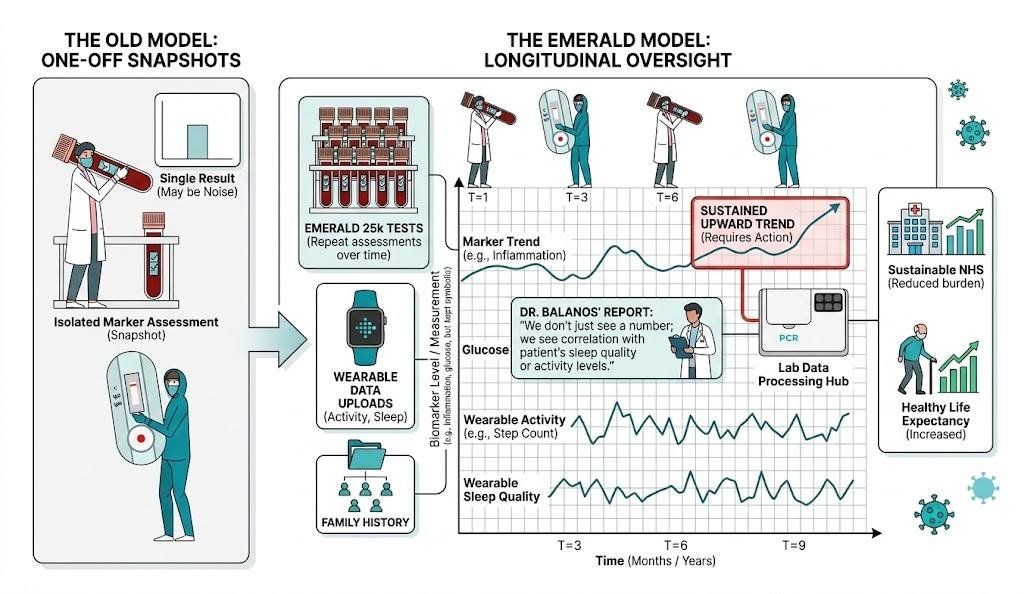
- What gives Emerald’s dataset its analytical depth is its longitudinal dimension.
- Rather than capturing one-off results, the 25,000 tests include repeat assessments, allowing shifts in individual biological baselines to be tracked over time. A single elevated inflammation reading may represent noise. A sustained upward trend across multiple assessments is a clinical signal requiring action.
- Dr. Balanos articulated the distinction clearly in the report: “When we see a shift in inflammation or glucose, we don’t just see a number; we see how it correlates with a patient’s sleep quality or activity levels.”
- This integration of biomarker data with lifestyle context, encompassing diet, exercise, sleep, and daily habits, represents the direction in which preventive medicine is increasingly moving. Emerald’s model combines in-clinic laboratory assessments with wearable data uploads, family history, and past medical records, giving clinicians a far more complete picture than a single GP appointment can generate.
- The company’s position is direct. Shifting the UK’s healthcare culture from reactive treatment to data-led prevention is the only sustainable way to reduce the long-term burden on the NHS and improve healthy life expectancy,” the report concludes.
Final Conclusion
The findings from Emerald’s 25,000 biomarker tests point to a deeper issue within the UK’s healthcare landscape, one that goes beyond access and into the limits of current detection methods. While public awareness of health risks has improved, the data shows that awareness alone is not enough to drive meaningful biological change.
A significant proportion of individuals who actively engage in their health still present with elevated cholesterol, excess weight, and hidden metabolic or inflammatory risks. This suggests that the current system, largely built around reactive care and threshold-based diagnosis, is missing the earlier stages of disease development where intervention is most effective.
The absence of routine testing for key markers like systemic inflammation further widens this gap. Combined with an over-reliance on visible indicators such as BMI, it creates blind spots that allow conditions like pre-diabetes and cardiovascular disease to progress undetected.
What emerges is not just a clinical concern, but a structural one. The UK is facing a widening “healthspan gap,” where longer life does not equate to healthier life. Without a shift toward longitudinal monitoring, personalised data, and earlier intervention, this gap will continue to grow, placing increasing strain on both individuals and the NHS.
Preventive, data-led healthcare models like the one demonstrated in Emerald’s analysis offer a practical path forward. By identifying risk earlier and linking biological changes to lifestyle factors in real time, they enable more precise and timely interventions.
Ultimately, closing Britain’s silent health gap will require more than policy adjustments or increased funding. It will demand a fundamental shift in how health is measured, monitored, and managed, moving from episodic care to continuous insight, and from treating disease to truly preventing it.
References
- World Health Organization. (2019). Burnout is an occupational phenomenon: International Classification of Diseases.
- Public Health England. (2020). Health matters: Obesity and the food environment.
- Ference, B. A., Ginsberg, H. N., Graham, I., et al. (2017). Low-density lipoproteins cause atherosclerotic cardiovascular disease. European Heart Journal, 38(32), 2459–2472.
- Ridker, P. M. (2016). From C-reactive protein to interleukin-6 to interleukin-1. Circulation Research, 118(1), 145–156.
- Stefan, N., Häring, H. U., Hu, F. B., & Schulze, M. B. (2013). Metabolically healthy obesity. The Lancet Diabetes & Endocrinology, 1(2), 152–162.
- Tabák, A. G., Herder, C., Rathmann, W., et al. (2012). Prediabetes: A high-risk state for diabetes development. The Lancet, 379(9833), 2279–2290.
- O’Neill, S., & O’Driscoll, L. (2015). Metabolic syndrome: A closer look at the growing epidemic. Journal of Clinical Medicine, 4(6), 1130–1147.
- Holick, M. F. (2007). Vitamin D deficiency. New England Journal of Medicine, 357(3), 266–281.
- McLean, E., Cogswell, M., Egli, I., et al. (2009). Worldwide prevalence of anaemia. Public Health Nutrition, 12(4), 444–454.
Disclaimer
The information presented in this article is for general informational and educational purposes only and is not intended as medical advice. It is based on publicly available data, research findings, and insights from Emerald’s biomarker analysis. Still, it should not be used as a substitute for professional medical diagnosis, treatment, or guidance.
Individual health conditions can vary significantly, and readers should consult a qualified healthcare provider or GP before making any decisions related to their health, including changes to diet, lifestyle, supplementation, or medical treatment.
While every effort has been made to ensure the accuracy of the information at the time of publication, healthcare guidelines and scientific understanding may evolve. The authors and publishers do not accept responsibility for any consequences arising from the use or reliance on the information contained in this content.