



Relationships across the UK are shifting faster than at any point in recent memory. Longer working hours, the rising cost of living, and the quiet creep of screens into every corner of family life have changed how couples, parents, and friends actually talk to one another. Yet the single factor that research continues to point to as the clearest predictor of a healthy, lasting bond is not income, shared hobbies, or even time spent together. It is the quality of everyday conversation.
Why British Couples Are Talking Less Than They Think
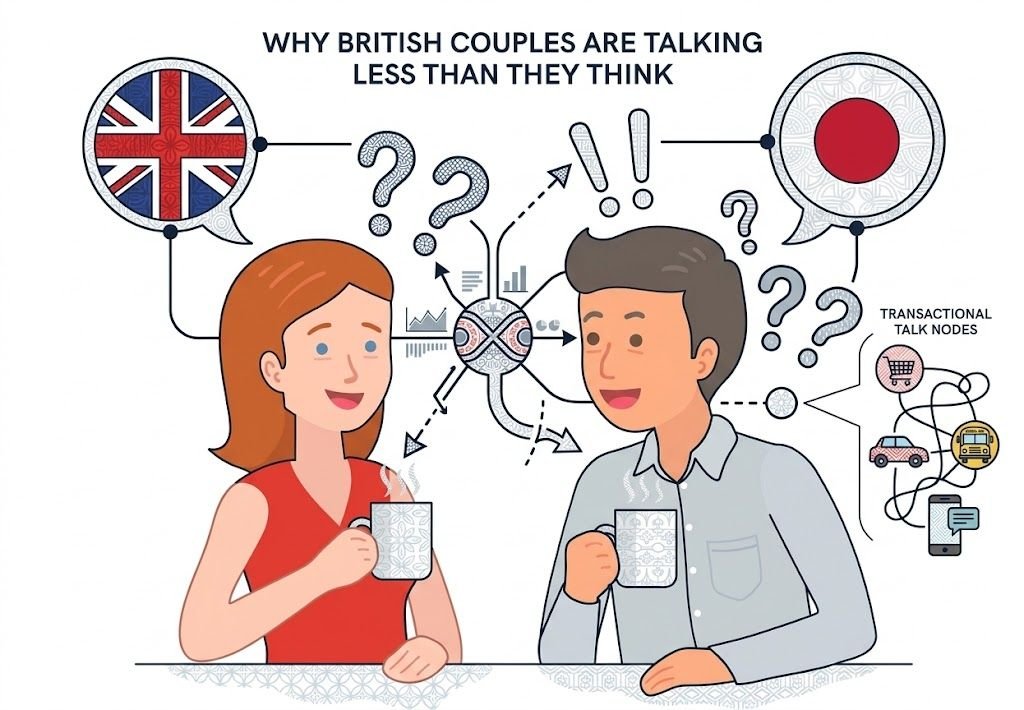
A 2023 survey by Relate, the UK’s largest relationship charity, found that nearly one in four couples spend less than ten minutes a day in uninterrupted conversation. Mealtimes are increasingly shared with phones, and evenings are split between separate streaming services on separate devices. The irony is sharp: we live in an age of constant messaging, yet emotional closeness is in measurable decline.
Part of the issue is that surface-level communication is mistaken for genuine connection. Sending a WhatsApp about the weekly shop, or a quick how was your day between school runs, keeps the household functioning but rarely nourishes the relationship itself. Psychologists call this transactional talk, and while it is necessary, it is not enough on its own.
Science of Meaningful Dialogue
Research published by the American Psychological Association and echoed in UK longitudinal studies shows that couples who regularly engage in what Dr John Gottman calls bids for connection report significantly higher relationship satisfaction over five-year periods. A bid can be as small as pointing out a robin in the garden or mentioning something that worried you at work. What matters is whether the other person turns towards, away from, or against the bid.
Data from the UK’s Office for National Statistics also links strong personal relationships to lower anxiety and higher reported life satisfaction, reinforcing the idea that conversation is not simply a social nicety. It is a genuine public health asset.
Common Communication Patterns That Quietly Damage Relationships
Therapists working with British families tend to see the same handful of unhelpful patterns repeated across very different households. Recognising them is the first step to replacing them.
- Criticism disguised as a question, such as “Why do you always leave the kitchen like this?”
- Stonewalling, where one partner withdraws entirely rather than engage with a difficult subject.
- Contempt, expressed through sarcasm, eye-rolling, or mocking, is the strongest single predictor of separation, according to Gottman’s research.
- Defensiveness, where every concern is immediately met with a counter-complaint rather than an acknowledgement.
None of these patterns makes someone a bad partner or parent. They are learned habits, often modelled in childhood, and they can be unlearned with awareness and practice.
Practical Ways to Reopen Conversation at Home
The good news is that repair does not require dramatic gestures or expensive retreats. Small, consistent changes tend to outperform grand resolutions.
Start with a device-free fifteen minutes each evening. Not an hour, not a whole meal, just fifteen focused minutes where phones are in another room. Couples who try this for two weeks often report feeling noticeably closer, simply because genuine attention has become so rare that even a small dose feels meaningful.
Second, practice curious questions rather than closed ones. Instead of “good day?”, try “what was the most frustrating part of today?” or “was there a moment today that surprised you?” These open questions invite genuine answers rather than reflexes.
Third, whether you are catching up with a partner over a cup of tea, messaging a friend you have not seen in months, or joining an online community to chat with like-minded people about shared interests, the principle is the same: give the exchange your full attention, ask follow-up questions, and resist the urge to redirect the conversation to yourself immediately.
Rebuilding Connection After a Rough Patch
Every long-term relationship goes through periods of distance. Redundancy, bereavement, a new baby, or simply the accumulated fatigue of modern life can leave couples feeling more like housemates than partners. The NHS mental health pages are refreshingly blunt about this: feeling disconnected from your partner is common, not shameful, and it responds well to structured effort.
A useful starting point is what therapists call a state-of-the-union conversation, held weekly, in which each partner shares one thing they appreciated that week and one thing that felt difficult, without the other partner interrupting. It sounds formal, but couples who adopt it consistently describe it as the single most useful habit they have added to their relationship.
When to Seek Professional Support

If conversations at home repeatedly escalate into arguments, or if one or both partners feel unheard for months at a time, professional support is worth considering. The British Association for Counselling and Psychotherapy maintains a searchable register of accredited therapists across the UK, and many offer sliding-scale fees. Couples counselling is no longer the last resort it was once thought to be; increasingly, British couples are using it as preventative maintenance rather than emergency repair.
Conclusion
Modern British life pulls couples, families, and friendships in a dozen directions at once. The constant hum of notifications, the pressure of bills, and the sheer pace of daily routines can make genuine conversation feel like a luxury. It is not. It is the most practical, affordable, and evidence-backed tool any of us has for building the relationships we actually want. Fifteen attentive minutes a day, a handful of curious questions, and the willingness to put the phone down are, in the end, what hold people together.
Disclaimer
This article is intended for general informational and educational purposes only. It does not constitute medical, psychological, or therapeutic advice and should not be used as a substitute for consultation with a qualified professional. If you are experiencing significant distress in your relationship or mental health, please get in touch with your GP or an accredited practitioner.
References
- Gottman, J. M., & Silver, N. (1999). The Seven Principles for Making Marriage Work. Three Rivers Press.
- Holt-Lunstad, J., Smith, T. B., & Layton, J. B. (2010). Social Relationships and Mortality Risk: A Meta-analytic Review. PLoS Medicine, 7(7), e1000316. DOI: 10.1371/journal.pmed.1000316
- Proulx, C. M., Helms, H. M., & Buehler, C. (2007). Marital Quality and Personal Well-Being: A Meta-Analysis. Journal of Marriage and Family, 69(3), 576–593. DOI: 10.1111/j.1741-3737.2007.00393.x
- Robles, T. F., Slatcher, R. B., Trombello, J. M., & McGinn, M. M. (2014). Marital Quality and Health: A Meta-Analytic Review. Psychological Bulletin, 140(1), 140–187. DOI: 10.1037/a0031859
- Office for National Statistics (2023). Personal Well-being in the UK. Retrieved from www.ons.gov.uk
- Relate (2023). The Way We Are Now: Relationships in the UK. Retrieved from www.relate.org.uk