


Modern work has made staying in touch easier, but it has not always made people feel closer. Many of us spend our days moving from one video call to another, answering messages, checking notifications, and trying to look present on screen. It is useful, but it can also feel flat.
That is why real-world events matter again. Festivals, conferences, stadium games, local meetups, and watch parties give people something digital tools cannot fully replace. They bring back the small human moments that often get lost online.
Physical Advantage
There is a clear difference between joining a meeting online and walking into a busy room. In person, you notice the mood straight away. You hear people chatting before things begin. You see who is relaxed, who is interested, and who is unsure. You catch the side comments, the smiles, the awkward pauses, and the small reactions that do not always come through on a screen.
Online meetings are useful, but they often feel like tasks. You join, speak when needed, then leave. A live event feels different because you are sharing the same space with other people. That makes conversations feel more natural.
Trust is also easier to build face-to-face. A quick chat over coffee, a shared laugh, or a simple conversation after a talk can do more than a long chain of emails. These moments may seem small, but they are often the reason people remember an event.
Where Community Actually Roots
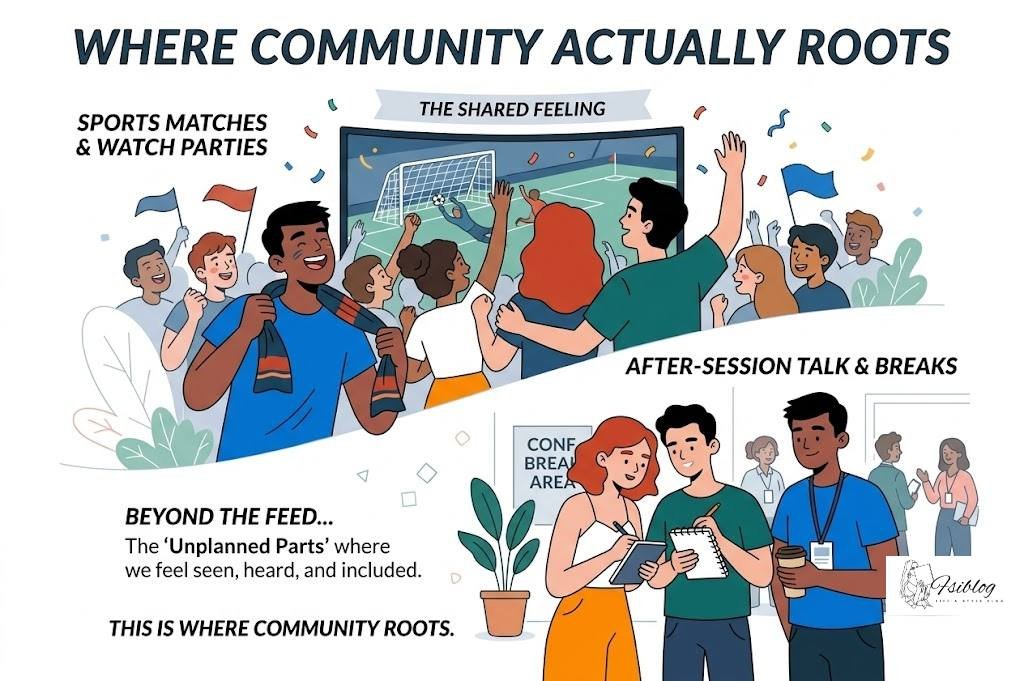
Real community is hard to build only through a feed or a chat group. It usually grows when people spend time together, share the same moment, and feel part of something bigger than themselves.
You can see this clearly at watch parties and sporting events. Fans gather in pubs, homes, fan zones, and local venues because watching alone is not the same. Whether people are cheering for their team, talking about the match, or checking a World Cup betting site before kick-off, the main point is the shared feeling around the event.
The same thing happens at conferences. The talk on stage may be useful, but the best conversations often happen afterwards. Someone asks a question in the hallway. Two people compare notes during a break. A small group keeps talking long after the session ends.
Apps can help with tickets, reminders, maps, and check-ins. But the real value comes from the unplanned parts. That is where people feel seen, heard, and included.
Bridging the Gap: Use Tech, Don’t Be Controlled By It
Technology is not the problem. The problem starts when every event tries too hard to turn itself into another screen-based experience.
A good event uses technology quietly. It helps people register, find the right place, get updates, and stay informed. After that, it should step back. Use the digital tools to make the event smoother, not to replace the reason people came in the first place.
This matters because people do not attend live events just for information. They can get information online. They attend because they want atmosphere, conversation, energy, and a break from sitting behind a screen.
Hybrid options can still be useful, especially for people who cannot travel. But for the people in the room, the focus should stay on the live experience. The best events make technology feel helpful without letting it take over.
Business: It Is Time to Get Real Again
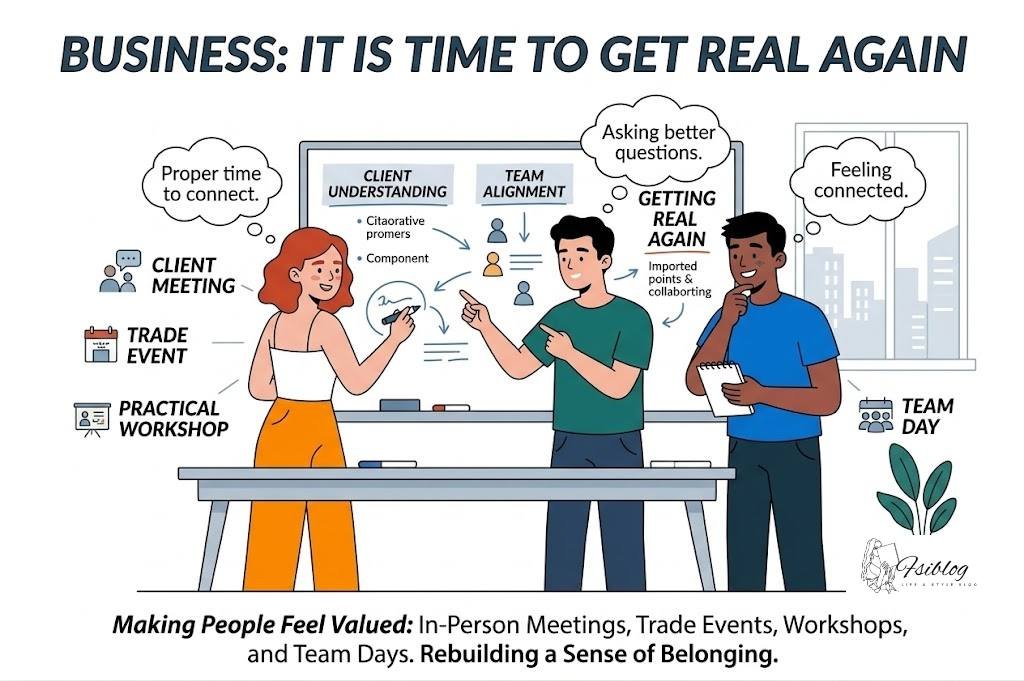
Businesses have become very good at sending messages, but not always good at making people feel valued. A packed inbox, a quick video call, or another project update does not always create a strong relationship.
In-person events can change that. A client meeting, trade event, workshop, or team day gives people proper time together. It allows them to speak without rushing, ask better questions, and understand each other more clearly.
For UK businesses, this is especially important now. Many teams work remotely or across different offices. That flexibility is useful, but it can also make people feel disconnected from the company and from each other. A well-planned live event can help rebuild that sense of belonging.
It does not have to be expensive or overproduced. Sometimes, a small local gathering, a practical workshop, or a relaxed team meet-up can do more than a large corporate event. What matters is that people feel the time is worth showing up for.
Bottom Line
We are not going to stop using laptops, phones, or video calls. They are too useful, and they make work and life easier in many ways. But they cannot replace every part of human connection.
Live events remind people what online life often misses. They give us shared space, shared energy, and real conversations. They help people feel part of something instead of just watching from the outside.
As more of daily life becomes digital, real-world events will become even more important. Festivals, conferences, stadium games, and watch parties are not just entertainment. They are one of the simplest ways people can log off, turn up, and feel connected again.
Disclaimer
This article is for general information only. It is not health, legal, business, financial, or gambling advice. Any mention of betting or odds is included only as a general example of how some adults may talk about major sporting events. Gambling is for adults only, can carry financial risk, and is regulated differently depending on location. Readers should follow local laws and should not gamble if under age or if gambling may cause personal or financial harm.
References
- Holt-Lunstad, J., Smith, T. B., & Layton, J. B. (2010). Social relationships and mortality risk: A meta-analytic review. PLOS Medicine, 7(7), e1000316. doi: 10.1371/journal.pmed.1000316
- Bailenson, J. N. (2021). Nonverbal overload: A theoretical argument for the causes of Zoom fatigue. Technology, Mind, and Behavior, 2(1), 1–6. doi: 10.1037/tmb0000030
- Riedl, R. (2022). On the stress potential of videoconferencing: Definition and root causes of Zoom fatigue. Electronic Markets, 32, 153–177. doi: 10.1007/s12525-021-00501-3
- Daft, R. L., & Lengel, R. H. (1986). Organizational information requirements, media richness and structural design. Management Science, 32(5), 554–571. doi: 10.1287/mnsc.32.5.554
- Packer, J., & Ballantyne, J. (2011). The impact of music festival attendance on young people’s psychological and social well-being. Psychology of Music, 39(2), 164–181. doi: 10.1177/0305735610372611
- Ballantyne, J., Ballantyne, R., & Packer, J. (2014). Designing and managing music festival experiences to enhance attendees’ psychological and social benefits. Musicae Scientiae, 18(1), 65–83. doi: 10.1177/1029864913511845
- Arcodia, C., & Whitford, M. (2006). Festival attendance and the development of social capital. Journal of Convention & Event Tourism, 8(2), 1–18. doi: 10.1300/J452v08n02_01
- Ahn, Y. J. (2021). Do informal social ties and local festival participation relate to subjective well-being? International Journal of Environmental Research and Public Health, 18(1), 16. doi: 10.3390/ijerph18010016
- Hassanli, N., Walters, T., & Williamson, J. (2021). “You feel you’re not alone”: How multicultural festivals foster social sustainability through multiple psychological sense of community. Journal of Sustainable Tourism, 29(11–12), 1792–1809. doi: 10.1080/09669582.2020.1797756