


A casino offer can be taken in at a glance, but understanding it should take longer than the tap that accepts it. Cashback feels self-explanatory because the headline always says the same thing: a percentage of a stated loss comes back to you. What that sentence leaves out is everything that decides whether the percentage is worth anything. In mobile play, a cashback bonus online casino promotion should be read through its full conditions, not judged by the headline alone. The loss calculation, the eligible games, the credit cap, the payout method, and any conditions attached to the returned amount all sit underneath the number.
For Canadians assessing a feature on a phone, the headline percentage should be the last thing you weigh, not the first. A sensible reading routine confirms local availability, opens the complete offer rules, and sets a spending limit before the session starts. A cashback label does not turn a loss into a saving. It only describes what might come back if a specific set of conditions is met. Players in the UK will recognise the same pattern on their own screens, which is part of why the habits below travel well across both markets.
Canada is not governed by one uniform online gaming rulebook. The legal structure lets provincial governments conduct and manage lottery schemes within their own borders, so authorized operators and player requirements differ from province to province. Ontario is a useful working example because it runs a regulated iGaming market with published operator and player protection requirements. Britain reaches a similar destination by a different road: online gambling offered to consumers in Great Britain is licensed centrally by the UK Gambling Commission under the Gambling Act 2005, through its Licence Conditions and Codes of Practice, while Northern Ireland sits under separate, older legislation. Neither country is as seamless as the phrase “the rules” suggests, and in both, the first job is working out which framework actually applies to you.
Why Mobile Convenience Calls for a Slower Check
A phone folds browsing, account access, payments, and play into one bright rectangle. That compression is the whole problem. A bold cashback banner is built to be noticed in a thumb scroll, while the definition sitting beneath it is not. The question worth pausing on is never how prominent the rebate looks. It is the activity that the operator will actually use to work it out.
So a player can treat cashback as a conditional term, not as a reason to play more. Before opting in, the spending decision should still make sense with any possible return removed from the sum entirely. That keeps the choice tied to an entertainment budget rather than to an expected credit after losses. It is a small discipline, and it reads the same in Toronto or in London.
What a Cashback Calculation Needs to Reveal
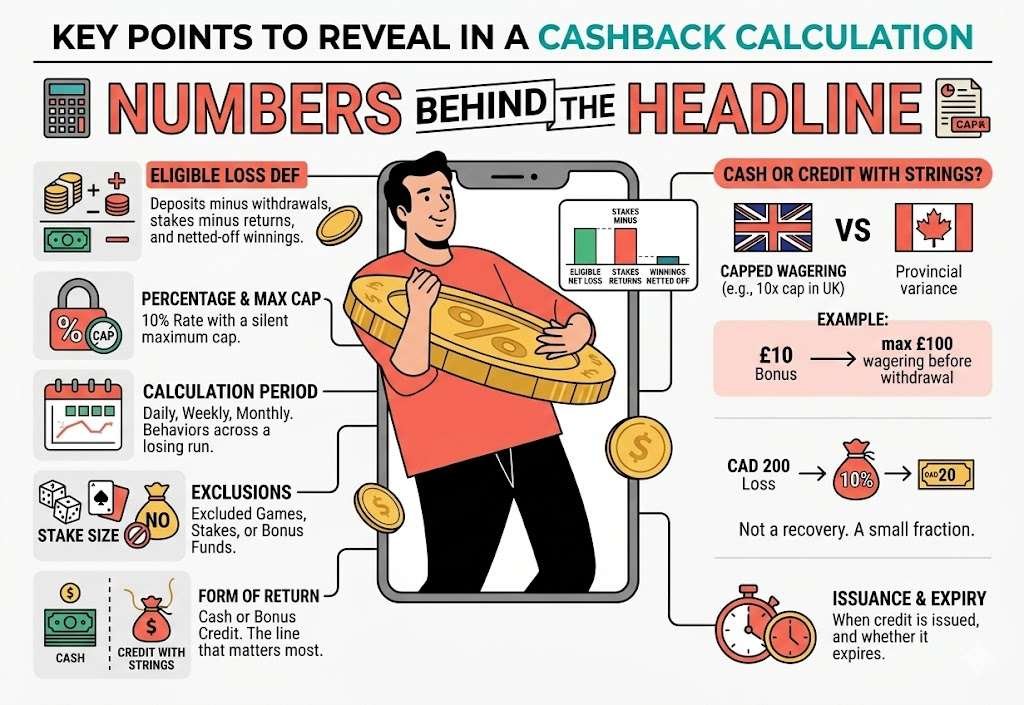
Cashback describes a return based on a defined loss over a defined window. The percentage on its own explains almost nothing, because the terms decide which losses qualify and what the returned money can do. A careful mobile check should pin down a short list of points.
Numbers behind the headline
- How eligible net loss is defined (deposits minus withdrawals, stakes minus returns, and whether any winnings are netted off).
- The cashback percentage and any maximum credit, since a generous rate often hides a quiet cap.
- The calculation period used is because daily, weekly, and monthly cashback behave very differently across a losing run.
- Whether particular games, stakes, or bonus funds are excluded or weighted.
- Whether the return is cash, restricted credit, or subject to further wagering.
- When the credit is issued, and whether it expires.
Cash, or credit with strings?
The line that matters most is what form the return takes. Cashback paid as withdrawable cash is one thing. Cashback paid as bonus credit, you must wager before any of it converts, is another. This is also where a clear UK connection helps, because Britain has recently tightened exactly this point. Under reforms flowing from the 2023 White Paper and the revised Social Responsibility Code 5.1.1 of the LCCP, wagering requirements on UK licensed sites are now capped at ten times the bonus value. The Commission’s own illustration is that a £10 bonus cannot demand more than £100 in bets before winnings can be withdrawn. A Canadian reader has no reason to assume the same ceiling applies to a provincial offer, but the example shows why “what must I do with the credit” is a sharper question than “how big is the percentage.”
Consider a hypothetical offer that returns 10 per cent of an eligible net loss. If a player’s qualifying loss for the stated period is CAD 200, the figure before any cap or further condition is CAD 20. That does not restore the original CAD 200, and it should not move a spending limit chosen before play. Read the same maths in pounds, and it behaves identically, and if that CAD 20 (or its sterling equivalent) lands as bonus credit rather than cash, there may be turnover to clear before any of it can be withdrawn. Either way, the return is a small fraction of the loss, not a recovery of it.
What Canadian Players Can Check First
In Ontario’s regulated iGaming market, a private operator must be registered with the Alcohol and Gaming Commission of Ontario and, apart from OLG.ca, hold an operating agreement with iGaming Ontario. iGaming Ontario publishes a listing of sites offered by regulated and authorized operators, and checking that status gives a clearer starting point than judging an offer by its promotional wording. Ontario also places controls around the marketing of inducements, bonuses, and credits, with such offers allowed on an operator’s gaming site or through direct marketing after active player consent rather than through unrestricted public promotion.
A UK reader can map this almost point for point. The equivalent first check is confirming that an operator holds a UKGC licence on the Commission’s public register, rather than trusting a slick banner. Britain has also moved on to bonus marketing: alongside the wagering cap, the recent LCCP changes ban cross-product incentives (so an offer cannot make you bet across, say, sports and slots to unlock one reward) and require operators to show the material terms at the point of offer instead of burying them several screens deep. Different regulators, same instinct: put the authorized setting and the displayed conditions at the centre of the reading process.
Turning a Percentage Into a Control Routine
A cashback offer can be examined without letting it set the pace of play. In Ontario, regulatory standards require players to have an easy and obvious way to set financial and time-based limits at registration and afterwards, and iGaming Ontario points players towards time and money limits, taking breaks, and BetGuard, its option for excluding oneself from regulated online gambling in the province. The UK arrives at the same place through its own tools: deposit limit prompts that licensed operators must show before a first deposit, light-touch financial checks once net deposits reach a set threshold over a rolling month, and GAMSTOP, a single registration that excludes a player across every UKGC-licensed online operator at once. Free, confidential support sits behind both systems, from provincial helplines in Canada to GamCare’s National Gambling Helpline and BeGambleAware in Britain.
A practical mobile routine is the same wherever you play:
- Confirm which framework applies where the play will occur (your province in Canada, or UKGC licensing in Great Britain).
- Check that the site is offered by a regulated and authorized operator, using the official listing or register rather than the advert.
- Read the loss definition, percentage, cap, eligible activity, credit form, and expiry before depositing.
- Set time and spending limits independently of any possible return.
- Stop, take a break, or use the available exclusion tools when play no longer fits those limits.
That sequence puts the offer after the budget, not before it. It also turns a quick mobile interaction into a repeatable decision process you can run against every new promotion that appears.
Percentage Is Not the Main Decision
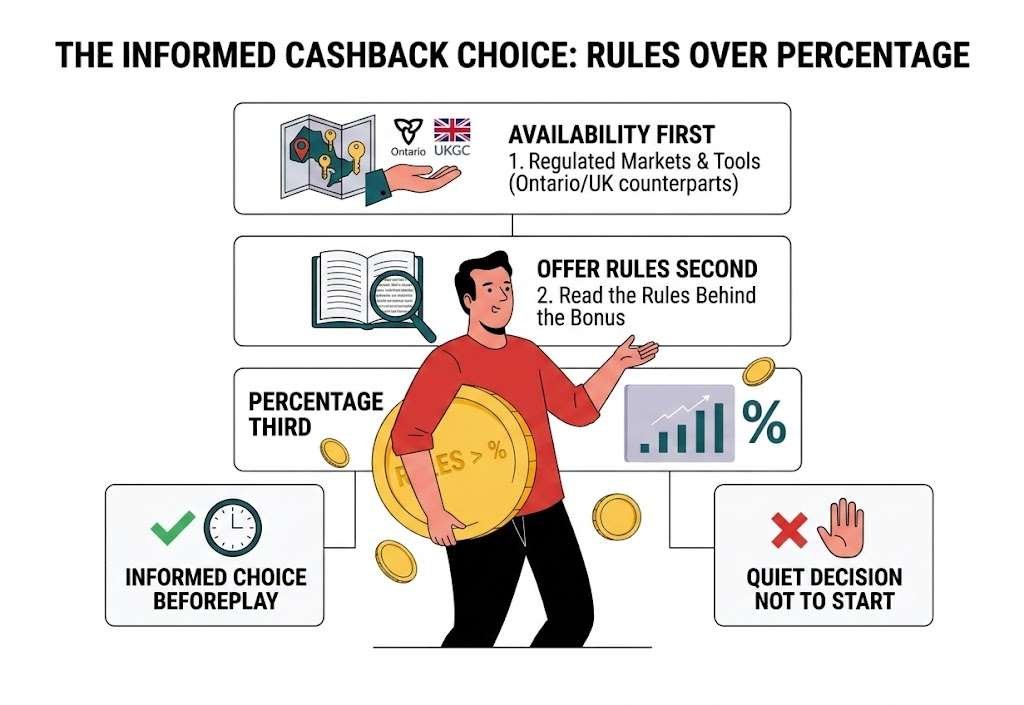
Mobile access makes an incentive feel immediate while its real conditions stay easy to overlook. The careful order is availability first, offer rules second, and percentage third. In Ontario, regulated market checks and player control tools keep that order intact, and a UK reader will find a close counterpart in UKGC licensing and the recent bonus reforms. The deeper point is the same on either side of the Atlantic: reading the rules behind a cashback bonus online casino promotion is what separates an informed choice from a hopeful one.
Cashback can be understood as a calculation, but it should not be treated as a justification for playing longer or accepting greater losses. The useful outcome is not a larger credit after a session. It is a clearer decision made before the session starts, and, just as often, the quiet decision not to start at all.
Disclaimer
This article is provided for general educational and informational purposes only. It is not legal advice, financial advice, gambling advice, or an encouragement to gamble. Online gambling is age-restricted and subject to local laws, licensing rules, and regulatory requirements. Readers should only consider gambling where it is legal for them to do so and should always check the rules that apply in their own province, country, or region.
Cashback offers, bonuses, free credits, and similar promotions do not remove gambling risk. A cashback return is usually only a small portion of a qualifying loss and may be subject to caps, expiry dates, eligibility rules, wagering requirements, or withdrawal restrictions. Players should never treat cashback as guaranteed money, a recovery method, or a reason to increase spending.
Anyone who feels gambling is becoming difficult to control should stop and seek support. In Great Britain, support is available through the National Gambling Helpline, GAMSTOP, and GambleAware. In Ontario, players can use self-exclusion and player protection tools available through regulated gambling systems. Gambling should always be treated as paid entertainment, not as a way to make money or recover losses.
References
- Alcohol and Gaming Commission of Ontario. Registrar’s Standards for Internet Gaming. AGCO updated online regulatory standards for internet gaming operators in Ontario. Accessed June 2, 2026.
- Alcohol and Gaming Commission of Ontario. Marketing and Advertising. AGCO, last updated May 14, 2026. This page explains Ontario rules on gambling inducements, bonuses, credits, advertising, and marketing restrictions. Accessed June 2, 2026.
- UK Gambling Commission. Licence Conditions and Codes of Practice. Gambling Commission, online LCCP resource, version effective from April 6, 2026. This document sets out the licence conditions and social responsibility requirements for licensed gambling operators in Great Britain. Accessed June 2, 2026.
- UK Gambling Commission. LCCP Condition 5.1.1: Rewards and Bonuses, Social Responsibility Code. Gambling Commission. This section includes rules on wagering requirements, bonus transparency, and restrictions on cross-product incentives. Accessed June 2, 2026.
- UK Gambling Commission. Gambling Promotions to Be Safer and Simpler. Gambling Commission news release, published March 26, 2025. This announcement explains the cap on wagering requirements and changes intended to simplify gambling promotions. Accessed June 2, 2026.
- UK Government. Gambling Act 2005, c. 19. Legislation.gov.uk, official revised legislation. The Act provides the statutory framework for gambling regulation in Great Britain. Accessed June 2, 2026.
- GAMSTOP. Control Your Gambling. GAMSTOP, official online self-exclusion service for gambling websites and apps licensed in Great Britain. Accessed June 2, 2026.
- GamCare. Talk to Us Now: National Gambling Helpline. GamCare, the official support page, provides confidential information, advice, and support for people affected by gambling. Accessed June 2, 2026.
- GambleAware. Gambling Help and Gambling Addiction Support. GambleAware, official public support and advice resource for people concerned about gambling. Accessed June 2, 2026.