


Think back to the last time you actually waited two or three days for a payment to clear. It probably annoyed you more than it should have. That pause. The overnight batch processing, the Friday-afternoon transfer that wouldn’t land until Monday. Used to be just an accepted part of life. Now it feels like asking someone to send a fax.
The shift didn’t happen overnight, but by 2026 it’s hard to argue it hasn’t happened completely. Digital wallets have moved from a niche convenience into something closer to consumer infrastructure. How we pay, how we receive money, and how we expect financial tools to behave have all quietly been rewritten.
Instant Settlement Is the New Baseline
In the UK, contactless payment has been standard since roughly 2014. But the shift now running through the market is different in kind, not just degree. It isn’t about tapping instead of swiping. It’s about expecting the transaction to be entirely invisible. Initiated, confirmed, and settled before you’ve put your phone back in your bag.
According to the Federal Reserve’s 2026 Diary of Consumer Payment Choice, cash remains the third-most-used payment instrument among U.S. Consumers. Still, it continues to lose ground to digital and mobile alternatives year on year. The UK picture is sharper still. London Loves Business reported in June 2026 that new-generation digital wallets are now outperforming PayPal on speed and merchant acceptance across several consumer categories. The battle for the UK payments market isn’t between banks and fintechs anymore. It’s between fintechs and faster fintechs.
For the everyday London professional, this plays out in small but cumulative ways: Apple Pay on the Tube. Monzo splitting the dinner bill in real time. A Revolut transfer hitting a freelance client’s account on a Sunday afternoon rather than the following Wednesday. These aren’t conveniences anymore. They’re expectations. The moment one platform in a category offers instant settlement, every other platform in that category has to match it or lose users.
That expectation has spread far beyond retail spending.
When Instant Payments Moved Into Digital Leisure
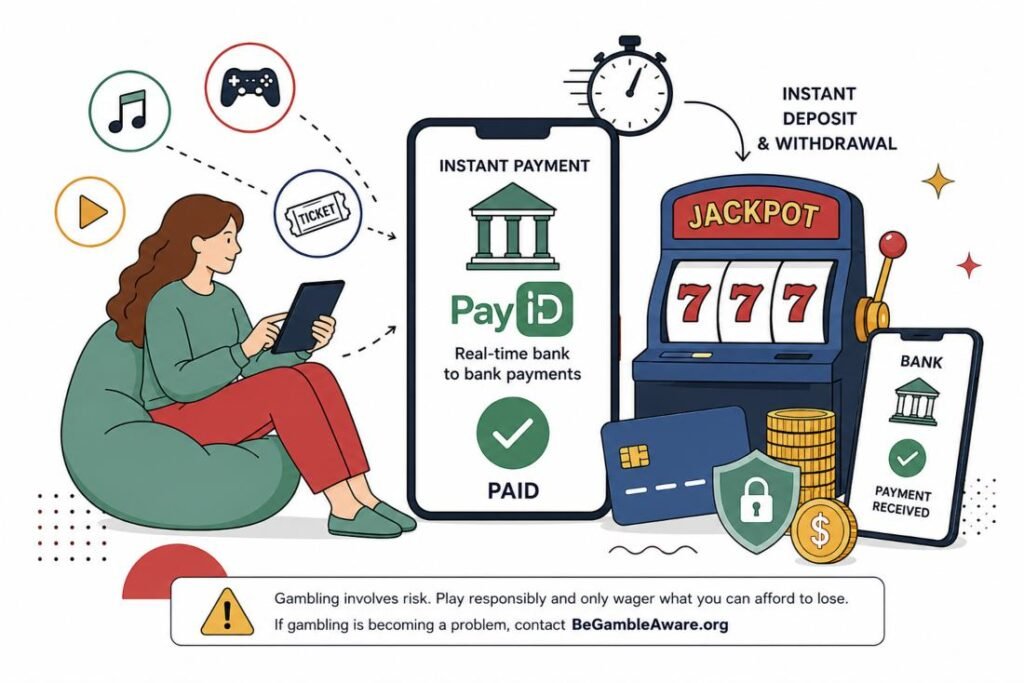
Streaming, gaming, event ticketing, app purchases. All of these industries have quietly restructured their payment rails around the assumption that users won’t tolerate friction. Spotify doesn’t ask you to confirm a BACS transfer. Neither does Deliveroo. The payment is so integrated into the experience that most people couldn’t tell you which card was charged if you asked them immediately afterward.
The same philosophy has reached digital entertainment platforms globally, including casual gaming and real-money play. Platforms in Australia, for instance, have adopted PayID. The country’s real-time bank-to-bank payment system. At a speed that genuinely surprised industry observers. PayID lets users link a mobile number or email address directly to their bank account, removing the card middleman entirely. According to IBTimes AU, around 50% of Australians were actively using PayID by mid-2025, with adoption driven largely by that core demand for frictionless, on-demand money movement.
This is why most of the best instant PayID pokies have moved to PayID as a primary deposit and withdrawal method rather than a secondary option. The platforms that made it the default. Rather than burying it three menus deep. Saw player retention improve, because the experience matched what users already expected from every other app on their phone. The friction point that used to define online payments in this category (waiting for a card processor, dealing with declined transactions, watching a balance update 48 hours late) was gone.
Gambling involves risk. Play responsibly and only wager what you can afford to lose. If gambling is becoming a problem, contact BeGambleAware.org or call 1-800-GAMBLER.
What’s Actually Driving the Shift in the UK
A few structural things have converged. Open Banking, introduced under PSD2, gave third-party apps the legal framework to plug directly into bank accounts. The rollout was slow and messy at first, but by 2025 it had quietly become the backbone of dozens of consumer apps most people use without thinking about it. Klarna, Plum, Cleo, Emma. These work because Open Banking exists.
At the same time, the major banks have had to respond. Barclays and HSBC have both upgraded their own apps significantly in the last two years, adding features that would have seemed like fintech-startup territory in 2020. Real-time notifications, instant card freezes, spending categorisation. The baseline has moved upward for everyone.
For UK consumers specifically, Bankrate’s 2025 digital banking research found that 55% of consumers now access their accounts primarily via mobile. Among millennials and Gen Z, 45% describe themselves as exclusively digital bankers: no branch visits, no chequebooks, no interest in either. The demographic skewing here matters. The consumers who most strongly define current expectations are the ones who never knew a world before instant digital payments. They’re not comparing digital wallets favourably to bank transfers. They’ve never had patience for bank transfers.
Lifestyle Implications Nobody Talks About
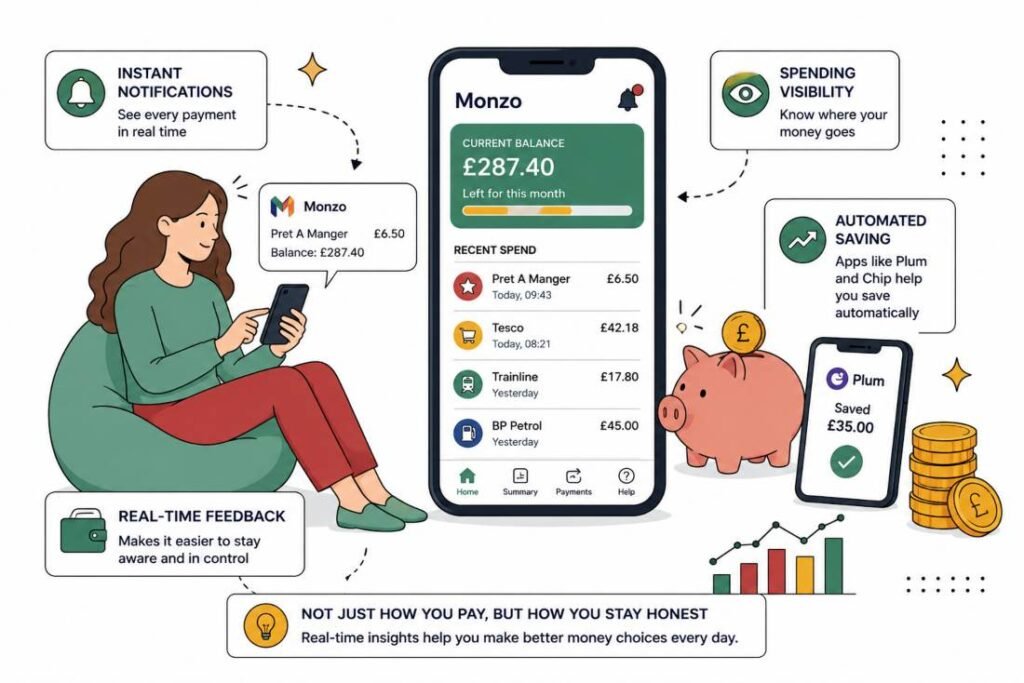
There’s a frugal-living angle here that tends to get buried under the tech conversation. Digital wallets don’t just make payments faster. They make spending more visible.
Every Monzo user knows the experience: a notification hits your phone within two seconds of a tap, showing the merchant, the amount, and your remaining balance for the month. Impulse spending doesn’t disappear, but it becomes harder to ignore. You can’t forget about the £6.50 oat-milk latte if the app tells you about it before you’ve walked out the door. This is part of why apps like Plum and Chip have grown so fast. They sit on top of the instant payment rails and convert the visibility into automated saving and spending discipline.
For anyone actively trying to cut everyday costs. A real conversation in 2026, given where energy bills and grocery prices have landed. This kind of real-time financial feedback is more actionable than any monthly bank statement. It’s not just how you pay. It’s how you stay honest about what you’re spending.
If you’re thinking about rewriting your own money habits, FSIBlog’s piece on smart ways to cut everyday expenses gets at a lot of the same tension. The gap between what we know we should do with money and what the frictionlessness of modern payments makes it easy to avoid doing.
Platforms Left Behind
Not every corner of digital life has made the transition. Some industries are still catching up, and the friction shows. Anyone who’s tried to get a refund from a marketplace, dispute a subscription charge through a legacy bank portal, or transfer money internationally through a high-street account will know exactly what 2016-era payments infrastructure still feels like in practice. Slow, opaque, non-committal about timelines.
That gap is actually an opportunity for the platforms that do get it right. Speed and transparency, when they become rare, become differentiators. That’s true whether you’re a fintech challenger, an entertainment platform, or an event ticketing service trying to reduce checkout abandonment.
The consumer expectation has been set. The question now is just about which industries close the gap fastest.
FAQ
| Question | Answer |
|---|---|
| What is a digital wallet and how does it differ from a regular bank account? | A digital wallet (such as Apple Pay, Google Pay, Monzo, or Revolut) stores payment credentials and lets you make transactions directly from your phone without entering card details each time. Unlike a traditional bank account, it is designed for speed, convenience, and real-time spending visibility rather than long-term savings or credit products. |
| Is PayID available in the UK? | No. PayID is an Australian payment system that links a mobile number or email address to a bank account for instant bank-to-bank transfers. The UK equivalent is Faster Payments, which also enables near-instant transfers but operates through different payment infrastructure. Both reflect growing consumer demand for faster settlement. |
| Are digital wallets actually safer than using a debit card? | Generally, yes. Digital wallets use tokenisation, meaning your actual card number is not shared with merchants. They also support biometric authentication, such as fingerprint or facial recognition. However, users should maintain backup authentication methods in case they lose access to their device. |
| How do I know which digital wallet works best for budgeting? | It depends on your priorities. Monzo and Starling offer detailed spending insights and instant notifications. Revolut provides additional features such as currency exchange and savings pots. Apple Pay and Google Pay work best as convenient payment layers on top of an existing bank account. Many people use more than one wallet to suit different needs. |
| Will traditional banks eventually offer the same experience as fintechs? | Traditional banks continue to improve their mobile apps, and institutions such as Barclays, HSBC, and Lloyds have made significant progress. However, many still rely on legacy banking infrastructure, which can limit how quickly they deliver the same level of speed and flexibility as newer fi |
Conclusion
Digital wallets have changed money habits because they remove the small delays people used to accept. A payment that once needed a card machine, a bank branch, or a two-day wait now happens in seconds. That has changed more than checkout speed. It has changed how people budget, shop, save, subscribe, split bills, and move money across apps.
The real shift is not just technical. It is behavioural. People now expect money to move with the same ease as a message, a food order, or a streaming subscription. When one platform makes payments instant and clear, slower platforms start to feel outdated.
Traditional banks are not disappearing, but they are no longer setting the pace alone. Fintech apps, real-time payment rails, Open Banking tools, and mobile wallets have raised the standard. The winners will be the services that make payments fast, safe, transparent, and easy to control.
The frictionless lifestyle is not about spending more. Used well, it can help people see their money more clearly, avoid late surprises, and make faster decisions. The future of everyday banking will belong to platforms that understand this simple point: people do not just want digital payments. They want money to move when life moves.
Disclaimer
This article is for general information only and should not be taken as financial, banking, legal, tax, or investment advice. Digital wallets, fintech apps, and instant payment systems may involve fees, fraud risks, account limits, service outages, data-sharing permissions, and different consumer protections depending on the provider and country.
Always check the official terms, fees, privacy policy, and security settings of any payment app before using it. Do not share passwords, one-time codes, recovery phrases, or banking login details with anyone.
This article also mentions digital entertainment and real-money gambling platforms for industry context only. Gambling involves financial risk and is not suitable for minors. Only adults who meet the legal age requirement in their location should access gambling services. Never gamble with money you cannot afford to lose. If gambling is causing stress, debt, secrecy, or loss of control, seek help from a licensed support service in your country.
References
- Dahlberg, T., Mallat, N., Ondrus, J., & Zmijewska, A. (2008). Past, present and future of mobile payments research: A literature review. Electronic Commerce Research and Applications, 7(2), 165–181. doi: 10.1016/j.elerap.2007.02.001
- Kim, C., Mirusmonov, M., & Lee, I. (2010). An empirical examination of factors influencing the intention to use mobile payment. Computers in Human Behavior, 26(3), 310–322. doi: 10.1016/j.chb.2009.10.013
- Hanafizadeh, P., Behboudi, M., Koshksaray, A. A., & Tabar, M. J. S. (2014). Mobile-banking adoption by Iranian bank clients. Telematics and Informatics, 31(1), 62–78. doi: 10.1016/j.tele.2012.11.001
- Slade, E. L., Dwivedi, Y. K., Piercy, N. C., & Williams, M. D. (2015). Modeling consumers’ adoption intentions of remote mobile payments in the United Kingdom: Extending UTAUT with innovativeness, risk, and trust. Psychology & Marketing, 32(8), 860–873. doi: 10.1002/mar.20823
- Oliveira, T., Thomas, M., Baptista, G., & Campos, F. (2016). Mobile payment: Understanding the determinants of customer adoption and intention to recommend the technology. Computers in Human Behavior, 61, 404–414. doi: 10.1016/j.chb.2016.03.030
- Ryu, H. S. (2018). What makes users willing or hesitant to use Fintech? The moderating effect of user type. Industrial Management & Data Systems, 118(3), 541–569. doi: 10.1108/IMDS-07-2017-0325
- de Luna, I. R., Liébana-Cabanillas, F., Sánchez-Fernández, J., & Muñoz-Leiva, F. (2019). Mobile payment is not all the same: The adoption of mobile payment systems depending on the technology applied. Technological Forecasting and Social Change, 146, 931–944. doi: 10.1016/j.techfore.2018.09.018
- Kaur, P., Dhir, A., Bodhi, R., Singh, T., & Almotairi, M. (2020). Why do people use and recommend m-wallets? Journal of Retailing and Consumer Services, 56, 102091. doi: 10.1016/j.jretconser.2020.102091
- Górka, J. (2025). The rise of instant payments: A cross-country comparison. Central European Management Journal. doi: 10.1108/CEMJ-10-2024-0297