



Most skincare advice seems to be written for someone with an empty evening and a bathroom nobody else needs. Real mornings rarely look like that. Someone is asking where their shoes went. A work message has landed before seven. Whatever routine you intended gets compressed into the gap between the kettle boiling and the front door closing.
So the useful question is not how to find more time. It is which few steps are worth keeping when there is almost none, and how to make those steps survive a week that goes sideways.
Obstacle Is Usually Interruption, Not Minutes
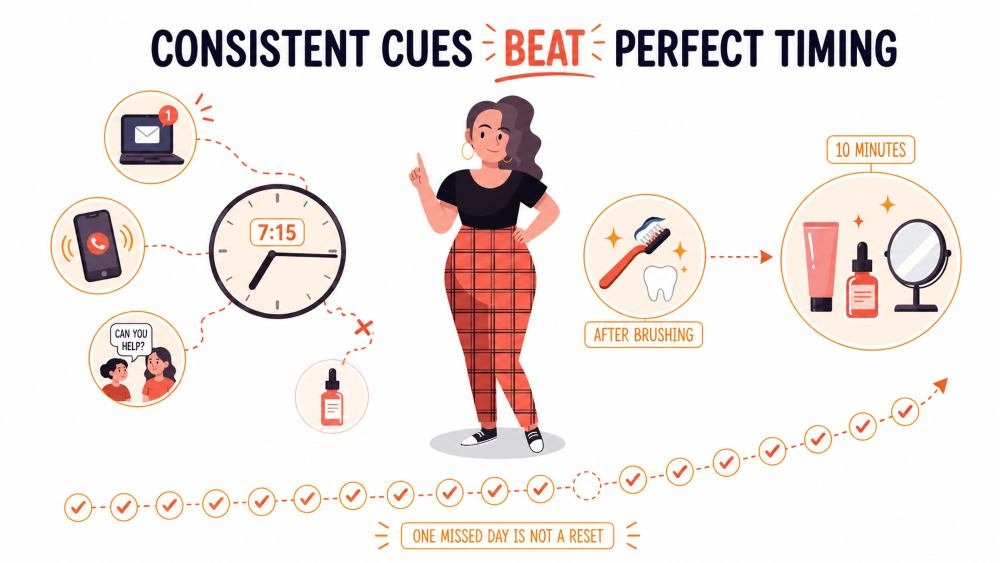
Ten minutes exist in most days. Ten uninterrupted minutes at a predictable point often does not, and that is a different problem needing a different fix.
Research on how everyday habits actually form is genuinely useful here. Ninety-six volunteers were tracked over twelve weeks as they tried to adopt a new daily behaviour, and the researchers found that automaticity built up through repetition in a consistent context. How long that took varied enormously between people, from around eighteen days at the quick end to well past two hundred at the slow end.
Two practical things follow. First, attaching a step to something that already happens reliably beats attaching it to a clock. “After I brush my teeth” is a sturdier cue than “at 7:15”, because the toothbrushing happens whether or not the morning has gone to plan. Second, the same study found that missing one occasion did not meaningfully set the process back. A skipped night is not a reset, which is worth remembering the next time a bad week makes the whole thing feel pointless.
A Morning Routine That Survives A Rushed Exit
Five minutes is enough if you spend it on the right things.
Start with a gentle cleanse. Dermatologists are fairly consistent on the mechanics of this: use lukewarm water and your fingertips rather than a washcloth or a scrubbing tool, choose a non-abrasive cleanser without alcohol, and pat dry instead of rubbing. The American Academy of Dermatology’s guidance on how to wash your face without irritating it is short enough to read in a minute and covers most of what goes wrong. Follow with moisturiser while your skin is still slightly damp.
Then sunscreen, which is the step to defend when everything else gets cut. If you are in Singapore or anywhere else near the equator, this is a year-round consideration rather than a seasonal one. The National Environment Agency publishes Singapore’s ultraviolet index readings every fifteen minutes from the Changi Meteorological Station between 7 am and 7 pm. The accompanying Ministry of Health advisory recommends sunscreen of at least SPF 30, along with shade, sunglasses that block UVA and UVB, and a broad-brimmed hat, particularly between 11 am and 3 pm when levels peak. Worth checking once, if only to see how high the reading is on an ordinary overcast Tuesday.
Makeup, if you wear it, comes last and can be as minimal as you like. Nobody has ever regretted owning fewer products in a rush.
An Evening Routine For When You Have Nothing Left
By nine or ten at night, most people’s willingness to stand at a sink has evaporated. Design for that version of yourself, not the aspirational one.
Removing the day matters more than whatever you apply afterwards. Cleanse properly, then use one product that suits your skin, whether that is a night cream or a serum. Two steps you will actually complete are worth more than five you will skip.
There is also a reasonable argument for going to bed. A study of sixty women published in Clinical and Experimental Dermatology compared self-reported good sleepers with poor sleepers and found measurable differences in how skin recovers after a barrier disruption: the poor sleepers lost more water through the skin at baseline. They recovered around 30 per cent less well over the following days. It is a single study on a small sample, so it is not the last word. But if the honest choice on a given night is between a twenty-minute routine and twenty more minutes of sleep, the sleep is a defensible use of the time.
One small change removes more friction than any product swap: keep the two things you actually use within arm’s reach of where you stand. Most abandoned routines die at the point of opening a cupboard.
Supporting Your Skin From The Inside On Rushed Days
Nutrition tends to be the first thing to slide when the week gets busy, which matters more than it sounds. A review in the journal Nutrients on the roles of vitamin C in skin health notes that healthy skin normally holds high concentrations of the vitamin, where it supports collagen synthesis and contributes to antioxidant defence against UV-induced photodamage.
Because vitamin C is water-soluble, the body does not store it, so intake needs to be regular rather than occasional. The NIH Office of Dietary Supplements sets the recommended daily amount of vitamin C at 75 mg for adult women, rising to 85 mg in pregnancy and 120 mg while breastfeeding, with an upper limit of 2,000 mg a day from all sources combined. Going well beyond that can cause nausea and stomach upset, so more is not automatically better.
Food should do most of the work here, and a handful of strawberries or half a red pepper goes a surprisingly long way. On the days when it does not happen, a ready-to-drink option is one way to close the gap without adding another task. The Sato Hakubi White C Drink supplies 1,000 mg of ascorbic acid per 60 ml bottle alongside tocopherol acetate and nicotinamide, taken as one bottle a day, which makes it easy to fold into a morning that is already moving. It is intended for people over fifteen, and the manufacturer advises that pregnant and breastfeeding women speak to their doctor before taking it.
Weekly Ten Minutes Worth Protecting
Beyond the daily basics, very little needs to happen often.
Exfoliation is the main candidate, and it is worth being selective rather than enthusiastic. Dermatologists point out that exfoliation is not right for everyone and that the method should match your skin: those with dry, sensitive or acne-prone skin usually do better with a mild chemical exfoliant than a scrub, and anyone with a darker skin tone or a history of dark spots after breakouts should be cautious with stronger treatments. Once or twice a week is plenty. If your skin looks irritated afterwards, that is information, not a sign to persevere.
The other weekly habit costs nothing: glance at what is actually on your shelf. Products go off, half-used bottles accumulate, and clearing the ones you have quietly stopped reaching for makes the shelf easier to use at speed.
Asking For The Time Is Part Of The Routine
For a lot of women, the hardest part is not the routine but carving out the window to do it in without someone appearing at the door.
That difficulty is structural rather than personal. International Labour Organization figures on the division of unpaid care work show that women in Asia and the Pacific spend 4.1 times as long on it as men, carrying roughly 80 per cent of the total hours in the region. If you have felt that there is no slack in your day, you are reading your own schedule correctly.
Which makes asking for fifteen protected minutes a scheduling conversation rather than a favour. Naming a specific window and a specific person, “I need the bathroom to myself from 9:30, can you handle bedtime reading”, tends to work better than a general request to be given more space. It also makes the time visible to everyone else in the house, which is usually what stops it being the first thing to disappear.
Fitting Beauty Around Your Life, Not The Reverse
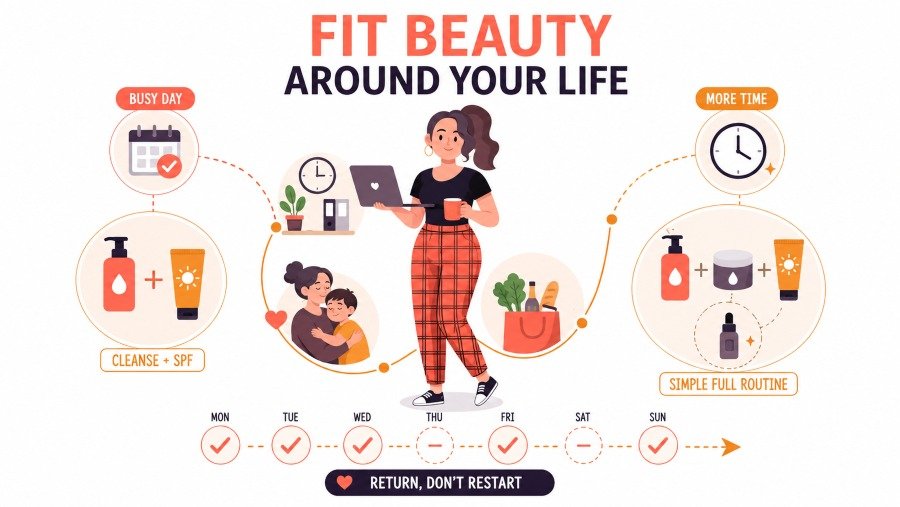
The routines that last are boring. A small number of products you trust, applied at a moment that already exists in your day, with no expectation that every day will go to plan.
Some weeks you will manage three steps twice a day. Some weeks you will manage a cleanse and sunscreen and nothing else, and that is still a routine. The evidence on habit formation is fairly forgiving about the occasional miss. What it rewards is coming back.
Disclaimer: This article is intended for general information only and does not constitute medical advice. Individual skin needs vary, and supplements can interact with medicines and existing health conditions. Please consult a doctor, pharmacist or qualified dermatologist before starting a new supplement or skincare regimen, particularly if you are pregnant, breastfeeding, or managing a diagnosed skin condition.
References
- Lally, P., van Jaarsveld, C. H. M., Potts, H. W. W. and Wardle, J. (2010) “How are habits formed: Modelling habit formation in the real world”, European Journal of Social Psychology, 40(6), pp. 998–1009. DOI: 10.1002/ejsp.674
- American Academy of Dermatology Association. “Face washing 101”. Available at: https://www.aad.org/public/everyday-care/skin-care-basics/care/face-washing-101
- National Environment Agency, Singapore. “Ultraviolet Index” (advisory on sun protection measures sourced from the Ministry of Health). Available at: https://www.nea.gov.sg/corporate-functions/weather/ultraviolet-index
- Oyetakin-White, P., Suggs, A., Koo, B., Matsui, M. S., Yarosh, D., Cooper, K. D. and Baron, E. D. (2015) “Does poor sleep quality affect skin ageing?”, Clinical and Experimental Dermatology, 40(1), pp. 17–22. DOI: 10.1111/ced.12455. PMID: 25266053
- Pullar, J. M., Carr, A. C. and Vissers, M. C. M. (2017) “The Roles of Vitamin C in Skin Health”, Nutrients, 9(8), 866. DOI: 10.3390/nu9080866. PMCID: PMC5579659
- National Institutes of Health, Office of Dietary Supplements. “Vitamin C: Fact Sheet for Consumers”. Available at: https://ods.od.nih.gov/factsheets/VitaminC-Consumer/
- American Academy of Dermatology Association. “How to safely exfoliate at home”. Available at: https://www.aad.org/public/everyday-care/skin-care-secrets/routine/safely-exfoliate-at-home
- International Labour Organization (2018) “ILO: Women do 4 times more unpaid care work than men in Asia and the Pacific”, drawing on Care work and care jobs for the future of decent work. Available at: https://www.ilo.org/resource/news/ilo-women-do-4-times-more-unpaid-care-work-men-asia-and-pacific
- Sato Pharmaceutical (Singapore). “Hakubi White C Drink” product information. Available at: https://satopharm.com.sg/product/hakubi-white-c-drink/