



Most walkers think about grip first.
Then they think about waterproofing, ankle support, cushioning, or whether the sole looks rugged enough for a muddy trail. All of those things matter. But there is one feature many people still ignore until a long walk teaches them the hard way: the shape of the front of the shoe.
That front section, the toe box, can decide whether a hike feels steady and comfortable or slow and punishing.
A lot of hiking shoes are still too narrow at the front. They may look sporty and streamlined, but once your feet start swelling, your toes start rubbing, and the downhill sections begin, that sleek shape stops looking clever. It starts feeling like the problem.
That is why more walkers are paying attention to wide toe box walking shoes. Not because “wide” sounds softer or more relaxed, but because the front of the shoe plays a bigger role in comfort, balance, and foot health than many hikers realise.
Why The Toe Box Matters More On Trails Than On Pavements
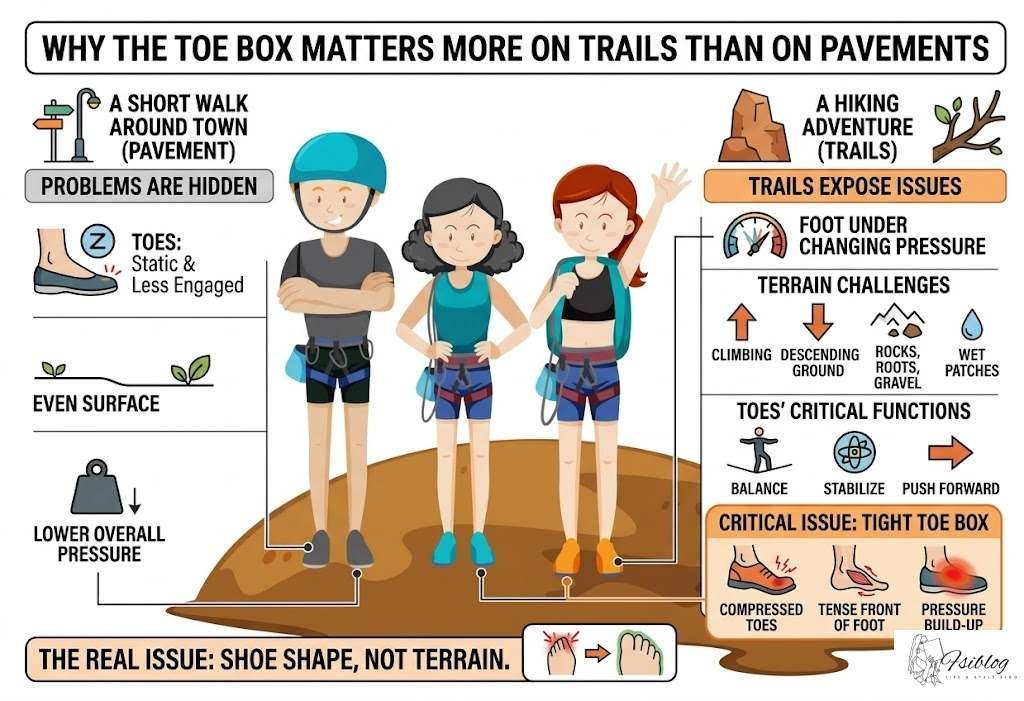
A short walk around town can hide a lot of fitness problems.
A trail usually exposes them.
Hiking puts the foot under changing pressure all day. You are climbing, descending, stepping across uneven ground, adjusting to rocks, roots, gravel, and wet patches. Your toes are not just sitting there. They are constantly helping you balance, stabilise, and push forward.
If the front of the shoe is too tight, the foot cannot do that job naturally.
Your toes get compressed. The front of the foot stays tense. Pressure builds where it should not. A shoe that felt “fine” in the shop can become deeply annoying once the path gets steeper or the miles start adding up.
That is why hikers often blame the terrain when the real issue is the shoe shape.
Narrow Hiking Shoes Create Problems Slowly, Then All At Once
The trouble with a tight toe box is that it usually does not ruin the walk in the first ten minutes.
It builds.
At first, you notice a bit of pressure near the little toe. Then the front of the foot feels warm. Then the descent starts, and your toes begin nudging the front more than they should. By the time you stop for a break, you are already thinking about your feet far more than the view.
This is how many walking days go wrong.
Not through one dramatic failure, but through a long chain of small irritations. The shoe keeps rubbing. The toes stay crowded. The forefoot never settles. Your walking rhythm changes because you are adjusting to discomfort without even realising it.
A better toe box does not just “feel roomier.” It removes one of the main reasons a decent walk turns into a tiring one.
Toes Need Space To Spread On Uneven Ground
This is the part many people underestimate.
Your toes naturally spread slightly when you walk, especially when the ground is uneven. That spreading helps with balance and gives the foot a more stable base. On trails, where the surface keeps changing, this becomes even more important.
If the toe box is too narrow, that natural movement gets restricted.
Instead of helping you stabilise, the front of the shoe starts dictating how your foot must behave. That can make the whole lower body feel more tense, particularly on technical paths or long descents where every step needs a bit more control.
A wide toe box supports natural movement. It does not force the front of the foot into a sharper shape to make the shoe look faster or slimmer.
That is a practical advantage, not a cosmetic one.
Downhill Walking Is Where Bad Toe Boxes Get Exposed
A lot of hikers notice toe discomfort most on descents, and there is a simple reason for that.
When you walk downhill, your foot shifts forward. If the shoe is too short, too narrow, or shaped too sharply at the front, the toes absorb that force again and again. You start getting pressure in the nails, rubbing at the ends of the toes, and that cramped feeling that makes every step more irritating than the last.
This is where wide-toe box walking shoes often make their biggest impression.
They give the front of the foot more room to settle. That does not mean your foot should slide around. The heel still needs to hold properly. But the toes should not feel like they are being punished every time the trail tips downward.
If your downhill comfort is poor, the toe box deserves more attention than it probably gets.
Foot Swelling Changes Everything After The First Hour
Even good-looking hiking shoes can become bad hiking shoes once your feet start swelling.
And they usually do swell.
Longer walks, warmer weather, uphill effort, and hours on your feet all increase foot volume. That means a shoe that felt just snug enough when you laced it up in the morning may feel far tighter by midday.
This is one of the main reasons hikers misjudge fit.
They try shoes on while fresh, on level flooring, for a few minutes. The trail is nothing like that. A hiking shoe needs to fit not just at the start of the day, but also after effort, heat, and distance have changed the foot.
A wider, better-shaped toe box gives you that extra margin without turning the shoe sloppy. It allows the foot to exist like a real foot, not a perfectly static object.
Wide Toe Box Does Not Mean Loose, Clumsy Or Oversized
Some walkers avoid wider-front shoes because they think the fit will feel floppy.
That is not what a good wide toe box does.
It is not about making the whole shoe oversized. It is about giving the forefoot the right shape. The heel can still feel secure. The midfoot can still feel supported. The shoe can still feel trail-ready and stable. The difference is that the toes are not forced together for no good reason.
This matters because many hikers have been taught to equate tightness with support.
In reality, the best support comes from the right shape in the right places. A shoe can hold the foot well without squeezing the front into submission.
The aim is control without compression.
Walkers With Bunions, Broad Forefeet, Or Toe Crowding Feel The Difference Fastest
Some hikers benefit from a wide toe box almost immediately.
If you have bunions, broader forefeet, toe crowding, or a foot shape that never quite fits standard outdoor shoes, the relief can be obvious from the first walk. The rubbing drops. The pressure eases. The shoe stops feeling like it was designed for someone else.
But this is not only for people who already think of themselves as having “problem feet.”
A lot of walkers with average-sized feet still prefer wider toe boxes once they try them properly on longer routes. That is because the benefit is not only medical or structural. It is functional. More natural toe room often feels better across a distance.
The longer the walk, the more that difference tends to show.
Better Toe Space Can Improve How Long You Enjoy Walking
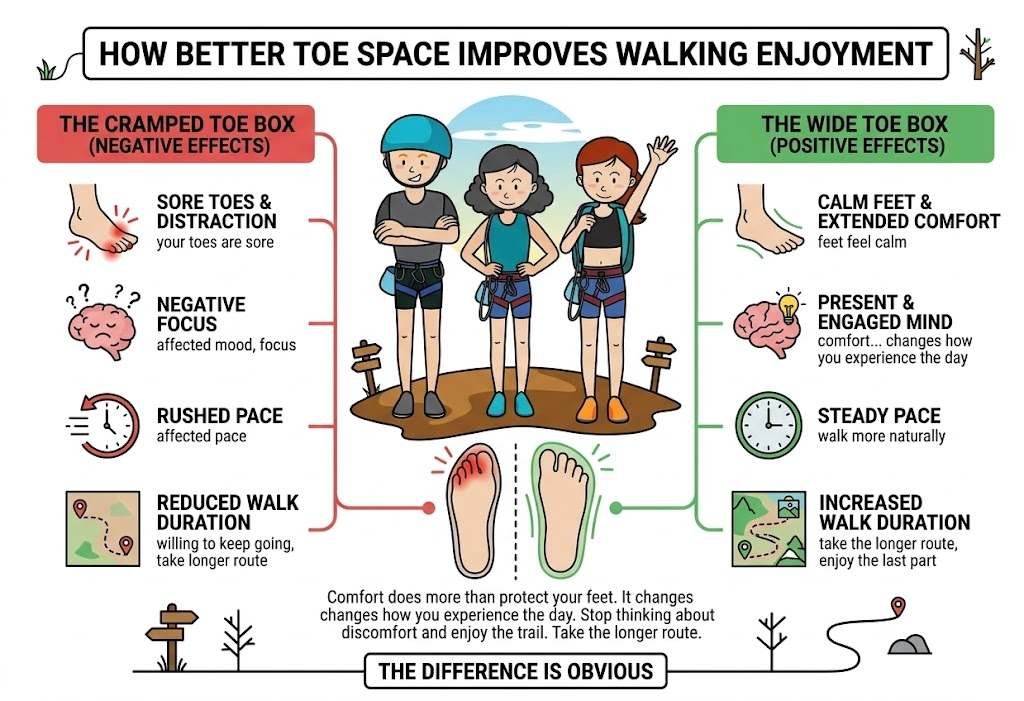
Comfort does more than protect your feet.
It changes how you experience the day.
If your feet feel calm, you walk more naturally. You stop thinking about discomfort every few minutes. You feel more willing to keep going, take the longer route, or enjoy the last part of the trail instead of rushing back because your toes are sore.
This is what many people miss when they treat shoe fit as a small detail.
A cramped shoe not only affects the foot. It affects your mood, your pace, your focus, and how much you enjoy being outdoors. A better-shaped hiking shoe makes the experience smoother in a way that can seem small until you compare it against a bad one.
Then the difference becomes obvious.
What Else Needs To Work Alongside The Toe Box
A wide toe box matters, but it is not the only thing that matters.
The shoe still needs decent grip, a stable sole, sensible cushioning, and a heel that holds without rubbing. The upper should feel accommodating without becoming sloppy. Good hiking footwear works as a full system, not a single feature.
But the toe box is often the overlooked part of that system.
People obsess over outsole lugs and waterproof membranes while ignoring the front shape that their toes will be dealing with all day. That is backwards. If the shoe hurts at the front, the rest of the specs will not rescue the walk.
Fit should not be the last thing you think about. It should be near the top.
Final Thoughts
A wide toe box is not a luxury feature for fussy hikers.
It is one of the most practical things a walking shoe can offer.
On trails, your feet need room to spread, stabilise, swell, and handle changing terrain. When the front of the shoe is too narrow, everything gets harder. Descents feel harsher. Balance feels less natural. Pressure builds. Rubbing starts. The walk becomes more about enduring the shoe than enjoying the route.
That is why this feature deserves more attention than it gets.
Walkers often spend time researching traction, weather protection, and ankle design. They should. But the shape of the toe box belongs in that same conversation. It is not secondary. It is central.
If your current hiking shoes leave your toes sore, cramped, or irritated, the answer may not be more cushioning or thicker socks.
The front of the shoe may be wrong for the job.