



At 12:17 on the first properly warm Saturday of May, I watched a coffee frappé separate before it reached the collection counter.
The top had become a loose cap of pale foam. Underneath it sat a thin, coffee-coloured liquid, followed by a stubborn layer of crushed ice that refused to travel up the straw. Nine customers were waiting, both blenders were running, and the young woman who had ordered the drink held it towards the light before asking, quite politely, “Is it meant to look like this?”
It was not.
I apologised, remade it and produced something only slightly better. By the time the lunchtime rush ended, we had thrown away seven drinks, used far too much milk and fallen behind on the rest of the orders.
Until that afternoon, I had treated a frappé base as an optional extra. I thought good coffee, cold milk, flavoured syrup and a powerful blender should be enough. That failed batch taught me that a modern blended drink is not simply a cold coffee with ice added. It is a small piece of food science that must still work when the café is busy, the ice changes shape and three different people are preparing it.
Recipe Looked Simple Until We Had to Repeat It
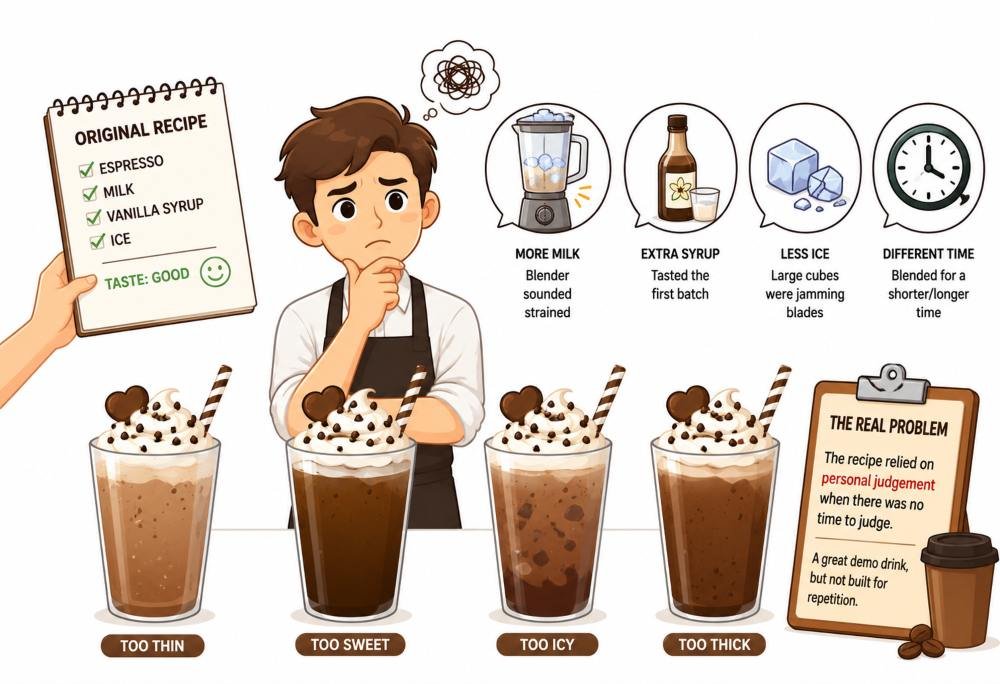
Our original recipe had been developed during a quiet weekday morning. We used espresso, milk, vanilla syrup and ice, then adjusted everything by eye until it tasted right.
The first drink was pleasant. The second was acceptable. That was enough for us to print it on the summer menu.
What we had not tested was repetition.
During the Saturday rush, one member of staff used a little more milk because the blender sounded strained. Another added extra syrup after tasting the first batch. Someone else reduced the ice because large cubes were jamming beneath the blades. Every decision seemed minor, but together they changed the drink completely.
The problem was not that anyone lacked skill. The problem was that the recipe depended on personal judgement at the exact moment when there was no time for careful judgement.
Ice is particularly unforgiving. Too little produces a thin drink. Too much can leave dry pieces floating in the cup. The temperature of the milk, the size of the ice and the blending time all affect the final result. Even the order in which ingredients enter the jug can change how evenly everything mixes.
I had designed a drink that worked as a one-off demonstration. I had not designed one that could survive a service.
I Complained, Then Learnt the Supplier Was Technically Right
My first reaction was to blame the ingredients.
I contacted the supplier and explained that the base we had tested was not giving us the texture we expected. I sent photographs of the separated drinks and described the foam, the watery bottom and the ice left behind in the cup.
The reply was uncomfortable because it was accurate.
We had used less powder than the recommended serving amount, added more liquid than the specification allowed and changed the ice ratio without adjusting anything else. We had also been pouring the powder directly onto wet ice, where part of it clumped against the side of the jug instead of dispersing through the drink.
The supplier was technically right. The product had not failed. We had treated the instructions as a loose suggestion.
That conversation changed the way I thought about beverage bases. A good base is not there merely to make a drink sweeter or creamier. It helps control the relationship between water, fat, air and ice. Depending on the formulation, ingredients such as emulsifiers and stabilisers can support body, texture and a more uniform structure. The Institute of Food Science and Technology’s explanation of food additives helped me understand why these ingredients may be included, while its simple guide to how emulsification affects texture explains why ingredients that appear to be mixed can still separate without the right structure.
The distinction I had missed was simple: flavour creates the idea of a drink, but structure makes that idea repeatable.
Base Did Not Replace Skill, but It Removed Guesswork
After the failed weekend, we stopped changing several things at once.
We weighed the ice rather than filling the jug to an uncertain line. We measured the milk, timed the blend and wrote down the order of ingredients. We also compared the cost per finished cup instead of looking only at the price of a bag or bottle.
During that process, I tested a professional frappe mix powder as the structural base for blended drinks, while using Grenadine syrup pomegranate separately in a fruit-led cooler where its colour and sharp sweetness made more sense. Keeping the ingredients in roles they could perform well gave us better results than forcing every fashionable flavour into one crowded recipe.
That was another useful lesson. Versatility does not mean every ingredient belongs in every beverage.
A reliable base gave us a neutral starting point that could carry coffee, chocolate, caramel or fruit flavours without requiring the team to rebuild the texture each time. Syrups then had a clearer job: changing the flavour, aroma or visual character of the drink.
The difference became obvious on the following Saturday. At 1 pm, we had twelve drinks on the rail and a queue reaching the door. One staff member called across the counter, “Same recipe for the chocolate one?”
“Same base, different syrup,” I replied.
She nodded and carried on. There was no long explanation, no guessing and no blender jug filled with half-finished experiments. The drink left the counter with a smooth body from top to bottom, and it still looked right several minutes later.
That quiet, ordinary moment mattered more than the attractive test drink we had made the week before. A café recipe earns its place on the menu when it works under pressure.
Consistency Also Exposes the Real Cost of a Drink
Before this mistake, I judged ingredients mainly by pack price. A cheaper powder or syrup appeared to leave more room for profit.
That calculation was incomplete.
A product can look inexpensive while requiring a larger serving, producing more failed drinks or taking longer to prepare. It may also behave differently with oat drinks, dairy milk, coffee, acidic fruit ingredients or large amounts of ice. Once waste and staff time are included, the cheaper choice may cost more per sale.
Our seven rejected drinks represented more than wasted liquid. We had used coffee, milk, ice, takeaway cups, lids and staff time. We also delayed customers who had ordered simple drinks that should have been quick to serve.
WRAP’s hospitality resources show why this matters beyond one café. Its Food Waste Reduction Roadmap encourages food and drink businesses to measure waste, identify where it occurs and act on the results rather than treating losses as an unavoidable part of service.
Once we began recording failed drinks, we found patterns that memory had hidden. Most waste occurred when a new recipe had no measured method, when staff substituted ingredients without guidance or when a large drink was created by simply adding more liquid to the regular recipe.
The solution was not to remove creativity. It was to move experimentation away from the customer queue.
We tested new drinks in small batches, recorded the exact measurements and only added them to the menu once another member of staff could reproduce them without help.
A Smooth Drink Still Needs Transparent Ingredient Information
My failed recipe initially seemed like a quality problem, but it also revealed a more serious weakness. We did not have an organised ingredient and allergen record for every component used in the drink.
Many beverage bases contain milk or milk-derived ingredients. Some may include soya, while sauces, toppings and flavoured powders can introduce other allergens. Plant-based milk does not automatically make a finished drink dairy-free when the base, sauce or garnish contains milk.
The UK Food Standards Agency provides detailed allergen guidance for food businesses, including the need to provide accurate allergen information and manage cross-contamination. Its Safer Food, Better Business guidance for caterers is also useful for cafés that need a practical food-safety system rather than informal knowledge passed between staff.
After our menu review, we required an ingredient specification and allergen declaration before approving a new powder, syrup, sauce or topping. We also stopped relying on phrases such as “should be fine” or “probably dairy-free”.
Customers should not have to depend on guesswork, and neither should the person serving them.
A professional product is not simply one that creates a good texture. It should arrive with information that allows the business to use it responsibly.
Sweetness Had to Be Designed, Not Added Automatically
Once the texture improved, another problem became easier to notice: some of our drinks were far too sweet.
Previously, the thinness of the drink had disguised this. We kept adding syrup because the flavour disappeared as the ice melted. Once the base held the drink together properly, the same amount of syrup tasted heavy.
This is where standardisation helped again. We could reduce syrup without losing body, producing a drink that tasted balanced rather than simply intense.
The NHS advises that added sugars, including those found in syrups, should make up no more than 5 per cent of daily energy intake, which is about 30 grams per day for people aged 11 and over. Its guidance on reducing sugar in food and drink is a useful reminder that a large blended beverage can contain several sweetened components at once.
That does not mean cafés must remove indulgent drinks. It means the recipe should be intentional.
We began checking the sugar contribution from the base, flavoured syrup, sauces, whipped toppings and garnishes together. We also offered smaller sizes and avoided adding a decorative syrup drizzle unless it genuinely improved the drink.
For larger businesses in England, calorie information may also be a formal menu responsibility. The government’s guidance on calorie labelling in the out-of-home sector applies mandatory requirements to businesses with 250 or more employees and encourages smaller operators to consider voluntary labelling. The Food Standards Agency also provides nutrition-labelling guidance for businesses that need to present product information clearly.
Even where labelling is not compulsory, knowing what is in a recipe makes better menu decisions possible.
What I Now Ask Before Approving a Beverage Ingredient
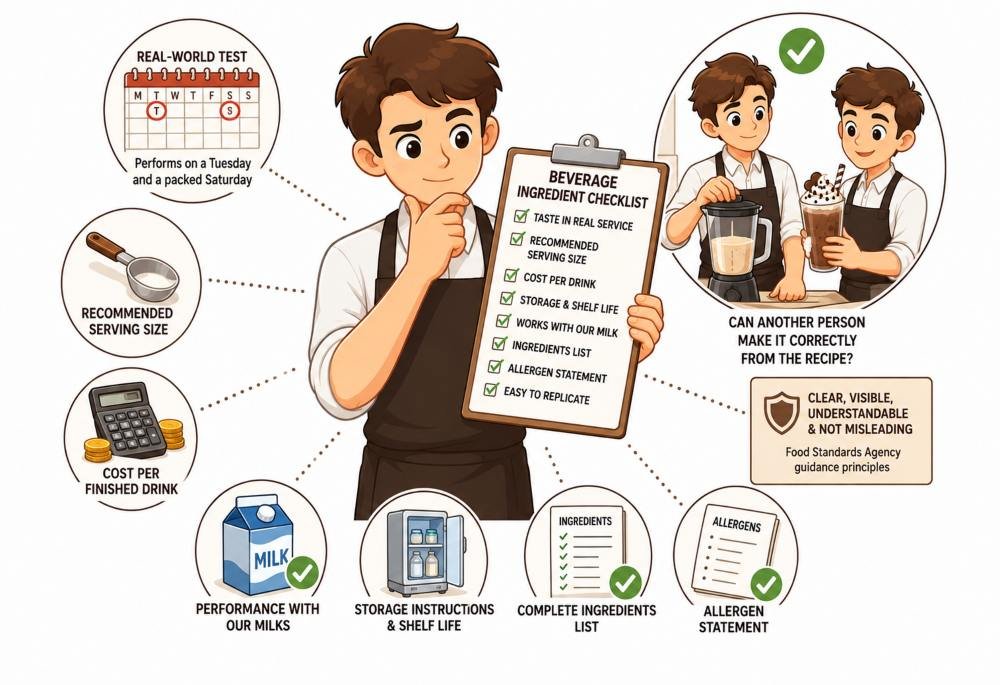
I no longer begin by asking whether an ingredient tastes impressive in a supplier demonstration.
I want to know how it behaves on an ordinary Tuesday and during a packed Saturday afternoon. I check the recommended serving size, cost per finished drink, storage instructions, shelf life after opening and performance with the milks we actually use.
I also ask for a complete ingredients list and allergen statement. The Food Standards Agency’s food labelling and packaging guidance explains that product information must be clear, visible, understandable and not misleading. Those principles are just as useful when a café evaluates supplier documents as when it communicates information to customers.
Most importantly, I test whether another person can prepare the drink correctly from the written method.
A recipe that only works when its creator is standing beside the blender is not ready for a commercial menu.
Failed Frappé Changed How I Think About Creativity
I used to associate creative drinks with more ingredients: an extra sauce, a brighter syrup, a larger topping or another flavour competing for attention.
Now I see creativity as control.
It is knowing which part of the drink provides flavour, which part creates structure and which garnish genuinely improves the experience. It is making something attractive without allowing presentation to weaken taste, service speed or ingredient transparency.
The base matters because it gives that creativity a stable place to begin. It cannot repair weak coffee, poor measurements or careless preparation, but it can make a properly developed recipe easier to repeat.
The separated frappé was partly an ingredient problem, partly a process problem and largely my own planning failure. I had approved a drink because one version looked good in a quiet kitchen. I had not asked whether it could be made fifty times by different people while customers waited.
That was the real lesson. Modern beverage creation is not proven by the most impressive cup produced during testing. It is proven by the fiftieth cup served on a busy afternoon, when the texture is still smooth, the flavour is still balanced and nobody behind the counter has to guess.