



Ask around, and the standard answer is “winter”. It is broadly right and almost useless, because British holidays are rarely booked into an open calendar. They are booked around a half-term, a shift rota, or a bank holiday that can be stretched with three days of annual leave. The useful question is not which month is best in the abstract. It is what each month gives you, and what it quietly takes away.
Phuket is warm every day of the year, so temperature is seldom the deciding factor. What shifts between months is the state of the sea, the shape of the afternoon, the price of a room, and, in a detail that catches out a surprising number of visitors, whether the boat trip you flew twelve hours for is legally permitted to run at all.
Phuket Runs On The Andaman Calendar, Not Thailand’s
Thailand does not have one weather season, and this is where most planning goes wrong. Phuket sits on the Andaman coast, the country’s western side, and takes its rhythm from the southwest monsoon. The Foreign, Commonwealth and Development Office travel advice for Thailand puts the rainy season at roughly May to October, while noting that Koh Samui and the southeast of the country usually run the opposite way, wet from November to March. So the friend who raved about Samui in February and the colleague who was rained off a boat in Phuket in August are both describing the truth about different coasts.
Three broad seasons apply here: cool and dry from November to February, hot from March to mid May, and the southwest monsoon from mid May through October. That mid-May boundary matters more than the tidy “June to October” you often see quoted. Thailand’s national park authorities close the Similan and Surin islands on 15 May every year, which tells you where the people who work on the water actually draw the line.
November To February: The Months British Winter Was Made For
This is the island at its most reliable. Skies are clearest, humidity settles to something a Northern European genuinely enjoys, and daytime highs sit in the low thirties. The sea holds at around 29°C, which is warmer than most British swimming pools and a distinctly odd sensation in January.
Calm water is the real prize. Boat trips to Phi Phi, Phang Nga Bay and the Similans run dependably; underwater visibility is at its annual best, and cancellations are rare. Sunsets over the Andaman are the reason half of Phuket’s beach bars exist.
Prices follow the weather. Christmas and New Year form the most expensive fortnight on the island by a wide margin, and the better rooms in Patong and Karon go months in advance. February is the quieter, cheaper half of peak season and, judged on weather alone, is probably the single best week of the year to be standing on Kata Beach.
What The Flight Timetable Quietly Tells You
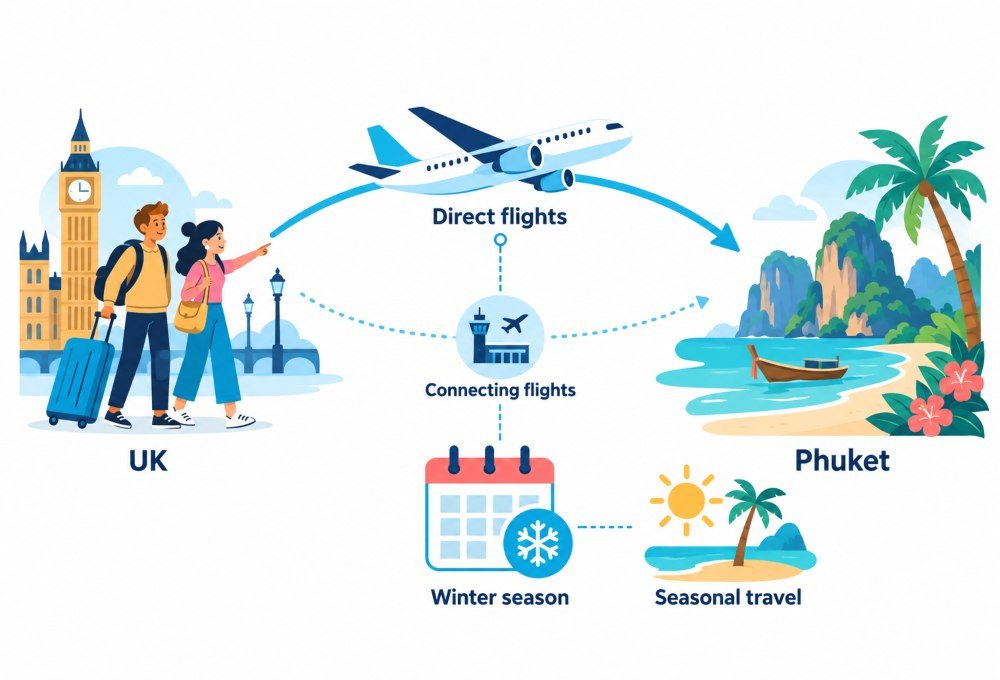
Reaching Phuket from the UK long meant a connection through Doha, Dubai, Istanbul, Singapore or Bangkok, with total door-to-gate journeys of fourteen to sixteen hours. That has changed. TUI has flown Gatwick to Phuket with Dreamliners for several seasons, and Virgin Atlantic began a Heathrow to Phuket service on 18 October 2026, operating three times a week on a Boeing 787-9. The flight itself runs a little over twelve hours, and Phuket is seven hours ahead of GMT, six when the UK is on British Summer Time.
The interesting part is what the schedule implies. These are winter season routes rather than year-round ones. Airlines put expensive aircraft where demand and weather are dependable, and no carrier has chosen to fly Britons directly into Phuket in August. That is the seasonal picture expressed in aeroplanes rather than rainfall charts, and it is worth more than any average.
March To Mid May: Heat, Songkran And The Last Of The Calm Sea
March is the last comfortable month before the heat arrives properly. By April, afternoons commonly reach 33°C or 34°C with humidity thickening ahead of the rains, and the shade stops helping much after about two in the afternoon.
April also brings Songkran, the Thai New Year, observed as a national holiday from 13 to 15 April and inscribed on UNESCO’s list of Intangible Cultural Heritage of Humanity in 2023. The listing describes the gentler side of it: the pouring of water as an act of cleansing and respect, the visits to elders, the bathing of Buddha images. In Patong it also becomes a multi-day water fight along Bangla Road conducted with hosepipes, buckets and total commitment. There is no opting out if you are on the street. Bring a waterproof phone pouch, leave your passport in the hotel safe, and do your temple visits in the morning before things escalate.
Sea conditions hold through April and into the first half of May, so this is still boat trip weather. Room rates soften noticeably once Songkran ends, making late April an underrated window: hot, certainly, but calm water, low rainfall and shoulder season pricing.
Mid May To October: The Green Season, Honestly Assessed
Rain in the green season is usually a matter of hours rather than days. Mornings are frequently bright, cloud stacks up after lunch, and an hour of serious rain clears the air by early evening. September is typically the wettest month of the year in Phuket, with August close behind.
The sea deserves more attention than the rain. The FCDO warns of strong riptides off Thai coasts, particularly during monsoon season, and Phuket’s west-facing beaches, Patong, Karon and Kata among them, take the swell head-on. Beaches operate a flag system, and a red flag means stay out of the water regardless of what anyone else is doing. The Royal Life Saving Society’s water safety guidance for holidays abroad is worth five minutes before you fly, particularly if children are swimming. Jellyfish also drift closer inshore between May and October.
Then there are the closures, which is where itineraries come unstuck. Mu Ko Similan and Mu Ko Surin national parks shut completely from 15 May to 15 October, a fixed annual decision by Thailand’s Department of National Parks that applies to every operator without exception. Maya Bay on Phi Phi Leh, along with Loh Samah and Lo Ko bays, closes every year from 1 August to 30 September. Phang Nga Bay, Phi Phi Don and the Khao Sok rainforest run all year, but the two trips that fill Instagram do not.
On health, dengue is the mosquito-borne risk that actually shapes a Thailand trip, and the Aedes mosquitoes that carry it feed during daylight rather than at dusk, which upends most of the advice British travellers absorb about evenings and bed nets. The National Travel Health Network and Centre’s country guidance for Thailand is the UK reference point and is worth reading alongside a GP or travel clinic appointment six to eight weeks before departure. In practice it means daytime repellent, not just something plugged in overnight.
The case for coming anyway is genuine. Room rates fall sharply, beaches empty, the interior turns properly green, waterfalls in Khao Sok run at full volume, and Kata and Kalim pick up surf. If budget is the binding constraint, June and early July usually offer the best ratio of price to weather.
Twelve Months At A Glance
- January. Driest, clearest, calmest. Peak season in full swing and priced accordingly.
- February. The connoisseur’s month. Peak weather, slightly softer prices than December.
- March. Warming up but still very manageable. Good value before the April heat.
- April. Hottest month. Songkran from the 13th to the 15th. Sea still calm.
- May. Two months in one. The first fortnight is fine, then the parks close on the 15th and the monsoon settles in.
- June. Green season proper, but sunny mornings are common. Often the best value of the year.
- July. Wetter, still workable, and the last month to see Maya Bay before it shuts.
- August. Heavy rain, rough seas, Maya Bay and the Similans both closed.
- September. Usually the wettest month. Lowest prices on the island.
- October. The turn. Maya Bay reopens on the 1st, the Similans on the 15th, direct UK flights resume mid-month.
- November. Peak season restarts. Clear skies, calmer seas, noticeably quieter than December.
- December. Excellent weather throughout, with prices climbing steeply from the middle of the month.
How Phuket’s Calendar Meets The UK School Year
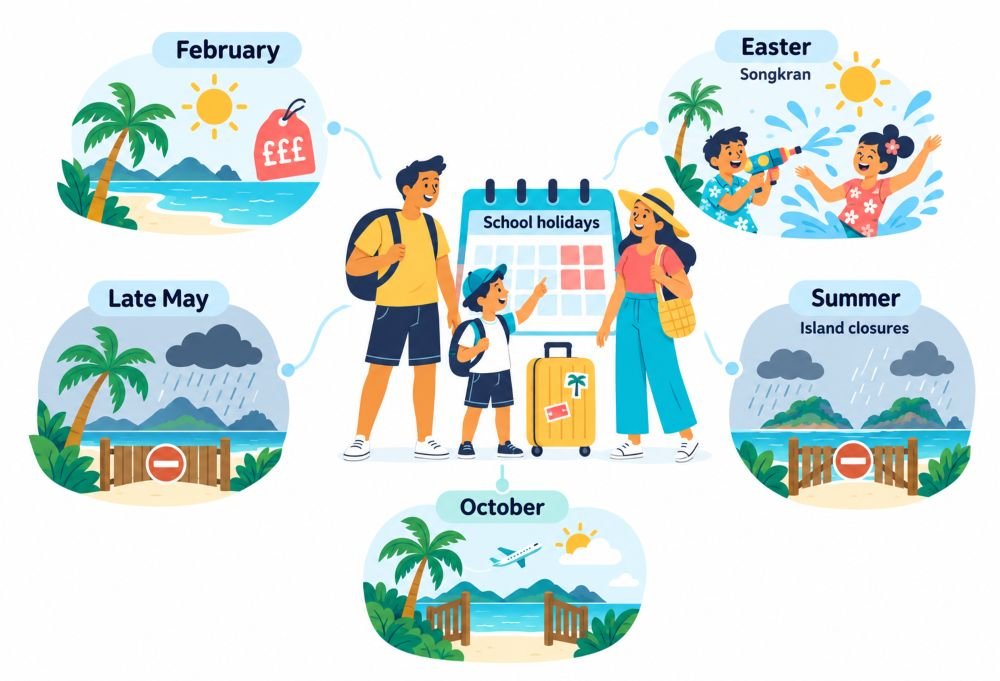
February half-term lands squarely in the finest fortnight of the Phuket year, which is why it books out early and why prices barely dip. It is worth the premium if you can absorb it.
The Easter break frequently brushes against Songkran, giving families a genuine cultural spectacle alongside the heat. Late May half-term is the awkward one: the monsoon has just begun, and the Similans closed a fortnight earlier.
The long summer holiday is the hard case. Late July to early September in England and Wales overlaps the wettest stretch of the Phuket year and the only window in which Maya Bay and the Similans are shut simultaneously. Scottish schools break up in late June and return in mid-August, which is a real advantage here, since an early July trip still catches Maya Bay before the 1 August closure. Term dates vary by council as well as by nation, so it is worth checking your own against the government’s school term and holiday dates service before you commit to a fortnight.
October half-term is the quiet winner. Maya Bay reopens on 1 October, the Similans on 15 October, the direct flights restart around the same time, and prices have not yet climbed towards Christmas. For a family wanting good weather, open islands and a bill that does not require a second look, it is the strongest week in the calendar.
Choosing A Base That Copes With Any Month
Where you stay matters far more in the green season than in January; in February, almost anywhere works. In August, a remote resort down a long road turns a two-hour downpour into a lost day, while a walkable base turns the same downpour into a long lunch.
Central Patong is the most forgiving option in that respect, with shops, restaurants, spas and covered markets within a few minutes on foot. Deevana Plaza in Phuket sits about five minutes’ walk from Patong Beach and a similar stretch from Jungceylon and the night markets, which is the kind of geography that lets you take the sand in the morning and be somewhere dry by three without needing a taxi.
Phuket Old Town is the other sensible answer, and an underrated one. The Sino-Portuguese shophouses along Thalang Road, the Sunday Walking Street market, the small museums and the coffee shops all function perfectly well in the rain, and the east side of the island sees less monsoon swell than the west coast beaches.
Five Minutes Of Admin Before You Book
Read the current FCDO advice for Thailand and sign up for its email alerts, since entry rules and regional warnings change without much notice. Take out travel insurance that explicitly covers what you plan to do, as diving, jet skis and scooter hire are common exclusions, and remember that a GHIC is worthless outside Europe. Vapes deserve a specific mention: possessing or using one in Thailand is illegal, with no exemption for tourists, and enforcement is real.
In the week before you fly, check the Thai Meteorological Department for forecasts and weather warnings rather than relying on a phone app’s monthly averages. And if a national park is the centrepiece of your trip, confirm the opening dates with your operator directly, because closures can begin early when the weather turns. Individual days get cancelled when the crossing is too rough.
Short Answer Guide
If you want the best weather full stop, go in February. If you want the best balance of weather, price and open islands, aim for the second half of October or for November. If you want Songkran, go in April and make peace with the heat. If cost is what decides it, go in June and pack for wet afternoons. And if the summer holidays are your only option, go anyway, but build the trip around Phang Nga Bay, Khao Sok and the Old Town rather than around a Maya Bay photograph you will not be able to take.
Phuket rewards most months of the year. It rewards a planned month considerably more.
This article is intended for general information only and does not constitute travel, medical, financial or legal advice. Weather patterns, national park opening dates, flight schedules, entry requirements and hotel pricing change frequently. Always check current FCDO travel advice and consult a GP or travel clinic about vaccinations and health precautions before travelling.
References
- Foreign, Commonwealth & Development Office. Thailand travel advice: Safety and security. GOV.UK. Updated 8 September 2026. https://www.gov.uk/foreign-travel-advice/thailand/safety-and-security
- Virgin Atlantic. Virgin Atlantic launches non-stop flights from London Heathrow to Phuket. Virgin Atlantic Corporate Newsroom, 30 October 2025. https://corporate.virginatlantic.com/gb/en/media/press-releases/virgin-atlantic-launches-flights-to-phuket.html
- UNESCO Intergovernmental Committee for the Safeguarding of the Intangible Cultural Heritage. Songkran in Thailand, traditional Thai New Year festival. Representative List of the Intangible Cultural Heritage of Humanity, inscribed 2023 (18.COM). https://ich.unesco.org/en/RL/songkran-in-thailand-traditional-thai-new-year-festival-01719
- Royal Life Saving Society UK. Water Safety on Holiday. RLSS UK. https://www.rlss.org.uk/safety-on-holiday
- The Nation Thailand. Similan and Surin islands shut for five-month annual closure. 30 June 2026. https://www.nationthailand.com/news/tourism/40066673
- National Travel Health Network and Centre (NaTHNaC). Thailand: travel health information for UK travellers. TravelHealthPro, updated 6 August 2026. https://travelhealthpro.org.uk/countries/thailand
- Department for Education. School term and holiday dates. GOV.UK. https://www.gov.uk/school-term-holiday-dates
- Thai Meteorological Department. Weather forecasts and warnings. https://www.tmd.go.th/en/
- The Nation Thailand. Maya Bay in Krabi to be closed to tourists from August 1. Hat Noppharat Thara-Mu Ko Phi Phi National Park annual closure announcement. https://www.nationthailand.com/news/tourism/40040034