


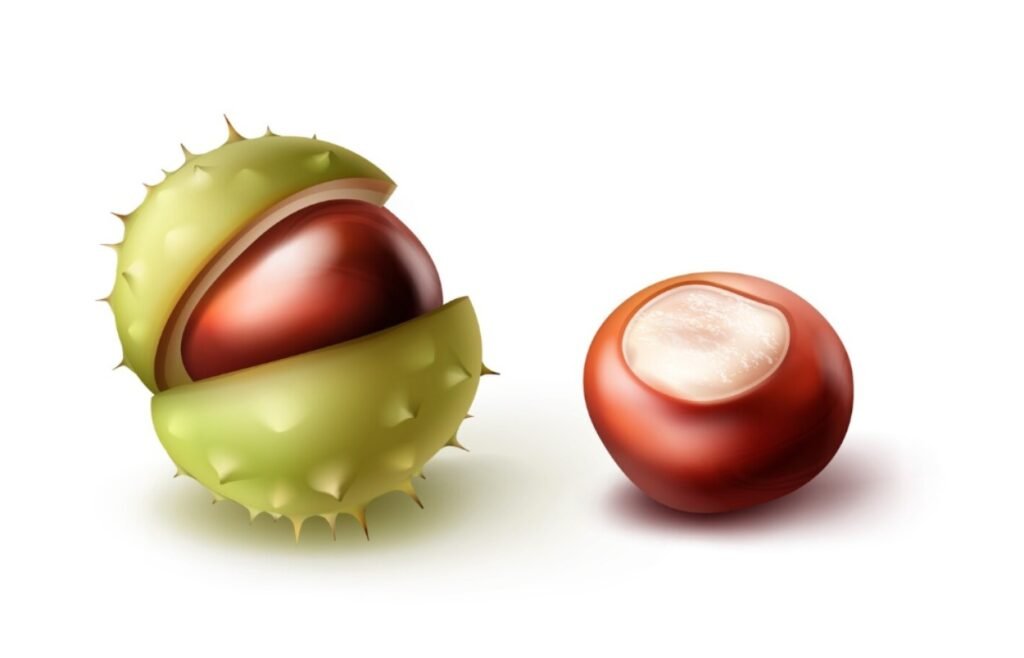
Horse chestnut extract is not a single raw material with one predictable composition. It is a preparation from the seeds of Aesculus hippocastanum L., and its performance depends on the extraction solvent, removal of unwanted constituents, concentration of triterpene glycosides, and final dosage form. For a product developer or buyer, the useful question is not simply whether a supplier offers “horse chestnut extract.” The useful question is what the extract is standardized to, how that marker is measured, and whether the safety controls match the intended use.
The distinction matters because raw horse chestnut plant parts contain toxic constituents, while standardized seed extracts are manufactured to remove or control those constituents. The European Medicines Agency describes preparations made by solvent extraction and subsequent concentration, while the U.S. National Center for Complementary and Integrative Health distinguishes standardized extracts from raw seeds, bark, flowers, and leaves. A product specification should preserve that distinction from the first sample through finished-goods release.
What Plant Material Is Used?
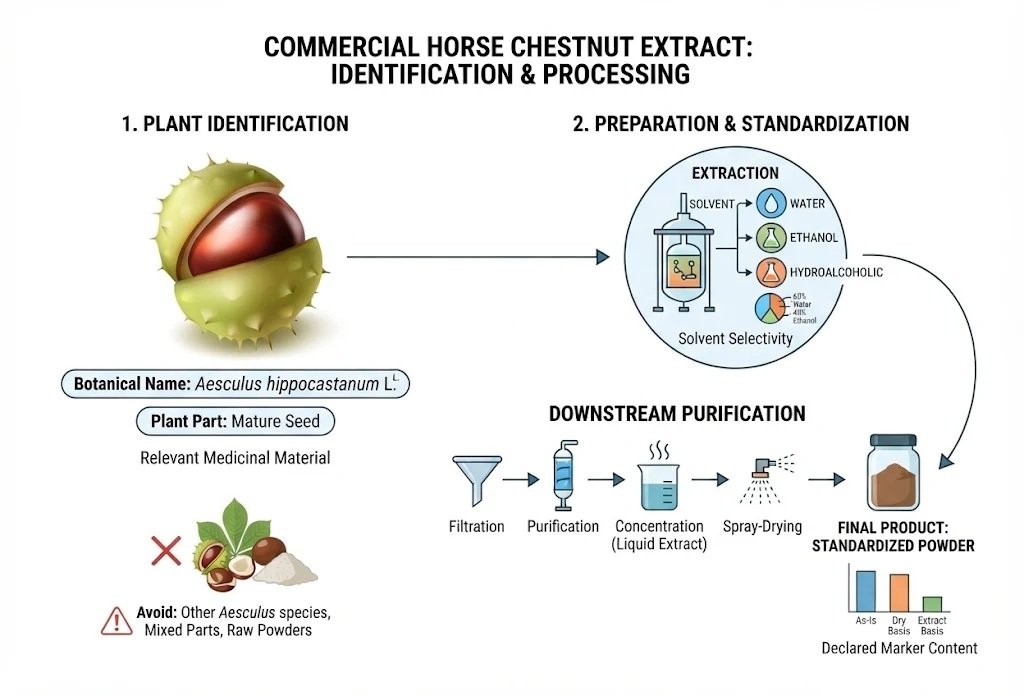
Commercial horse chestnut extract should be identified by botanical name, plant part, and preparation. The relevant plant is Aesculus hippocastanum L. and the relevant medicinal material is the mature seed. “Horse chestnut” should not be used as a substitute for a complete identity statement because other Aesculus species, mixed plant parts, or unprocessed powders can lead to a materially different safety and analytical profile.
The seed is normally extracted with water, ethanol, or a hydroalcoholic solvent. The selected solvent affects which compounds enter the extract and how much downstream purification is required. A liquid extract may be concentrated and dried to produce a powder. A spray-dried powder may also contain a carrier or processing aid, so the declared marker content should be stated on an agreed basis, such as as-is, dry basis, or extract basis.
Aescin Is A Marker, Not The Whole Product
Aescin is a group of triterpene saponins used to describe the principal standardized fraction in many horse chestnut preparations. It is useful for batch comparison, but it does not describe every constituent in the extract. The certificate of analysis should identify whether the result is reported as total triterpene glycosides, aescin, or another equivalent and should name the analytical method.
The EMA’s 2020 revised horse chestnut seed monograph gives a specific pharmaceutical example: dry extracts made with 40-80% (v/v) ethanol and standardized to 6.5-10% triterpene glycosides, calculated as protoaescigenin using an LC assay. An earlier monograph used a 16-28% range calculated as aescin by a photometric method. That older number has a different analytical basis and should not be compared directly with the revised range. Other listed preparations have their own solvents and specifications; the extract identity must match the intended product and market.
| Specification item | Why it matters | What to confirm |
| Botanical identity | Confirms the plant and plant part | Aesculus hippocastanum L., mature seed, with authentication method |
| Extraction solvent | Changes the extract profile and residual-solvent risk | Solvent composition, extraction ratio, and concentration steps |
| Marker content | Allows lot-to-lot comparison | Aescin or total triterpene glycosides, reporting basis, method |
| Unwanted constituents | Raw material can contain toxic components | Removal or control strategy and related test result |
| Physical form | Affects handling and formulation | Liquid, dry extract, carrier, moisture, particle size, flow |
Why Standardization Changes Formulation Decisions
Two powders with the same botanical name can have different marker concentrations and different excipient loads. A low-marker powder may require a larger inclusion rate to reach the intended formulation level. A high-marker powder may reduce the amount of extract needed but can bring a different taste, color, bulk density, or solubility profile. The formula should therefore be written around the declared marker and the actual extract ratio, not only around the gross powder weight.
For capsules and tablets, developers normally examine powder flow, bulk density, moisture, particle size, and blend uniformity. A sticky or hygroscopic extract may need a carrier or granulation step. A dark or astringent extract may affect tablet appearance or a beverage’s sensory profile. If a supplier changes the carrier, drying temperature, or marker target, the change can affect both the active-equivalent calculation and the process behavior.
For liquid products, the solvent residue, pH, color, sedimentation, and compatibility with preservatives deserve separate checks. A clear solution at release does not prove that the marker remains stable during storage. Stability studies should use the final container, concentration, pH, oxygen exposure, and temperature profile rather than a simple raw-material hold test.
How The Extract Is Tested
Identity testing can combine macroscopic or microscopic examination of the seed material, botanical authentication, and chromatographic fingerprinting. A marker assay may use a validated photometric method or liquid chromatography, depending on the agreed specification and the product category. The method should define the reference standard, sample preparation, calculation basis, and system-suitability criteria.
A practical batch review usually separates four questions:
- Is the material really the specified plant and plant part?
- Does the extract contain the declared marker range?
- Were toxic or unwanted constituents removed or controlled?
- Will the powder or liquid behave consistently in the intended formula?
Microbiological limits, heavy metals or elemental impurities, pesticide residues, residual solvents, and adulterant screening should be selected according to the market and dosage form. The ICH quality guidelines, including Q3C on residual solvents and Q3D on elemental impurities, are a common reference point. Not every specification needs every possible test, but every listed test should have a reason. A long certificate with no defined acceptance basis is less useful than a shorter certificate linked to the formulation risk.
What Safety Information Must Stay Visible?
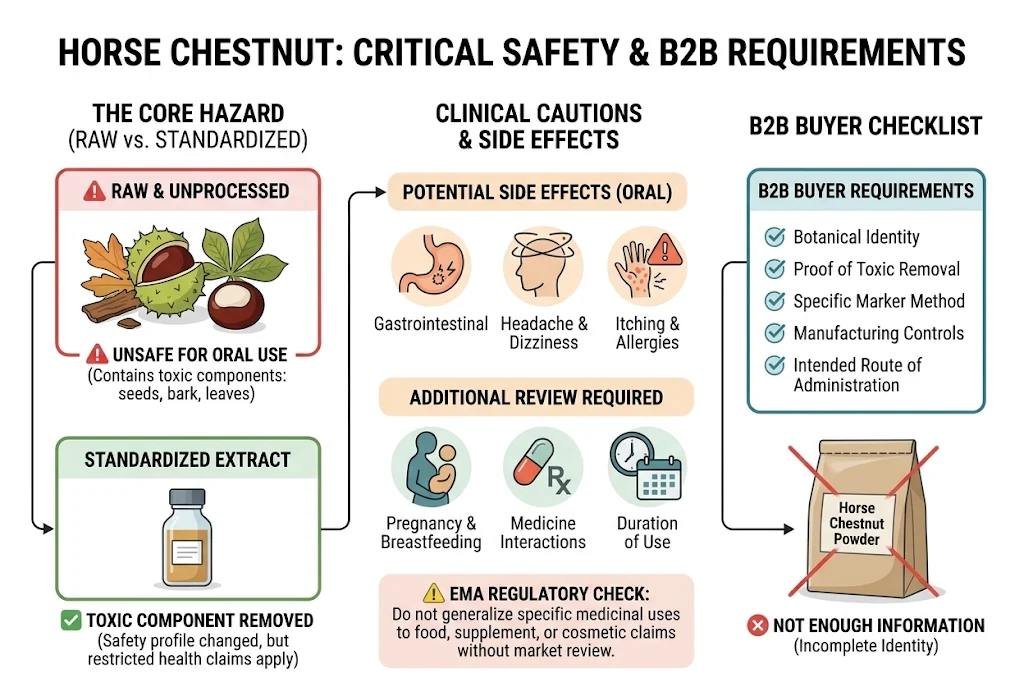
The raw seeds and other unprocessed plant parts are not equivalent to a standardized extract. NCCIH warns that raw horse chestnut seeds, bark, flowers, and leaves are unsafe for oral use because they contain a toxic component. Standardized seed extracts from which that component has been removed have a different safety profile, but short-term tolerability does not support an unrestricted health claim.
The EMA has evaluated horse chestnut seed preparations for specific traditional or well-established medicinal uses in defined products. That evidence should not be copied into a general food, cosmetic, or supplement claim without checking the destination market and product category. Side effects reported for oral preparations include gastrointestinal symptoms, headache, dizziness, itching, and allergic reactions. Pregnancy, breastfeeding, medicine interactions, and duration of use require additional professional review.
For a B2B buyer, the safety conversation should include the botanical identity, removal of toxic constituents, marker method, manufacturing controls, and intended route of administration. A supplier that provides only a generic “horse chestnut powder” description has not supplied enough information for a responsible product decision.
How To Compare Two Supplier Samples
Start with the label and the certificate, then compare the samples under the same conditions. Record the extract ratio, solvent, marker content, carrier, moisture method, particle-size range, and packaging. Reconstitute or disperse both samples at the intended use level and observe color, sediment, pH, and marker recovery. For a solid dosage form, run a small blend and check flow, fill variation, compression behavior, and content uniformity.
The comparison should also include a change-control question. Will the supplier notify the buyer if the seed origin, extraction solvent, carrier, marker target, or test method changes? A stable specification is valuable only when the supplier can maintain and communicate it. A technically strong sample does not compensate for an unclear change-notification process.
To build a supplier shortlist, teams can use PharmaSources to look for horse chestnut seed extracts. Before approving a sample, request the plant-part identity, extraction solvent, drug-to-extract ratio, marker basis, assay method, and a representative certificate of analysis. The final material decision still depends on the intended product, local requirements, and the buyer’s own verification testing.
Conclusion
Horse chestnut extract should be treated as a defined botanical preparation, not as an interchangeable plant powder. The plant part, solvent, purification steps, marker basis, safety controls, and dosage form all affect whether one lot can replace another. A useful specification names those variables and connects them to the tests that will be used for release and stability.
FAQs
| Question | Answer |
|---|---|
| Is Raw Horse Chestnut Seed The Same As Standardized Horse Chestnut Extract? | No. Raw seeds and other unprocessed plant parts may contain toxic constituents. Standardized seed extract is manufactured and tested to control its composition, often with a defined triterpene glycoside or aescin range. |
| What Does Aescin Percentage Tell A Buyer? | It provides a marker for comparing batches and calculating the amount of extract used in a formula. The certificate should also specify the reference basis, analytical method, and whether the result represents total triterpene glycosides or a specific aescin calculation. |
| Can One Horse Chestnut Extract Replace Another At The Same Weight? | Not automatically. Marker concentration, solvent history, carrier, moisture, particle size, and extraction profile can differ. Substitution should be supported by comparative testing in the intended product. |
Disclaimer: This article is for informational purposes only and does not constitute medical, pharmaceutical or regulatory advice. Horse chestnut raw materials and extracts can differ in composition and safety. Consult qualified professionals and verify applicable regulatory requirements before selecting, manufacturing or using any horse chestnut preparation.