



There is a specific kind of British person who noticed something odd on their phone this summer. They fly out to Calgary or Edmonton every few months. They kept a betting account opened years ago from a flat in Manchester or Cardiff. And at some point after the middle of July, that account started behaving differently on the Canadian leg of the trip. Sites that used to load stopped loading. Unfamiliar logos appeared where familiar ones had been.
Nothing had gone wrong with the phone. Alberta had stopped tolerating a grey market and built a licensed one in its place, and the moment it did, the rules governing that person’s play began to change depending on which side of the Atlantic they happened to be standing.
For anyone who plays across two jurisdictions, three things changed on 13 July. A legal, licensed alternative to offshore sites now exists in Alberta. It arrives with player protections that are genuinely substantial but strictly local. And not one of those protections recognises a British account, just as nothing you have set up in Britain reaches an Alberta one. Everything below follows from those three facts.
What Actually Happened On 13 July
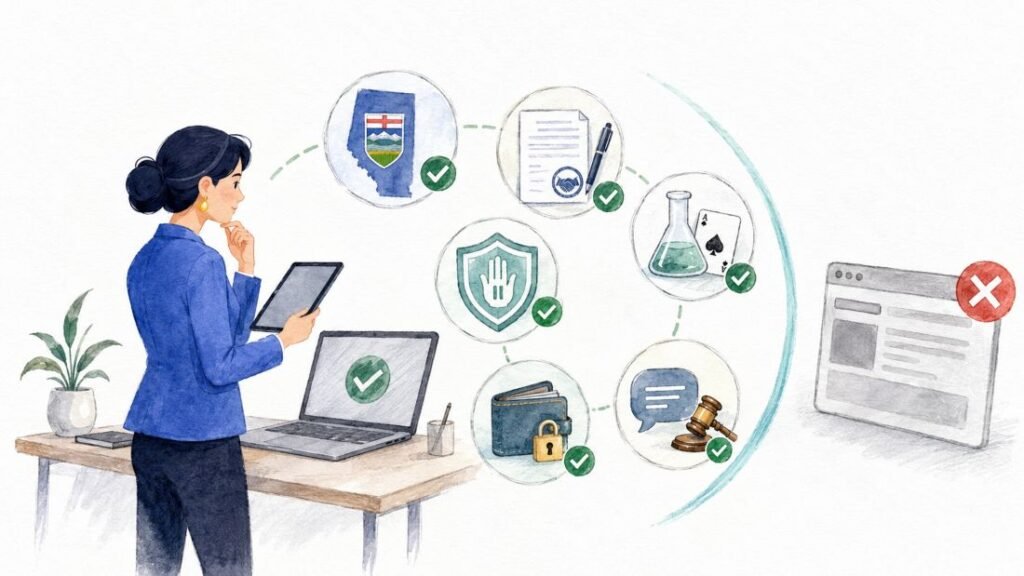
Alberta’s regulated online casino and sports betting market went live on 13 July 2026, with the Alberta iGaming Corporation overseeing the market and Alberta Gaming, Liquor and Cannabis acting as its regulator. Before that date, the only lawful option in the province was Play Alberta, the government’s own platform. Everything else sat offshore: no local licence, no local recourse, no obligation to anyone in Edmonton.
The scale of that grey market is the reason the province bothered. By the government’s own estimate, unregulated operators had taken roughly 70% of Alberta’s total iGaming market before the framework came in. This was never a case of building a market from nothing. It was a case of putting a fence around one that already existed, which is a considerably harder job and explains why the rollout took as long as it did.
British readers who followed Ontario’s opening in April 2022 will recognise the shape of it. Alberta is only the second Canadian province to let private operators compete under provincial oversight, and it borrowed Ontario’s architecture fairly directly. The Government of Alberta’s iGaming Strategy is worth reading if you want the official account rather than the industry commentary.
Two Organisations, And Why The Distinction Matters
Great Britain runs a single-regulator model. One body, the Gambling Commission, issues the licences, writes the conditions and takes the enforcement action. Alberta splits that work in two, and confusing the halves will send you looking for information in the wrong place.
AGLC is the regulator. It vets operators, writes the technical standards and runs the province’s centralised self-exclusion system. The Alberta iGaming Corporation is the commercial counterparty: it signs the operating agreements, governs revenue sharing, and handles anti-money laundering oversight and financial reporting. As of 13 July, every operator must hold an AGLC registration and have signed a commercial agreement with AiGC. One without the other is not enough, and AGLC’s iGaming guidance is blunt about the difference between the two bodies, largely because people kept mixing them up.
If your instinct is to do what you would do at home and pull up the Gambling Commission’s public register to check a name, the instinct is right, but the destination is wrong. Alberta has an equivalent. It is simply not the same list, and there are two boxes to tick rather than one.
A Licence Follows Your Feet, Not Your Passport
This is the part that catches people out, and it is worth stating plainly: a gambling licence attaches to where your body is at the moment you place the bet. Not your nationality. Not your billing address. Not the country where you opened the account.
A UK-licensed account and an Alberta-licensed account are two separate relationships with two separate regulators, and neither knows anything about the other. Cross a border, and the terms shift under you. That applies to internal Canadian borders too. A licensed Alberta site will block you the moment you drive into British Columbia or Saskatchewan, not only when you fly home to Gatwick.
It also pays to stop treating Canada as a single jurisdiction. Alberta’s minimum age is 18, which happens to match Great Britain. Ontario’s is 19. Assuming the Canadian rules are uniform because the country is one country is the same error as assuming Great Britain and Northern Ireland share a gambling regulator, which they do not.
Protections You Rely On Do Not Travel
Here is the sharpest practical consequence. GAMSTOP binds operators licensed in Great Britain and nobody else. It lets you self-exclude from every gambling website and app run by a business licensed in Great Britain for a period of your choosing, and the Gambling Commission maintains a list of free multi-operator self-exclusion schemes covering online play, betting shops and land-based casinos. An Alberta-licensed operator sits entirely outside that perimeter. It has no interface to the register, no duty to query it and no reason to.
The reverse is equally true. AGLC’s centralised self-exclusion programme covers registered Alberta iGaming sites, land-based casinos and racing entertainment centres in a single request, and it does precisely nothing for an account you hold in Britain.
Anyone whose life genuinely runs across both markets should know both sets of numbers before they need them, rather than searching for them under pressure. In Alberta, the GameSense Info Line connects callers to an advisor who can also walk them through self-exclusion, and the wider AGLC responsible gambling programme sits behind it. In Britain, the National Gambling Helpline run by GamCare is free and staffed around the clock: two countries, two systems, no overlap between them.
Where The Two Rulebooks Genuinely Diverge
Beyond self-exclusion, the substantive rules differ in ways that will surprise a British player.
- Stake caps. Great Britain now limits online slots at the level of the individual spin. A £5 maximum applies to adults aged 25 and over, with a £2 maximum for 18-to 24-year-olds, following the Government’s decision on stake limits for online slots. Alberta has no equivalent statutory per-spin ceiling. What it has instead is a ban on autoplay and on running several games at once, which is stricter than most markets and goes after a different mechanism of harm entirely.
- Advertising and bonuses. This one is genuinely counterintuitive. Under Alberta’s rules, only the operator itself may communicate promotional terms, either on its own site or directly to players who have opted in to hear from it. A comparison site cannot publish an operator’s bonus terms at all. British affiliates face no such prohibition, provided they stay within the CAP codes and the relevant licence conditions.
- Tax. No meaningful difference. Neither country taxes recreational winnings, though Canada carves out professional gamblers under federal tax law.
- Payments. Licensed Alberta operators are barred from accepting cryptocurrency. Interac dominates instead, which is unfamiliar territory for anyone whose habit is a UK debit card and a five-second checkout.
What A Cross-Border Bettor Should Check Before Playing

The genuine upside of a regulated market is that verification became possible in a way it simply was not before July. Look for AGLC registration, a signed AiGC agreement, and the AiGC logo, which registered operators must display on advertising material. Games have to be certified by an independent accredited testing laboratory before they go live, and every operator must integrate with the centralised self-exclusion system as a condition of registration.
For a current view of which brands have cleared both hurdles, comparison sites such as Online-Casinos.com track the AGLC-registered casinos live in the province. Keep the advertising restriction in mind as you read: anything about a specific offer has to come from the operator’s own promotions page, so treat the absence of bonus detail on a comparison site as compliance rather than an oversight.
If a site is not on the approved list, the reasoning is straightforward. Your balance would not sit in a segregated account, there would be no complaints route, and self-exclusion would not reach it.
A Market Still Under Construction
Dozens of companies completed registration ahead of launch, but only around twenty were genuinely ready to take customers on day one, and the roster has kept moving since. AiGC reports on the market’s progress, so the list of licensed sites will keep changing for a good while yet. Ontario’s trajectory hints at the shape it may take: that market’s monthly handle grew roughly tenfold between its 2022 launch and 2025.
For anyone splitting the year between Britain and the prairies, the practical rule survives all of this detail intact. Check the licence that applies to where you actually are, not where you are from, and check it before you deposit rather than after something has gone wrong. The passport in your drawer has no opinion on the matter.
Disclaimer: This article is general information and not gambling, legal, financial, or tax advice. Online gambling is age-restricted and governed by the licensing rules of the jurisdiction you are physically in, not the country of your citizenship. The rules described here were accurate at the time of writing and are subject to change. If gambling is starting to feel difficult to control, free and confidential support is available through GameSense in Alberta, and through GAMSTOP, GamCare and the National Gambling Helpline in Great Britain.
References
- Government of Alberta. Alberta’s iGaming Strategy. Government of Alberta, 2026. https://www.alberta.ca/albertas-igaming-strategy
- Alberta Gaming, Liquor and Cannabis. iGaming. AGLC, 2026. https://aglc.ca/igaming
- Alberta iGaming Corporation. About Alberta iGaming Corporation. AiGC, 2026. https://www.abigaming.ca/about/
- Alberta Gaming, Liquor and Cannabis. Responsible Gambling. AGLC, 2026. https://aglc.ca/gaming/responsible-gambling
- GameSense by AGLC. Contact Us. Alberta Gaming, Liquor and Cannabis, 2026. https://gamesenseab.ca/contact-us
- Gambling Commission. Public Register. Gambling Commission, Great Britain. https://www.gamblingcommission.gov.uk/public-and-players/public-register
- Gambling Commission. Free Multi-Operator and National Self-Exclusion Schemes. Gambling Commission, Great Britain. https://www.gamblingcommission.gov.uk/public-and-players/page/free-multi-operator-and-national-self-exclusion-schemes
- Department for Culture, Media and Sport. New £2 Maximum Stake for Under 25s Playing Online Slots. GOV.UK, 23 February 2024. https://www.gov.uk/government/news/new-2-maximum-stake-for-under-25s-playing-online-slots
- GamCare. National Gambling Helpline. GamCare, 2026. https://www.gamcare.org.uk/
- Online-Casinos.com. Best Online Casinos in Alberta. Online-Casinos.com, 6 August 2026. https://www.online-casinos.com/canada/alberta/