



There is a familiar sequence in British homes. The downstairs loo starts gurgling when the washing machine empties. The shower drains a little slower each week. Then one Tuesday the maintenance hole in the back garden is full to the rim, somebody gets a quote for digging up half the patio, and the number on it is genuinely alarming.
What almost nobody does at that point is ask the question that decides everything else: whose pipe is it?
In England and Wales, the answer is frequently not the homeowner’s, and has not been since 2011. Getting that wrong is the single most expensive mistake in domestic drainage, and it is the reason a camera survey pays for itself long before anyone picks up a spade.
Question To Settle Before You Accept Any Quote
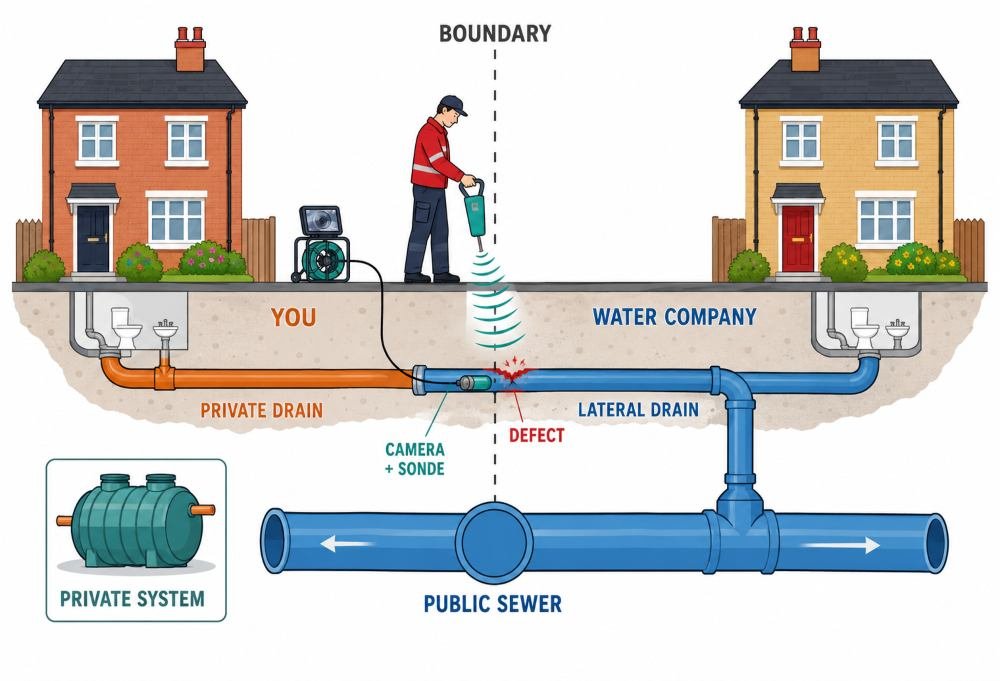
The vocabulary matters here because it has legal consequences. A drain serves one property. A sewer serves two or more. A lateral drain is the stretch of your drain that continues past your boundary before it joins the public sewer.
On 1 October 2011, the majority of private sewers and lateral drains in England and Wales transferred into public ownership. Water UK’s guidance on the transfer sets out what moved across, and Ofwat’s explanation of public and private sewers puts the practical position: the drains and private sewers carrying household waste are the householder’s responsibility up to the point they connect with the public sewer, which since the transfer is usually at the property boundary. Roughly 200,000 kilometres of pipework changed hands. Before that date, a collapsed shared run under a terrace could be split five ways between disputing neighbours. A House of Commons Library briefing from the time noted that most householders had no idea the pipe was theirs at all, and that their insurance was unlikely to cover it.
So the practical rule for most properties is this. Inside your boundary, serving only you, it is yours. Past the boundary, or shared with a neighbour, it is very probably your water company’s, and they will investigate and repair at no cost to you.
| Where the defect sits | Usually responsible |
| Inside your boundary, serving your property alone | You |
| Past your boundary, before the public sewer (lateral drain) | Water company |
| Shared run serving two or more properties | Water company |
| Public sewer in the road or open ground | Water company |
| Shared septic tank or private treatment plant | Owners, never transferred |
| Pipework connected after July 2011 and never adopted | Usually still private |
This is precisely the thing a survey resolves. A drain pipe inspection camera fitted with a sonde lets an operator trace the camera head from above ground and mark the defect’s position on the surface, which converts a vague “there’s a blockage somewhere out the back” into a measured distance from a known chamber and a point either side of a boundary line. That distinction is the whole ball game. Ring the water company before you agree to pay anybody, and if the fault turns out to be theirs, the job costs you nothing.
What The Camera Actually Sees In British Housing Stock
The defect list in most international guides is generic. British drainage has its own recurring cast, and it maps closely to when the house was built.
Victorian and Edwardian terraces typically run salt-glazed vitrified clay in short lengths with mortar joints. Clay itself lasts remarkably well, but the joints open as the ground moves, and open joints are an invitation. Anything planted within reach will find them, which is why a mature street lime or a willow anywhere near the run is a standing risk to a whole street’s drainage.
Post-war housing brings a different problem. Pitch fibre pipe, made from compressed wood cellulose impregnated with coal tar pitch, was installed widely across UK estates from the 1950s into the 1970s as a cheap, light alternative to clay. It came in long lengths, it was quick to lay, and it had a working life of roughly forty to fifty years, which means essentially all of it is now past its design life. It fails recognisably: the inner layers delaminate and blister, the pipe softens and deforms under soil pressure into an oval, and the narrowed, roughened bore catches everything that passes. Anyone buying a house built between 1950 and 1980 should treat this as a live possibility rather than an exotic one. It also changes the repair approach, because aggressive rodding or high-pressure jetting can strip the blistered inner wall and make a salvageable pipe worse.
Then there is the modern layer, which is fat and wet wipes. The two combine into the deposits that block domestic runs and, at scale, produce the fatbergs that make the news.
Telling these apart on a screen is a lighting problem more than a resolution problem. Underground pipe has no ambient light at all, and the difference between a hairline fracture, a delaminating blister and a smear of congealed grease is a matter of how the surface catches the light. A sewer camera with LED lights that can be dimmed as well as brightened matters more than most buyers expect, because a fixed bright array will blow out the highlights in a 100mm domestic pipe while being nowhere near enough in a 225mm shared run. Adjustability is the specification that actually affects diagnosis.
Report Is The Product, Not The Video
This is where a great deal of UK drainage content goes quiet, and it is the part that separates a professional survey from a bloke with a camera.
British CCTV drainage surveys are coded to the Water Research Centre’s Manual of Sewer Condition Classification, currently in its fifth edition and universally referred to as MSCC5, which sits on top of the European coding standard BS EN 13508-2. The UK Society for Trenchless Technology explains why the standard exists: it turns one operator’s subjective impression into data that another engineer, in another year, in another part of the country, can read and compare.
In practice, it means every observation gets a code and a severity grade from 1 to 5, split into structural and service conditions. Grade 1 is cosmetic. Grade 5 means severe damage or imminent collapse. Water companies, insurers, conveyancers and Building Control all read this format without needing anything explained to them. A report that says “there’s a crack at about ten metres” and nothing else is not a survey, and it will not support an insurance claim, a build-over application or an adoption agreement.
The coding is also a competence question, not just a software one. Surveyors classifying to MSCC5 hold the relevant WRc certification, and reports submitted for water company work are expected to reflect that. If you are commissioning a survey, ask which standard the report is coded to before you book. If you are buying equipment for professional use, the recording and reporting workflow matters as much as the camera head.
Buying A Property: What Your Survey Does Not Cover
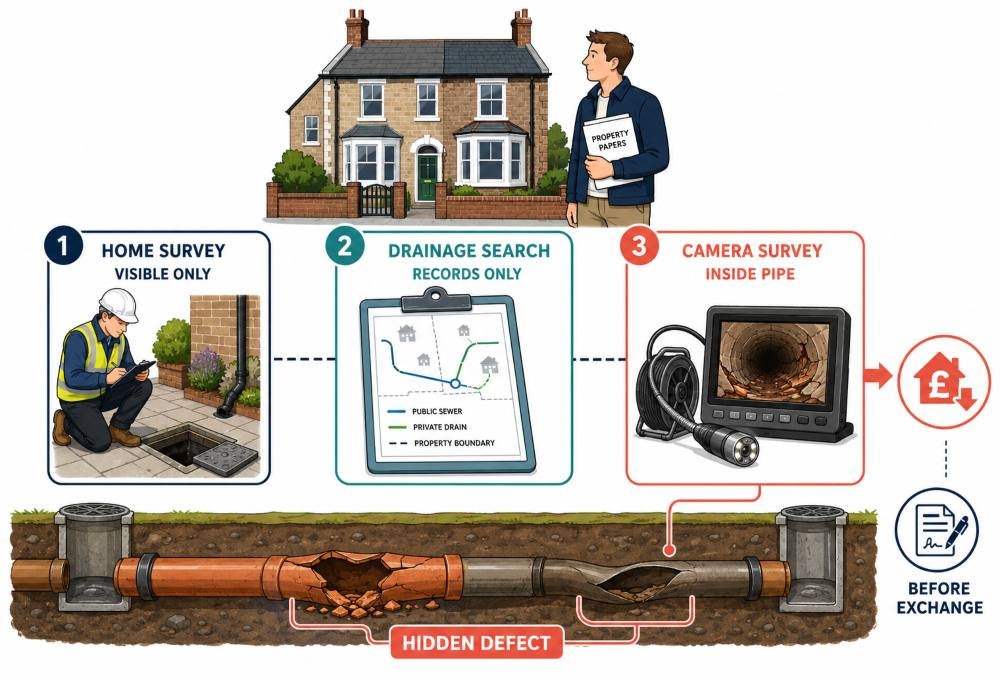
A widespread and expensive assumption among UK buyers is that the homebuyer’s survey covers the drains. It does not, and the standards say so plainly.
Under the RICS Home Survey Standard, the surveyor reports on what can be seen. Even at Level 3, the most detailed residential survey available, drainage is inspected only to the extent it is visible and is not tested beyond normal operation. In reality, that means lifting whatever chamber covers can be found and looking in. Covers under decking, a conservatory, a shed or a parked car do not get lifted, and nothing at all is seen inside the pipe.
The conveyancing search does not fill the gap either. The CON29DW drainage and water search, launched by the Law Society in 2002 and compiled from the water company’s own records, answers a standardised set of enquiries about how the property connects to the public network, whether a public sewer runs within the boundary, and who bills for what. That is genuinely useful information, and it is entirely about the public network’s records. It says nothing whatsoever about the condition of the private pipework you are about to own.
So on an older property, particularly a mid-century one, a camera survey is the only thing that looks inside the pipes before you exchange. On a purchase where pitch fibre or a collapsed clay run turns up, it is the difference between negotiating the price down and discovering the problem yourself two winters later.
Extensions, Build-Overs And Part H
Anyone extending needs to know what runs under the proposed footprint before the foundations are designed rather than after.
Approved Document H of the Building Regulations covers drainage and waste disposal in England, including guidance on building over and around sewers. Because the 2011 transfer moved so much pipework into public ownership, a great many houses now sit near, or over, an asset belonging to the water company, and extending across it requires a build-over agreement. Water companies typically want a recent CCTV survey as part of that application, dated within the last few months. Discovering this at foundation stage is considerably worse than discovering it at drawing stage.
Safety Case, Which Is Not Really Optional
For professional users, there is an argument here that has nothing to do with cost.
Enclosed drains and sewers are confined spaces in law. HSE guidance on confined spaces is unambiguous that entry should be avoided wherever it is reasonably practicable to do the work from outside, and remote inspection is the textbook way of achieving that. The Confined Spaces Regulations 1997 name sewers explicitly. People have died in them, including would-be rescuers going in after colleagues.
A camera is not a safety accessory bolted onto a diagnostic tool. For a drainage contractor it is often the control measure that makes entry unnecessary in the first place, and where entry genuinely cannot be avoided, it is what allows the work to be planned properly rather than discovered on the way in.
Specifying Kit That Suits The Work
Cable length and price are the easiest things to compare and among the least useful.
For domestic work in 100mm to 150mm pipe, a push rod system with a self-levelling head is the standard tool, and thirty metres of reasonably stiff rod handles most terraced and semi-detached runs from a rear chamber to the boundary. For larger shared runs and commercial work, a crawler unit earns its keep. The features that change day-to-day outcomes are a built-in sonde for above-ground tracing, genuine ingress protection on the head rather than a marketing claim about waterproofing, adjustable lighting, and recording that produces files you can actually put into a report. Battery life matters more in the UK than the spec sheet suggests, because a great many British inspection chambers are in back gardens with no power and no vehicle access.
Maintenance is dull and decisive. Rinse and dry the head after every job, run the rod through your hands looking for damage as you recoil it, and charge before storage rather than before the next call-out. Camera heads fail at the seals, and seals fail faster on kit that goes back in the van wet.
Short Version
A drainage camera is not really a plumbing accessory. It is an evidence-gathering tool, and in the UK the evidence answers three separate questions that each carry money: what is wrong, exactly where it sits relative to your boundary, and whether the water company, the insurer or Building Control will accept the resulting report.
Answer those before anyone starts digging. On a good proportion of British properties, the honest answer to the second one is that the problem was never yours to pay for.
Disclaimer: This article is general information rather than legal, technical or professional advice. Drainage ownership rules described apply to England and Wales; arrangements differ in Scotland and Northern Ireland, and exceptions exist for unadopted pipework, private roads and leasehold arrangements. Confirm your own position with your water and sewerage company before commissioning or paying for work. Work in drains and sewers carries serious risk and should be carried out by competent persons following current HSE guidance.