



Langley has become one of the most popular places to live in British Columbia, especially for people who want more space, a quieter lifestyle, and easy access to nature while still staying connected to the wider Vancouver area.
For UK readers, Langley can feel like a good balance between town life and outdoor living. It has neighbourhoods with schools, parks, shops, cafes, farms, walking trails, and family-friendly streets, but it is still close enough to other major areas for work, travel, and weekend plans.
Moving from the UK to Langley is exciting, but it also needs careful planning. You may need to think about immigration paperwork, healthcare, schools, driving, banking, insurance, housing, and shipping your belongings overseas.
Where Is Langley?
Langley is located in British Columbia’s Lower Mainland, east of Vancouver and close to Surrey, Abbotsford, and the Fraser Valley.
When people talk about Langley, they are often referring to two separate areas:
| Area | What It Means |
|---|---|
| City of Langley | A smaller urban centre with shops, services, parks, apartments, restaurants, and transport links |
| Township of Langley | A much larger area with neighbourhoods, rural roads, farms, green spaces, and family communities |
Both areas have their own advantages. The best option depends on your budget, work location, family needs, and lifestyle.
Why So Many People Are Moving to Langley
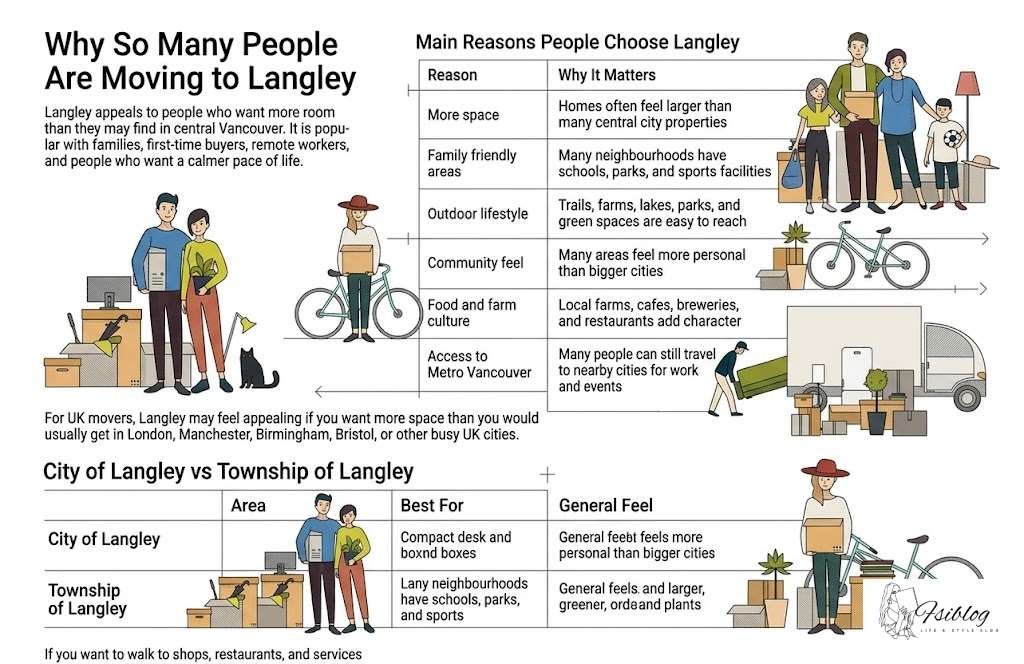
Langley appeals to people who want more room than they may find in central Vancouver. It is popular with families, first-time buyers, remote workers, and people who want a calmer pace of life.
Main Reasons People Choose Langley
| Reason | Why It Matters |
|---|---|
| More space | Homes often feel larger than many central city properties |
| Family friendly areas | Many neighbourhoods have schools, parks, and sports facilities |
| Outdoor lifestyle | Trails, farms, lakes, parks, and green spaces are easy to reach |
| Community feel | Many areas feel more personal than bigger cities |
| Food and farm culture | Local farms, cafes, breweries, and restaurants add character |
| Access to Metro Vancouver | Many people can still travel to nearby cities for work and events |
For UK movers, Langley may feel appealing if you want more space than you would usually get in London, Manchester, Birmingham, Bristol, or other busy UK cities.
City of Langley vs Township of Langley
Before choosing a home, it helps to understand the difference between the City and the Township.
| Area | Best For | General Feel |
|---|---|---|
| City of Langley | People who want convenience, shops, services, and a more urban lifestyle | Compact and practical |
| Township of Langley | Families, space seekers, rural lifestyle buyers, and people wanting quieter neighbourhoods | Larger, greener, and more varied |
If you want to walk to shops, restaurants, and services, the City of Langley may suit you better. If you want a larger home, quieter streets, or a more rural feel, the Township may be a better fit.
Best Langley Neighbourhoods to Consider
Langley is not one single type of place. Each neighbourhood has a different style, price range, and pace of life.
Willoughby
Willoughby is one of Langley’s fastest-growing areas. It has newer homes, townhouses, apartments, schools, shops, and family-focused developments.
Good for:
- Young families
- First-time buyers
- Newer housing
- People who want shops nearby
- Commuters who need access to major roads
Things to consider:
- It can feel busy because of fast growth
- Some areas may have construction nearby
- Traffic can be heavier at peak times
Walnut Grove
Walnut Grove is popular with families because it has schools, parks, recreation facilities, and established residential streets.
Good for:
- Families with children
- People who want a settled neighbourhood
- Access to major roads
- Parks and sports facilities
Things to consider:
- Homes can be competitive
- Some properties may be older and need updates
Fort Langley
Fort Langley is one of the most charming parts of the area. It has heritage character, independent shops, cafes, river walks, and a village-style atmosphere.
Good for:
- People who love character areas
- Weekend walks and cafes
- Historic charm
- A slower village feel
Things to consider:
- It can be more expensive
- Housing choice may be more limited
- It may not suit people who want a very urban lifestyle
Aldergrove
Aldergrove has a more relaxed and semi-rural feel. It can appeal to people who want more space and a quieter setting.
Good for:
- Buyers looking for better value
- Families who like a quieter area
- People who want access to farms and open spaces
- Those who do not need to commute daily to Vancouver
Things to consider:
- It is farther from Vancouver
- Public transport may be less convenient
- You may rely more on a car
Brookswood
Brookswood is known for leafy streets, larger lots, and a quieter residential feel.
Good for:
- Families wanting detached homes
- People who value privacy
- Buyers who want established neighbourhoods
- Those who prefer a suburban lifestyle
Things to consider:
- Some homes may be older
- Daily errands may require more driving
What UK Movers Should Know Before Choosing Langley
Moving from the UK to British Columbia is different from moving within the UK. You need to think beyond the property itself.
Important Questions to Ask First
| Question | Why It Matters |
|---|---|
| What immigration status will I have? | It affects work, study, healthcare, and long term planning |
| Will I need to commute? | Langley is outside central Vancouver, so travel time matters |
| Do I need schools nearby? | School catchment areas can affect where families choose to live |
| Will I drive? | Many parts of Langley are easier with a car |
| Can I manage healthcare before full coverage begins? | New residents may need private cover at first |
| Am I renting or buying first? | Renting first can help you learn the area before committing |
Immigration and Work Planning
Before moving, make sure you understand your legal route into Canada. Some people move through work permits, study permits, family sponsorship, permanent residence, or other immigration programmes.
Do not rely only on social media advice. Immigration rules can change, and your situation may depend on your age, job type, qualifications, family status, finances, and long-term plans.
If your move depends on work, check whether your job, employer, permit, or professional qualification will be accepted in Canada. Some industries may require Canadian licences, local experience, or extra paperwork.
Cost of Living: What to Expect
Langley can be more affordable than Vancouver, but it is not cheap. Housing, insurance, food, petrol, childcare, and utilities can still feel expensive compared with many UK towns.
Costs to Research Before Moving
- Rent or mortgage payments
- Home insurance or tenant insurance
- Car insurance
- Fuel and parking
- Groceries
- Childcare
- Mobile phone plans
- Internet
- Utilities
- Healthcare cover before full provincial coverage begins
- School supplies and activities
- Shipping costs from the UK
For many UK families, the biggest adjustment is not only the rent or house price. It is the total monthly cost once transport, insurance, groceries, and childcare are included.
Renting First vs Buying Straight Away
Many UK movers choose to rent first. This gives you time to understand Langley’s neighbourhoods, commute times, school areas, and daily routines before buying.
Renting First May Help If You
- Are new to Canada
- Do not know the neighbourhoods yet
- Need time to build a Canadian credit history
- Want to compare schools
- Are still deciding between Langley, Surrey, Abbotsford, Coquitlam, or Vancouver
- Are waiting for permanent employment
Buying straight away can work, but it is usually safer when you already understand the area and have good professional advice.
Getting Around Langley
Langley is easier if you drive, especially in the Township and more rural areas. Public transport is available, but travel can take longer than in central Vancouver.
Many residents use a car for school runs, shopping, appointments, and commuting. If you are used to strong public transport in parts of the UK, this may be an adjustment.
Transport Points to Consider
| Topic | Why It Matters |
|---|---|
| Driving | Useful for most daily routines |
| Public transport | Available, but not equally convenient in every area |
| Commuting | Travel times can change with traffic |
| Parking | Usually easier than central Vancouver, but still worth checking |
| Future transport projects | May improve links over time, but construction can affect traffic |
Driving in BC for UK Movers
If you are moving from the UK and plan to drive in British Columbia, check the driving rules before you arrive.
You may need to switch to a BC driving licence after becoming a resident. It is also sensible to bring proof of your UK driving experience because it can help with licensing and insurance.
Driving Checklist Before Leaving the UK
- Check that your UK licence is valid
- Gather proof of driving experience
- Request driving history documents if needed
- Research BC car insurance costs
- Learn local road rules
- Understand winter driving conditions
- Decide whether buying a car in BC is better than importing one
Driving in BC can feel different from the UK because roads are wider, vehicles are often larger, distances are greater, and winter conditions can be more serious in some areas.
Healthcare in British Columbia
British Columbia has a public healthcare system, but new residents may need to apply and wait before full coverage begins. Because of this, many people arrange private health cover for their first period in Canada.
Healthcare Tasks After Arriving
- Apply for provincial healthcare as soon as possible
- Arrange private health cover for the early period
- Keep copies of prescriptions
- Bring medical records, where possible
- Look for a local family doctor or clinic
- Learn where your nearest urgent care centre is
- Understand what is and is not covered
For families, it is worth organising healthcare paperwork before the move, especially if anyone has regular prescriptions or ongoing medical needs.
Schools and Family Life
Langley is popular with families, but school planning still matters. Catchment areas, available places, commute times, and after-school activities can all affect your decision.
What UK Parents Should Check
| Topic | Why It Matters |
|---|---|
| School catchment | Your address can affect school placement |
| Year group comparison | UK school years do not match Canadian grades exactly |
| Documents | Schools may ask for records, ID, and immigration documents |
| Transport | Some children may need driving or transit support |
| Activities | Sports, clubs, and music can help children settle |
| Childcare | Spaces can be limited and may need early planning |
Children often adjust well, but the first few months can still feel big. Keeping some routines familiar can help.
Weather and Lifestyle Differences
Langley has milder winters than many parts of Canada, but it is still different from the UK.
What UK Movers May Notice
- Winters can be rainy and damp
- Snow is possible, but not constant every winter
- Summers can be warmer and drier than many parts of the UK
- Wildfire smoke can affect air quality in some summers
- Outdoor life is a big part of BC culture
- Distances feel larger than in many UK towns
- Car ownership is more common in suburban areas
If you enjoy walking, cycling, lakes, mountains, farms, and outdoor weekends, Langley can be a strong fit.
How to Plan Your Move to Langley Without Stress
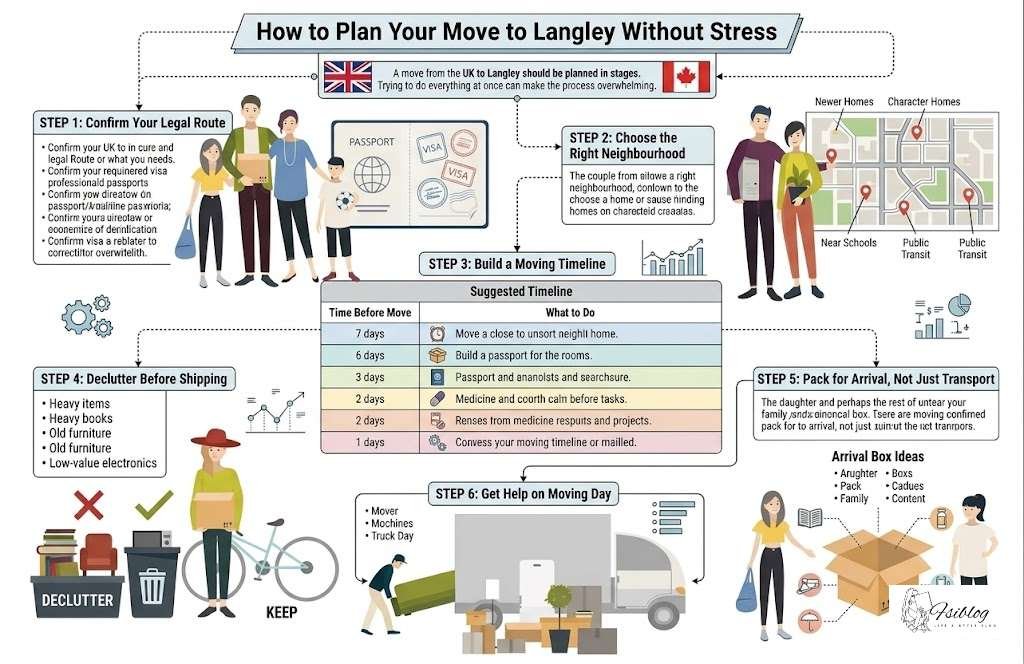
A move from the UK to Langley should be planned in stages. Trying to do everything at once can make the process overwhelming.
Step 1: Confirm Your Legal Route
Before booking flights or shipping furniture, confirm your visa, work permit, study permit, permanent residence status, or other legal route.
You should know:
- When you can enter Canada
- Whether you can work
- Whether your partner can work
- Whether children can study
- How long can you stay
- What documents must you carry on arrival
Step 2: Choose the Right Neighbourhood
Do not choose Langley only because someone online said it is a good place to live. Think about your real daily life.
Ask yourself:
- Where will I work?
- How long is the commute?
- Will I drive every day?
- Do I need schools nearby?
- Do I want a newer home or an older character home?
- Do I want a town feel or more land?
- Is public transport important?
- How close do I want to be to Vancouver?
Step 3: Build a Moving Timeline
A UK to Canada move needs more time than a local move. Ideally, start planning several months in advance.
Suggested Timeline
| Time Before Move | What to Do |
|---|---|
| Three to six months | Confirm immigration route, research areas, check job options, review finances |
| Two to three months | Sort belongings, get shipping quotes, collect documents, research schools |
| Six to eight weeks | Book movers, arrange temporary accommodation, organise medical records |
| Four weeks | Start packing non essential items, cancel UK services, set up travel insurance |
| Two weeks | Confirm flights, accommodation, transport, and arrival documents |
| First week in BC | Apply for healthcare, start licence steps, set up bank account, phone, and utilities |
Step 4: Declutter Before Shipping
International shipping can be expensive. The less you bring, the easier the move becomes.
What to Review Carefully
- Old furniture
- Heavy books
- Low-value electronics
- Clothes you rarely wear
- Children’s outgrown items
- Kitchen duplicates
- Large items that may not suit Canadian homes
- Anything that costs more to ship than to replace
Before shipping electrical items, check the voltage, plugs, and whether the item is worth bringing.
Step 5: Pack for Arrival, Not Just Transport
Your first few weeks in Langley may be busy. Pack essentials separately so you are not searching through boxes.
Arrival Box Ideas
- Passports and immigration papers
- Birth certificates and marriage documents
- Driving records
- Medical records and prescriptions
- School records
- Chargers and adapters
- Basic clothing for the season
- Toiletries
- Important contact details
- Printed address details for your first accommodation
Step 6: Get Help on Moving Day
Moving is tiring even when it is local. When you are arriving from the UK, dealing with jet lag, paperwork, children, luggage, and unfamiliar roads can make it harder.
Hiring experienced Langley movers can make the local part of the move easier, especially if you have furniture, stairs, fragile items, or a limited time to settle in.
First Week Checklist After Arriving in Langley
| Task | Why It Matters |
|---|---|
| Apply for healthcare | Registration should not be delayed |
| Arrange private health cover | Useful before full provincial coverage begins |
| Open a bank account | Helps with rent, bills, salary, and daily payments |
| Get a Canadian SIM card | Needed for local calls, banking, and appointments |
| Start driving licence steps | New residents may have a limited time to switch |
| Register children for school | School placement can take planning |
| Set up utilities | Electricity, gas, water, internet, and waste services may need action |
| Learn local routes | Test school runs and work commutes before you need them |
| Visit nearby shops and clinics | Helps the area feel familiar faster |
Common Mistakes to Avoid
- Assuming Langley is the same everywhere
- Forgetting that the City of Langley and the Township of Langley are different
- Underestimating commute times
- Moving without private healthcare cover for the early period
- Shipping too much from the UK
- Not checking school catchment areas
- Waiting too long to deal with driving paperwork
- Forgetting that Canadian credit history takes time to build
- Choosing a home before understanding the area
- Ignoring traffic and construction near major routes
Is Langley Right for You?
Langley may be a good fit if you want:
- More space than central Vancouver
- A family-friendly lifestyle
- Access to parks, farms, trails, and local food
- A quieter base with links to Metro Vancouver
- A mix of suburban, urban, and rural choices
- A place that is growing and changing
Langley may not be ideal if you need:
- A quick daily commute to downtown Vancouver
- A car-free lifestyle in every neighbourhood
- Big city nightlife on your doorstep
- The lowest possible housing costs
- A fully settled area with no construction or growth pressure
Final Thoughts
Moving to Langley, BC, can be a great choice for UK families, professionals, and individuals who want more space, access to nature, and a strong community feel while staying connected to the wider Vancouver region.
The key is preparation. Choose your neighbourhood carefully, understand your immigration route, plan healthcare cover, research schools, organise driving documents, and give yourself enough time to settle.
Langley is growing quickly, but it still offers a lifestyle that many people find calmer, greener, and more spacious than central city living. With the right planning, your move does not have to feel chaotic. It can be the start of a practical, exciting, and well-organised new chapter.