


Sarah didn’t wake up one day wanting to be a “wellness person.”
It happened out of desperation.
She had tried everything people usually try when stress starts winning: CBD oil that made her feel fuzzy, meditation apps she abandoned after three days, and a drawer full of herbal supplements that promised calm and delivered… nothing.
Between marking Year 10 papers and surviving endless parent meetings at her West London school, her evenings stopped feeling like rest and started feeling like overtime without pay.
Wine helped, briefly.
Then came the groggy mornings that made everything worse.
One Friday afternoon, a colleague casually mentioned something called “THCA tea.”
Sarah stared at her blankly. She genuinely had no idea what that even meant.
What’s This Stuff Actually
THCA stands for tetrahydrocannabinolic acid, which sounds terrifying if you don’t know what it is. Here’s the simple version.
THCA is the raw form of THC naturally found in hemp plants. But unlike THC, it does not get you high. Not even a little.
It only turns into psychoactive THC when exposed to very high heat, like smoking or baking.
If you steep it gently in hot water as you would with regular tea, the temperature is nowhere near high enough to trigger that change. You still get potential wellness benefits, but zero intoxication.
And yes, this matters; it is legal in the UK.
THCA itself isn’t controlled under the Misuse of Drugs Act. As long as the product contains less than 0.2% THC and is used as tea, it falls within legal boundaries.
Sarah checked this obsessively.
Teachers don’t take chances with legal grey areas.
First Cup Nerves

She ordered a sample anyway.
Nervous doesn’t even cover it; she was honestly anxious about it. What if it tasted awful? What if it made her feel strange? What if it was just another wellness gimmick?
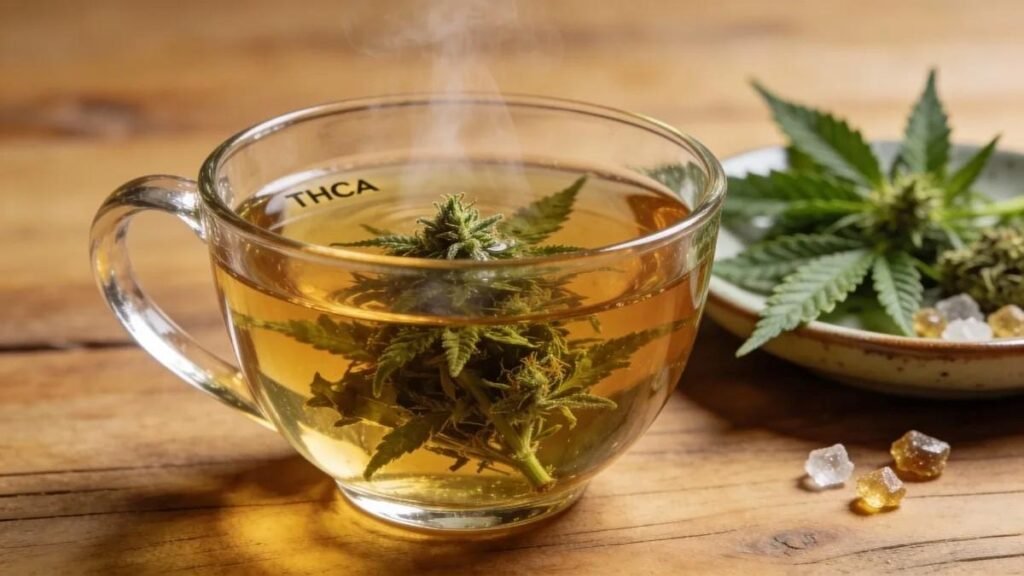
The instructions were simple: steep for five minutes in hot water.
She decided to try it on a Friday night, a safer timing.
The smell was earthy, slightly herbal. Not disgusting, just unfamiliar compared to her usual strong black tea.
She took a cautious sip.
Nothing dramatic happened.
Then, slowly, a gentle warmth spread through her body over about twenty minutes. Her shoulders loosened. Her thoughts slowed to a stop.
She finished the cup while reading.
For the first time in weeks, she wasn’t mentally juggling lesson plans, emails, and marking deadlines all at once. She was just… reading.
That night, she slept deeply.
Building The Habit
One solid night proves nothing. Sarah committed to two weeks straight.
Her evening routine formed naturally:
- 6:45pm – Home. Strips out of work clothes immediately. Physical transition matters more than you’d think.
- 7:10pm – Makes THCA tea. Small strainer, five-minute steep. The ritual itself calms her before the first sip even happens.
- 7:15pm – Sits properly. Phone away, laptop shut, marking ignored. Just tea.
- 7:30pm – The shift kicks in here. Subtle, like someone dialling down the volume on her internal chaos.
- 8:00pm – Whatever comes next flows with more presence. Less manic energy.
Consistency made the difference. Not some magic instant fix. Daily practice rewiring how she transitions between work brain and home brain.
CBD Comparison
| Aspect | CBD | THCA |
|---|---|---|
| Primary interaction (simplified) | Mainly associated with CB2 receptors linked to inflammation and stress responses | Interacts differently with the endocannabinoid system in its raw form |
| Psychoactive effects | Non-psychoactive | Non-psychoactive (when not exposed to high heat) |
| Overall feeling | Calm, often sedating | Calm, but mentally clear |
| Energy level | Can feel sleepy or heavy for some people | Relaxed without feeling slowed down |
| Mental state | Quiet, sometimes foggy | Quiet, but sharp and present |
| Best suited for | Evening wind-down, rest, sleep support | Stress decompression without loss of focus |
| User experience summary | “Forced to shut down” | “Choosing to slow down” |
London Life Problem
London doesn’t rest.
The Tube runs late, cafés open early, and emails never stop.
People get rewarded for being “always on” and quietly punished for having boundaries.
Most professionals end up coming home wired, relying on wine, TV, or mindless scrolling to take the edge off.
THCA tea offered Sarah something else: real decompression, not distraction.
Science Bits
Research on THCA is still emerging, but early findings suggest:
- It is non-psychoactive without heat activation
- It may have anti-inflammatory properties.
- It shows potential neuroprotective effects.
There aren’t decades of clinical trials yet, but there is enough evidence, plus centuries of hemp tea tradition, to take it seriously.
Who Benefits
After three months, Sarah felt clearer about who should try this.
It may help if you:
- Struggle to switch off after work
- Want to reduce evening alcohol.
- Feel “tired but wired” at night.
- Want calm without brain fog.
Probably skip it if:
- You face workplace drug testing
- You’re pregnant or breastfeeding.
- You take medications that interact with cannabinoids.
Absolutely avoid if:
- You’re a professional athlete (WADA banned THCA in 2025)
- You work in military or zero-tolerance environments.
Practical Info
Cost
Quality THCA tea typically costs £30–£50, covering around two to three weeks of daily use. More expensive than regular tea, but broadly in line with well-made CBD products.
Taste
Expect an earthy, herbal profile, sometimes with subtle citrus notes depending on the blend. Honey or lemon pairs well if you prefer a softer, sweeter cup.
When to Drink
Most people find evenings work best for unwinding, though some use it in the morning for calmer starts. Personal timing matters—experiment and observe.
Storage
Store in a cool, dry place away from direct sunlight. Excess heat can degrade THCA over time.
Preparation
Keep it simple:
- Hot water (not boiling)
- Steep for five minutes
- Strain and drink
Onset & Duration
Effects are typically noticed within 20–30 minutes, peak around 45–60 minutes, and may last two to three hours, depending on the individual.
Reality Check
Honesty time. THCA tea didn’t make Sarah’s job less stressful. Challenging students stay challenging. Parent emails still arrive at annoying times. The marking pile hasn’t shrunk.
Hasn’t eliminated all sleep issues either. Occasional rough nights still happen.
What changed? She processes stress better now. Created clear boundaries between work and home. Evenings feel like hers again rather than work bleeding into everything.
Good enough.
Three Months On
Most significant change isn’t flashy. It’s cumulative.
Better sleep most nights. Less morning dread. More patience with difficult students. Weekends feel fuller because she’s not dragging five days of unprocessed stress into them.
Colleagues noticed. “You seem chilled out lately,” one said. “What changed?”
Everything and nothing. Same person, same job, same chaos. Just found a tool that helps her meet challenges without total depletion.
Worth Trying?
Only you know. Everyone’s stress hits differently.
London professionals feeling constantly drained, who tried the usual wellness stuff and found it useless, who are curious about plant-based approaches but sceptical of hype, THCA tea might be worth exploring.
Start small. Try consistently for two weeks. Notice how you feel cumulatively, not just immediately.
Remember, it’s just tea. Legal, gentle, reversible if it flops.
Worst case? You’re out £40 and drank some herbal tea. Best case? You finally crack how to decompress after brutal days in London properly.
Tuesday 8pm
Sarah writes this at 8pm on a Tuesday. Earlier, she taught six lessons, handled a crisis, and sat through an overrunning staff meeting.
She’s home with an empty THCA tea cup beside her. Shoulders loose. Jaw relaxed. Not thinking about tomorrow’s lessons or next week’s chaos.
Just there. Present. Calm. Herself.
That’s the real win. Not fixing everything. Reclaiming evenings. Reminding yourself you’re more than your job, your productivity, your endless list.
Reading this at the end of another exhausting day? Consider considering.
Disclaimer: This reflects observed experiences with THCA tea and isn’t medical advice. THCA is legal in the UK when used as directed for tea prep. Always consult healthcare professionals before trying new wellness products, especially if taking meds, pregnant, breastfeeding, or subject to workplace drug testing.