



Money is one of those topics that can easily make your eyes glaze over. But when it directly affects how much of your income you keep at the end of the year, it becomes much more interesting. For UK families who own rental properties, run businesses from home, or are thinking about investing in property, understanding the tax reliefs available can make a meaningful difference to household finances.
Many people assume tax savings are only for large businesses or wealthy investors. In reality, everyday families often qualify for valuable reliefs but do not realise they exist. With the cost of living continuing to rise across the UK, knowing how to reduce your tax bill legally can help free up money for savings, family goals, or long-term investments.
Why Property and Tax Matter for UK Families


For most households, property represents the largest financial asset they will ever own. Whether it is the family home, a buy-to-let investment, or a building used for business purposes, the way that property is taxed can significantly affect long-term wealth.
Many UK families rely on property income to:
- Supplement their salary
- Build retirement savings
- Support children’s education costs
- Create long-term financial security
However, without understanding the tax system, it is easy to pay more tax than necessary.
A few common reasons families miss out on tax savings include:
- Assuming their accountant has already claimed everything available
- Not knowing certain expenses qualify for deductions
- Failing to keep proper records of property-related costs
- Being unaware of specialised tax reliefs
Learning the basics does not require expert-level knowledge of the tax code. But knowing which reliefs exist and when to seek professional advice can make a major difference.
Understanding Capital Allowances for Property Owners
One of the most valuable yet underused tax reliefs available to property owners is capital allowances.
In simple terms, capital allowances allow property owners to claim tax relief on certain assets and fixtures within a property. These are items that are essential to the function of the building but may not immediately appear obvious as deductible costs.
If you own a commercial property or certain types of rental property, you may be able to claim capital allowances on things like:
- Electrical systems
- Heating systems
- Lighting installations
- Fire alarms and security systems
- Air conditioning
- Lifts and escalators
- Kitchens and fitted furniture
- Bathroom fittings
- Insulation and energy systems
Instead of paying tax on income that has effectively already been spent on these elements, the tax system allows you to deduct qualifying costs from your taxable profits.
For many property owners, the value of these claims can be surprisingly high.
How Capital Allowances Work in Practice
To understand why capital allowances matter, it helps to look at how they affect taxable income.
Imagine a landlord earning £25,000 per year from a rental property. If a portion of the building contains qualifying fixtures worth £40,000, those costs may potentially be claimed as allowances depending on eligibility and property type.
This could reduce the landlord’s taxable profits significantly in the relevant tax year.
While exact calculations depend on individual circumstances, the principle is simple.
If you spend money on qualifying items within an income-generating property, the tax system may allow you to deduct those costs before calculating your tax liability.
Many families are unaware that these allowances may still be claimed even if the property was purchased several years ago.
Which Properties Can Qualify for Capital Allowances
A common misconception is that capital allowances only apply to large commercial developments. In reality, a wide range of properties may qualify depending on how they are used.
Properties that may be eligible include:
Commercial buildings
Examples include:
- Offices
- Shops
- Restaurants
- Warehouses
- Industrial buildings
- Medical practices
These properties typically contain a large number of qualifying fixtures and installations.
Furnished holiday lets
Holiday rental properties that meet HMRC criteria for furnished holiday lets may also qualify for capital allowance claims on certain fixtures and equipment.
Mixed-use properties
Buildings that combine residential and commercial elements can sometimes qualify for allowances relating to the commercial portion.
Because the rules can be complex, property owners often use specialist surveyors or tax professionals to assess the building and identify qualifying assets.
Retrospective Claims: Recovering Allowances From Previous Years
One of the most interesting aspects of capital allowances is that claims may sometimes be made retrospectively.
This means property owners who purchased buildings years ago may still be able to identify unclaimed allowances that were never included in their tax calculations.
In many cases, this involves:
- Conducting a specialist property survey
- Identifying qualifying fixtures
- Assigning values to those fixtures
- Amending tax calculations accordingly
For some investors, these retrospective claims can result in significant tax savings.
This is why specialist advice is often recommended when dealing with property tax matters.
Running a Business From Home and Claiming Expenses
Since the pandemic, working from home has become far more common across the UK.
Many families now operate small businesses, freelance work, or online shops directly from their homes.
If you run a business from home, you can claim a portion of household costs as business expenses.
These can include:
- Electricity and heating
- Broadband and internet
- Phone usage
- Office equipment
- Stationery and supplies
In some cases, a proportion of mortgage interest or rent may also be claimed, depending on how much of the property is used for business purposes.
For example, if one room in a five-room house is used regularly as an office, a percentage of household bills may be deductible.
It is important to keep clear records and speak with an accountant to ensure claims are calculated correctly.
Buy to Let Property: Tax Changes UK Landlords Should Understand
Buy-to-let has long been a popular investment strategy for UK families. The concept is simple.
Purchase a property, rent it out, and use the rental income to cover mortgage costs while the property increases in value over time.
However, the tax landscape for landlords has changed significantly in recent years.
Key changes include:
Mortgage interest relief changes
Mortgage interest can no longer be fully deducted from rental income in the same way it once was. Instead, landlords receive a tax credit based on interest payments.
Higher stamp duty for additional properties
Purchasing additional residential properties in the UK typically includes a stamp duty surcharge.
Increased compliance requirements
Landlords must now meet stricter regulations relating to:
- Energy performance certificates
- Tenant rights
- Property safety requirements
Because of these changes, tax planning has become more important than ever.
Understanding available deductions, expenses, and reliefs can help ensure that property investments remain profitable.
Allowable Expenses Landlords Should Not Overlook
In addition to capital allowances, landlords can deduct a range of ordinary expenses from their rental income.
Common allowable expenses include:
- Letting agent fees
- Property maintenance and repairs
- Insurance policies
- Ground rent and service charges
- Legal fees for tenancy agreements
- Advertising for tenants
- Council tax during vacant periods
- Accountant fees
Many landlords underestimate the total value of these deductions over the course of a year.
Teaching Children About Property and Financial Literacy
Owning property also provides an opportunity to teach children about money and long-term financial planning.
Conversations about property ownership can introduce concepts such as:
- Saving for deposits
- Mortgage repayments
- Rental income
- Investment risk
- Tax and government policy
Teenagers in particular can benefit from understanding how property investments work.
Schools rarely cover practical financial education in depth, yet these lessons become essential in adult life.
Helping children understand how assets generate income can build valuable financial awareness early on.
When It Is Worth Speaking to a Property Tax Specialist

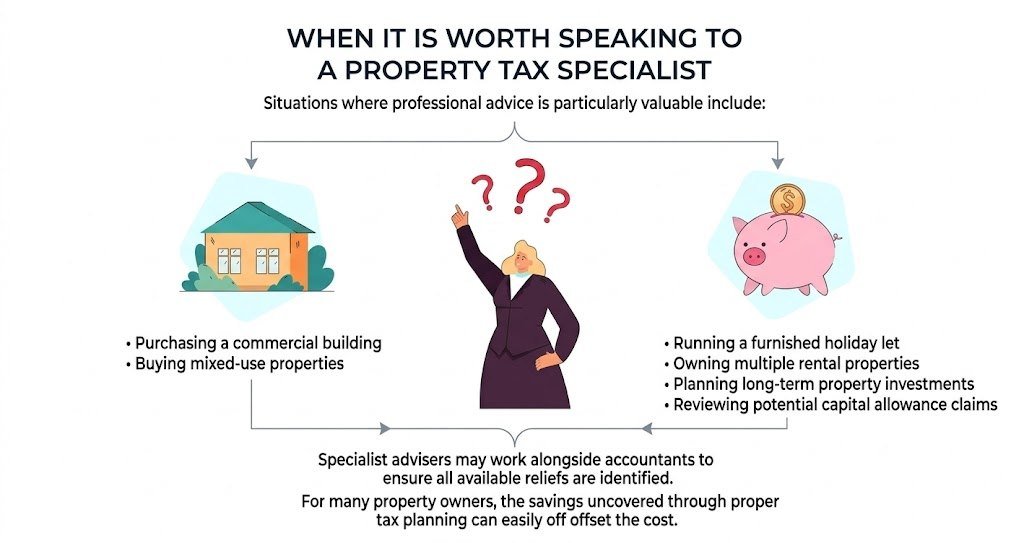
While many basic tax deductions are straightforward, property taxes can become complicated quickly.
Situations where professional advice is particularly valuable include:
- Purchasing a commercial building
- Buying mixed-use properties
- Running a furnished holiday let
- Owning multiple rental properties
- Planning long-term property investments
- Reviewing potential capital allowance claims
Specialist advisers may work alongside accountants to ensure all available reliefs are identified.
For many property owners, the savings uncovered through proper tax planning can easily outweigh the cost of professional advice.
Practical Steps UK Families Can Take Today
If you own property or run a business from home, a few simple steps can help improve your tax efficiency.
| Step | What to Do | Why It Matters |
|---|---|---|
| Review your property expenses | Look back over the past year and identify all costs related to maintaining or operating your property. | This helps ensure you do not miss any deductible expenses when calculating taxable income. |
| Keep organised records | Maintain digital copies of receipts, invoices, and maintenance costs. | Well organised records make it easier to support claims and avoid issues if HMRC ever reviews your accounts. |
| Speak with your accountant | Ask specifically whether capital allowances or additional property related deductions may apply. | Accountants can help identify tax reliefs that you may not be aware of and ensure everything is claimed correctly. |
| Consider a property tax review | Specialist property tax advisers can sometimes identify reliefs that general accountants may not explore in detail. | A professional review may uncover additional tax savings, especially for commercial or complex properties. |
| Plan future investments carefully | Before purchasing another property, consider tax implications alongside potential renta |
Conclusion
Property ownership can be a powerful way for UK families to build financial stability and long-term wealth. But the benefits of property investment depend heavily on understanding the tax system that surrounds it.
Many families unknowingly miss out on reliefs that could significantly reduce their tax bill. From everyday landlord expenses to more specialised claims such as capital allowances, there are legitimate opportunities to improve your financial position.
The key is awareness.
By learning the basics, keeping good records, and seeking professional advice when necessary, property owners can make more informed decisions and ensure that more of their hard-earned income stays where it belongs with their family.
For households navigating rising costs and planning for the future, making the most of available tax reliefs is one of the smartest financial steps you can take.