


When an engine control unit fails, it rarely gives much warning. One wet morning the car cranks but won’t fire. Or the dashboard lights up like a fruit machine, the engine cuts out at a roundabout, and the garage’s diagnostic tool simply reports “no communication”. Water ingress, a failed component on the circuit board or a long-running wiring fault can all leave the ECU unable to do its job.
Then comes the second shock. Most drivers assume that if a part breaks, you buy the same part and fit it. With an ECU, that logic falls apart. Immobilisers became standard on new cars sold in the UK in the late 1990s, and they did a great deal to bring down the old hot-wiring style of car theft. The catch is that the engine computer is now part of that security chain. When you turn the key or press the start button, the car runs a quick check to confirm the ECU is the exact unit it was paired with. A different unit, even one with an identical part number from the same model, fails that check, and the engine stays dead.
The main dealer answer is usually a brand new unit, ordered from the manufacturer, then coded to your car and keys through the maker’s own systems. It works, but it is slow and it is rarely cheap. You pay list price for the part, labour for fitting, a fee for programming and key matching, and you may be without the car for days while parts arrive.
There is a quicker and more practical option that many independent garages across the UK now use. Rather than teaching the car to accept a new unit, a specialist copies the identity of your old unit onto the replacement. Done properly, ECU Cloning makes the new box behave exactly like the original, with all of your car’s data intact. You plug it in, turn the key, and the engine starts. Below, we look at how the process works, where it saves money, and the cases where it isn’t the right fix.
What Is ECU Cloning And How Does It Work?
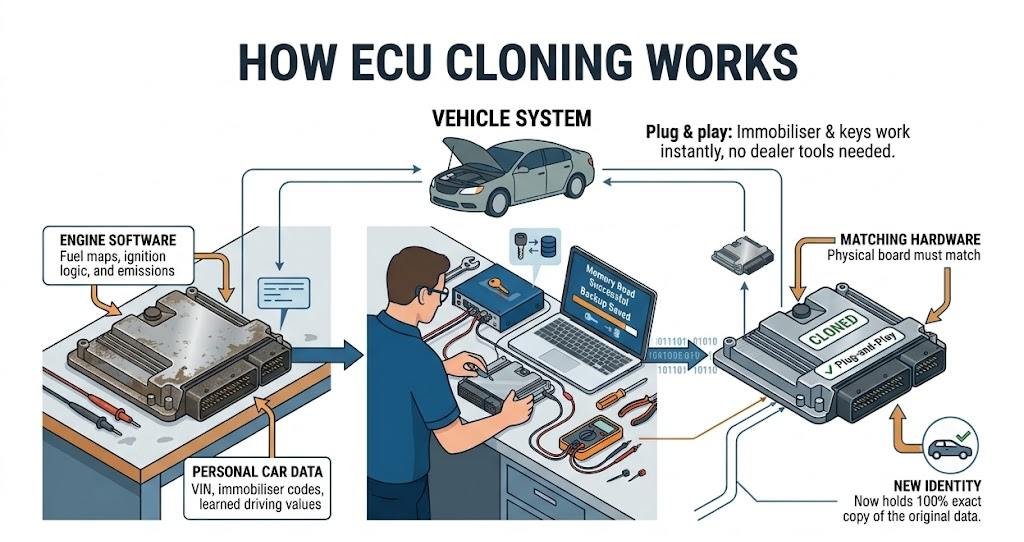
Every ECU carries two kinds of information. The first is the engine software: the fuel and ignition maps, emissions settings and control logic that the manufacturer wrote for that engine. The second is personal to your car, such as the Vehicle Identification Number, the immobiliser codes that link the unit to your keys, and small values the engine has learned over thousands of miles of driving.
Cloning means reading all of that data from the original unit and writing a complete copy onto a second unit with matching hardware. When the job is finished, the replacement holds the same identity as the old one. As the car powers up and the immobiliser asks the engine computer to prove who it is, the replacement gives the correct answers, because as far as the car can tell, nothing has changed.
That is the main difference from a dealer replacement. Cloning doesn’t involve registering a new unit to the vehicle using the online tool from the dealerships. Nothing new is paired and no keys are relearned. The identity simply moves from one box to another, and the engine management system treats the replacement as the first module.
The work itself happens on the bench rather than through the car’s diagnostic socket. The original ECU is removed and connected to specialist programming equipment so its memory can be read. Depending on the make, that might mean talking to the unit through its own connector, or opening the casing and connecting straight to the processor. A careful technician saves a full backup of the original before anything else happens, so there is always a way back if something goes wrong.
The replacement unit matters just as much. It normally needs to share the same hardware type as the original, and often the same part number family. Software can be rewritten, but the physical board inside cannot. This is why good used units from the same model are often the best choice. They cost far less than new, and once cloned they are, in practical terms, your old ECU in a healthier body.
Key Data Transferred During Cloning
| Data Category | Where It Is Stored | What It Does |
|---|---|---|
| Immobiliser data | EEPROM or a protected memory area | Holds PIN codes, key synchronisation data and anti-theft authorisation. Without it, the car will not start. |
| Vehicle Identification Number (VIN) | EEPROM and flash memory | Keeps the car’s identity consistent when garages and testers connect diagnostic equipment, avoiding mismatch fault codes. |
| Engine calibration | Processor flash memory | Keeps the factory fuel maps, ignition timing, emissions settings and any approved software updates. |
| Injector coding | Adaptation values | Stores the correction figure for each injector, which helps the engine idle smoothly and burn fuel cleanly, especially on diesels. |
| Learned adaptations | EEPROM | Retains throttle, idle and fuel trim values so the engine does not have to relearn them from scratch. |
The VIN point is worth a closer look for UK drivers. A unit that reports the wrong VIN can log fault codes and, on some cars, keep a warning light on. Under the engine warning light rules in the DVSA’s MOT inspection manual, an engine malfunction indicator lamp that is lit, or that doesn’t work at all, counts as a major defect and means a fail. The same section treats missing or obviously modified emission control equipment as a major defect too. A clean clone avoids both problems, because the replacement carries the original identity and the original factory calibration.
Traditional Dealer Replacement Vs. Professional Module Cloning
The dealer route starts with a new, blank ECU from the manufacturer. After fitting, the technician connects to the maker’s online servers, downloads the correct software and then pairs the unit with the immobiliser and keys. On some brands, every key has to be present for this step, so a lost spare can add yet more cost. The online checks exist for good reasons, since they make it harder for thieves to swap engine computers on stolen cars. For the honest owner, though, the result is a long chain of steps, each with its own charge and its own waiting time. And if the car won’t start in the first place, getting it to the dealer often means paying for recovery on a flatbed.
Cloning makes a copy of everything the original unit knows and places it on a second unit. Specialists do this with bench programming methods such as BDM (background debug mode), boot mode and bench mode. Each one is simply a way of talking to the ECU’s processor directly, outside the car, so that memory areas normally locked away from the diagnostic port can be read and written. Which method is used depends on the processor inside the unit, not on the owner’s preference.
It is also worth knowing that you are not tied to the main dealer for this kind of work. UK competition rules aim to keep the repair market open, so that independent garages can get the technical information, tools and parts they need to repair modern cars. The CMA’s guidance on motor vehicle agreements explains how this works under the Motor Vehicle Block Exemption Order, which came into force on 1 June 2023 and runs until 31 May 2029.
Direct Comparison: Replacement Approaches
| Factor | Main Dealer Replacement | Professional Cloning |
|---|---|---|
| Replacement part | New, unprogrammed unit from the manufacturer | Compatible used or recycled unit |
| How it is set up | Online coding through the maker’s systems | Full memory read from the old unit and written to the new one |
| Key and immobiliser matching | Required, sometimes with every key present | Not needed, as the original identity carries over |
| Your original settings | Start from factory defaults, so some values must be re-entered or relearned | Kept exactly as they were |
| Time off the road | Often several days, depending on parts supply | Often a day or two once the unit reaches the specialist |
| Typical cost | Can run well over £1,000 on many modern cars | Usually a few hundred pounds, depending on the unit |
| Where the work is done | At the dealer, which may need a recovery truck | At a workshop, or by sending the unit in by post |
Prices vary a great deal by make, model and region, so treat these figures as a rough guide rather than a quote. Still, the pattern is consistent. Most of a dealer bill comes from the new part and the programming, and cloning removes much of both.
Major Advantages Of Cloning
- Big savings on cost: Instead of paying full price for a new unit from the dealer, you can use a well-kept recycled or donor unit. On older cars especially, this can be the difference between repairing the car and sending it to the scrapyard.
- No dealer equipment needed: Once the clone is finished, the owner or a local mechanic simply plugs the unit back in. In most cases the car starts straight away, with no further coding or key matching.
- Your original setup stays as it was: Custom settings, software updates, injector codes and learned values all come across, so the car drives the way it did before the fault.
- Less waste: A good used unit gets a second life rather than going in a skip, and a new one doesn’t have to be made and shipped.
To see how this plays out, picture a common scenario. A ten-year-old diesel estate with 120,000 miles on the clock stops starting after a wet week. The garage finds that water has reached the ECU and the board is corroded, but the memory can still be read. A dealer quote for a new unit, coding and recovery could easily come close to what the car is worth to its owner. A cloned used unit, posted back within a few days and plugged in by the local garage, keeps the car on the road for a fraction of that. The numbers will differ for every car, but this is exactly the kind of situation where cloning earns its keep.
How Cloning Solves Common Diagnostic & Hardware Faults
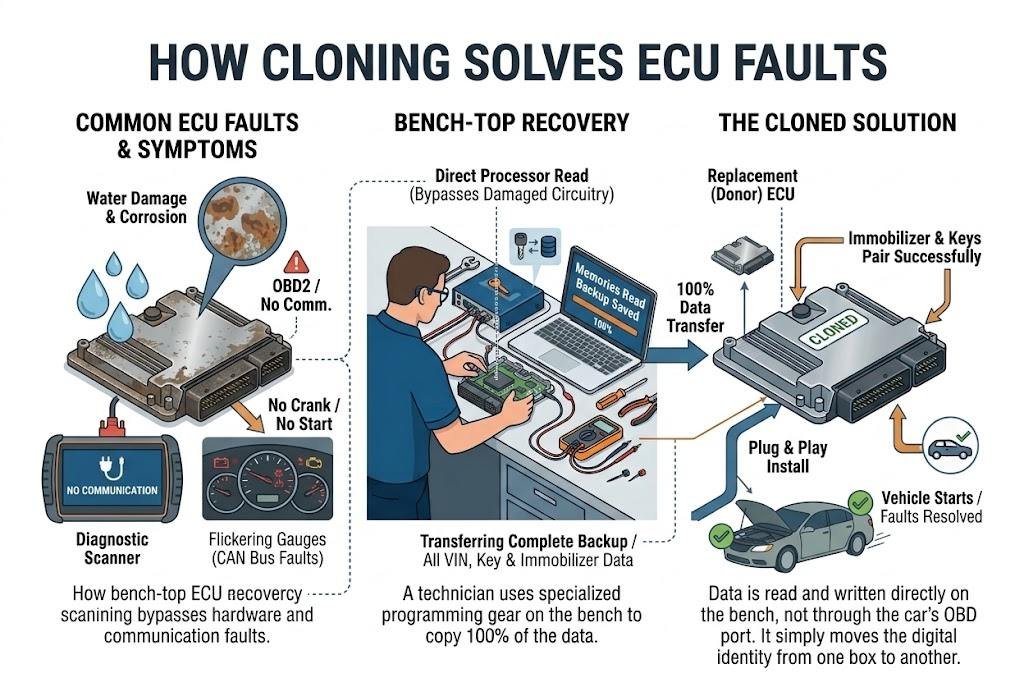
Cloning is most useful when the ECU itself is faulty but its memory can still be read. Standard diagnostic tools plug into the OBD2 socket under the dashboard and rely on the ECU being awake and able to talk. A damaged unit may not answer at all, which leaves a garage stuck with “no communication” on the screen and no fault codes to work from. Bench equipment gets around this by connecting to the processor and memory chips directly, skipping the damaged parts of the unit that stop it talking normally.
Common Failure Symptoms Resolved
No crank or no start. A fault inside the unit can stop the signals that control the starter relay, fuel pump or injectors. Moving the data to a healthy unit takes the faulty hardware out of the picture while keeping the immobiliser link to your keys.
Intermittent CAN bus faults. The CAN bus is the network that lets the car’s modules share information. If a damaged circuit inside the ECU keeps dropping off that network, you may see random warning lights, gauges that flicker or a car that stalls without warning. When the root cause sits inside the ECU, a clone onto a sound unit puts an end to it.
Water damage and circuit corrosion. This one is common in the UK. Every autumn, fallen leaves block the drains under the scuttle panel at the base of the windscreen, and rainwater that should run away can find its way into the area where some cars keep their ECU. Flooded roads cause similar trouble. The AA’s advice on driving through floodwater warns that water plays havoc with vehicle electrics and suggests avoiding water that is moving or more than 10cm deep. Once moisture gets inside an ECU, corrosion keeps spreading. Acting quickly gives the best chance of reading the data while the memory chips still work, so it can be moved to a replacement before the board fails completely.
A technical note for anyone weighing this up: even when the ECU won’t respond through the OBD2 port, specialist recovery equipment can often read the microcontroller inside it. A unit that looks completely dead from the driver’s seat is not always beyond saving.
Selecting The Right Solution For Your Vehicle
Start with a proper diagnosis. A failed ECU produces symptoms that look a lot like other faults, and replacing the engine computer won’t fix a corroded earth strap, a blown fuse, a damaged loom or a failing crank sensor. A good technician checks the power and earth supplies to the unit and rules out wiring before blaming the ECU itself.
Cloning is usually not the right answer in these situations:
- The car is still under the manufacturer’s warranty. In that case, the dealer should replace the unit at no cost to you.
- The original ECU is too badly damaged to read, for example with a burnt processor or a cracked board.
- The fault lies in the wiring, a sensor or another module rather than the ECU.
- The car uses a newer, heavily protected ECU that the specialist cannot yet support.
When you are dealing with an immobiliser lockout or an internal circuit fault and the original unit can still be read, it makes sense to work with a team that offers an ECU Cloning Service built to keep your settings, key data and VIN safe. It also means you don’t have to wait for a dealership slot or a parts order from abroad.
Not every provider works to the same standard, so a few checks are worthwhile before you send anything off. A reputable specialist will ask for proof that you own the car, usually the V5C logbook. That might feel like a hurdle, but it is a good sign, because the same tools could help a thief in the wrong hands. They should confirm compatibility before taking payment, back up the original data before writing anything, and test the cloned unit before it comes back to you. Look for a clear warranty on the work and a tracked, insured return service if you are posting the unit.
You also have legal protection. Under section 49 of the Consumer Rights Act 2015, a trader must carry out a service with reasonable care and skill. If a clone is done badly, that gives you a firm basis to ask for the work to be put right.
If you are removing the ECU yourself to post it, take photos of the connectors before unplugging anything, follow your car’s handbook or workshop guidance on disconnecting the battery, and pack the unit in an anti-static bag with plenty of padding. Put a note inside the box with the registration number and your contact details. Small steps like these save time at both ends.
Conclusion
Cloning gives UK drivers a reliable way around the high cost of main dealer diagnostics and new module replacement. It copies everything the original ECU holds, including the security data, the engine map and the VIN, onto a healthy replacement, so the car accepts it without any further matching. For water damage, internal circuit failures and stubborn communication faults, it is often the quickest way to get a car running again.
It isn’t a cure for every problem. A sound diagnosis comes first, warranty cars belong with the dealer, and some units are too far gone to read. But for a large share of out-of-warranty cars with a genuinely failed ECU, cloning turns an expensive matching job into a simple plug-in swap and keeps a perfectly good car on the road.
Disclaimer: This article is for general information only and is not a substitute for a diagnosis by a qualified technician. Vehicle security systems differ between makes and models, and not every ECU can be cloned. Cloning should only be carried out on a vehicle you own or are authorised to work on. Check your warranty terms and get a written quote before any work begins.