


Client work in the UK rarely starts as a polished presentation. It usually begins with interview notes, discovery documents, PDF reports, spreadsheet extracts, policy updates, market scans, or lengthy Word documents. Consultants then have to turn that raw material into a clear story that a client can understand in a boardroom, steering group, or project update meeting.
That translation work matters. A good consultant does not simply copy information from one format into another. They decide what matters, what needs evidence, what should be removed, and how the message should land with the audience. The challenge is that the first draft of a deck can still take hours before the real advisory work begins.
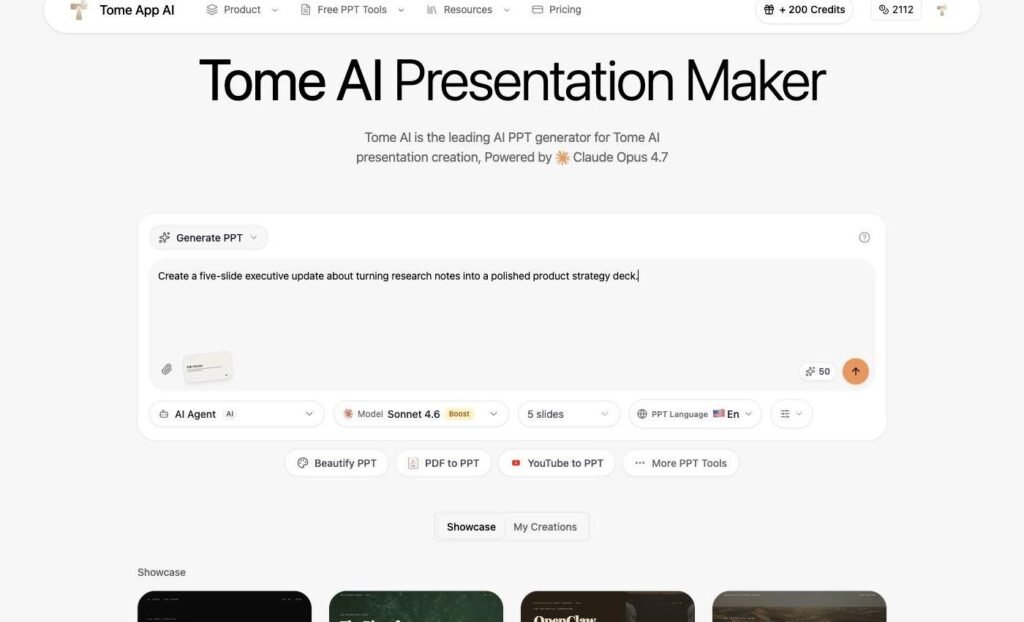
This is where AI presentation tools can help. Used properly, they can reduce the mechanical work of turning documents into slide structures. Tools such as Tome can support early-stage drafting, while the consultant remains responsible for judgement, evidence, accuracy, and client trust.
The need is especially relevant in the UK consulting market. The Management Consultancies Association estimates the UK consulting industry is worth £20.4 billion, with exports generating around £5.9 billion of sales. Its 2025 report also notes that digital and technology consulting, along with business transformation, remain among the most in-demand services.
Why This Matters for UK Consulting Teams
UK clients are under pressure to move faster while still managing risk. Public sector bodies, financial services firms, healthcare organisations, universities, retailers, and professional services businesses all need clearer reporting and better decision support.
At the same time, AI adoption is becoming more common but still uneven. DSIT’s 2026 AI Adoption Research found that 16% of UK businesses currently use AI, rising to 23% in business services and administration. Among businesses using or planning to use AI, 77% use or plan to use it for creative and content creation, 70% for administrative and support work, and 56% for data and analytics.
For consultants, those figures are important because presentation development often sits between all three areas. A client deck is creative, administrative, and analytical at the same time. It needs structure, message discipline, and enough evidence to support the recommendation.
Client Research Often Arrives in the Wrong Format
From Research Packs to Meeting-Ready Slides
A consulting team may receive a 40-page discovery report, a transcript from stakeholder interviews, an audit summary, or a technical document from a client. The information may be useful, but it is rarely written in a way that works for a senior decision-making meeting.
A client sponsor may not have time to read every page. They want to know what has changed, what the risks are, what options exist, and what action the team recommends. This means the consultant has to reshape the material into a short, logical narrative.
The uploaded draft already identified this practical workflow: client research may start as documents, while consultants need to convert it into structured, editable slides for review and presentation.
Why the First Draft Is the Bottleneck
The first version of a deck is often the slowest because it requires many small decisions. What should be the title of each slide? Which sections should be grouped together? What should become an executive summary? Which findings need to be moved into an appendix?
AI can help with that first-pass structure. It can suggest sections, summarise source material, and create a draft flow. But this should not be confused with final consulting work. The draft still needs a human expert to test the logic, challenge weak claims, check the evidence, and adapt the tone for the client.
How AI Presentation Tools Can Support UK Consultants
Turning PDFs into Editable Drafts
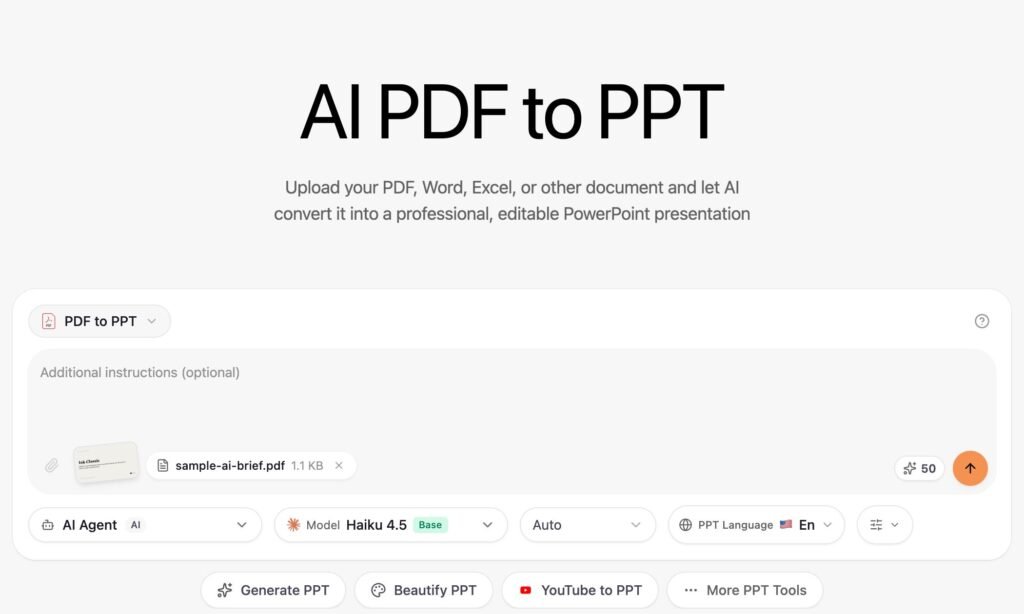
Consultants often receive PDF files that are useful but difficult to reshape. A market report, research pack, policy document, or audit output may contain the right information, but the format is not ideal for slide creation.
An AI presentation workflow can help by reading the source file and creating a draft presentation structure. The important word here is “draft”. UK consulting teams still need to check the source, remove anything confidential, adjust claims, and apply the firm’s presentation standards.
This is useful for:
| Use Case | How It Helps Consulting Teams |
|---|---|
| Internal Discovery Updates | A project team can turn early research into a short internal update before a client meeting. |
| Client Steering Committee Packs | A long progress report can be reshaped into a sharper meeting deck with decisions, risks, and next steps. |
| Market or Competitor Reviews | Large research documents can be condensed into themes, opportunities, and recommended actions. |
| Policy or Compliance Briefings | Public sector and regulated clients may need complex information turned into a clearer briefing format for non-specialist stakeholders. |
Word Documents Can Become Better Slide Outlines
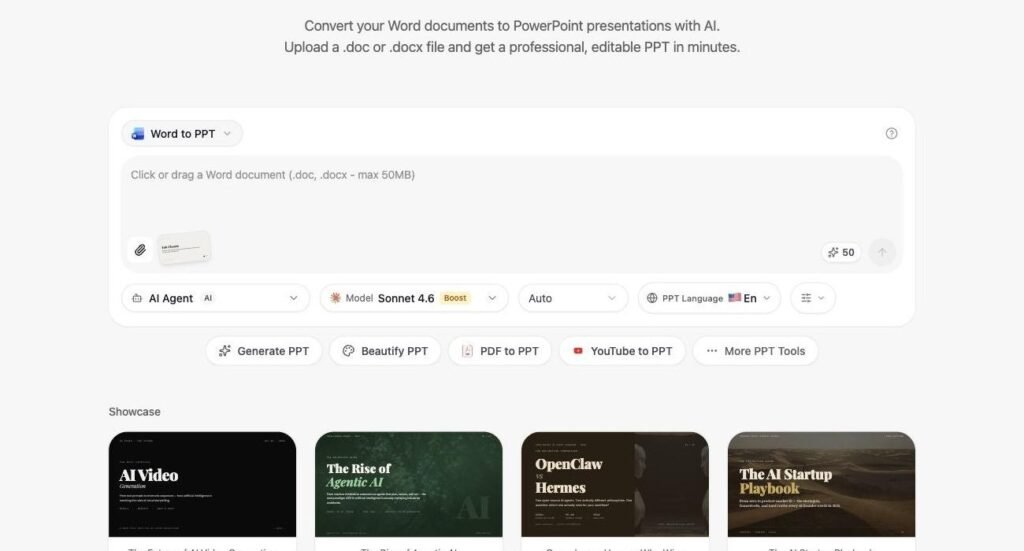
Many UK consulting projects still rely heavily on Word documents. Analysts write findings in detail, managers review the argument, and partners later ask for the story to be turned into slides.
This can create duplication. The thinking has already happened, but the presentation still has to be rebuilt almost from scratch. An AI presentation tool can help by turning the document into a first-pass slide outline.
For UK consulting teams, Tome App should sit in the production stage of the workflow, not the decision-making stage. It can help shape a draft, but it should not decide the recommendation.
A Practical Workflow for Consultants
A strong workflow could look like this:
| Step | Action | What to Do |
|---|---|---|
| Step 1 | Prepare the Source Material | Remove irrelevant sections, client-sensitive details, internal comments, and raw data that should not be uploaded. |
| Step 2 | Write a Clear Prompt | Tell the tool the audience, purpose, tone, length, and desired output. For example, a board update needs a different structure from a project team workshop. |
| Step 3 | Generate the First Draft | Use the AI output as a starting point. Do not treat it as finished work. |
| Step 4 | Review the Logic | Check whether the story is accurate, whether the recommendation follows from the evidence, and whether any important context has been lost. |
| Step 5 | Apply Human Expertise | Add client knowledge, commercial judgement, sector context, risks, and practical recommendations. |
| Step 6 | Finalise for Delivery | Improve visuals, add charts, check brand style, verify references, and make sure the deck answers the client’s real question. |
Why Human Oversight Is Essential
AI can speed up document-to-slide conversion, but consultants cannot outsource accountability. UK clients expect clear judgment, confidentiality, and evidence-based recommendations.
DSIT’s AI Adoption Research found that among UK businesses currently using AI, 84% reported at least some human input or checking of AI outputs, with 67% reporting significant input or checking. That supports a sensible consulting approach: AI can assist, but people must remain in control.
This is especially important when working with:
| Area | Why Human Oversight Matters |
|---|---|
| Regulated Industries | Financial services, healthcare, energy, legal, and public sector clients often have strict rules around data, claims, and decision-making. |
| Confidential Client Material | Consultants may handle commercially sensitive documents, staff data, customer information, pricing, contracts, or strategy papers. |
| Board-Level Recommendations | A board paper or executive deck must be accurate. A weak AI-generated claim can damage trust quickly. |
UK Data Protection and Confidentiality Considerations
UK consultants should be careful before uploading client files into any AI tool. The Information Commissioner’s Office provides guidance on applying UK GDPR principles to AI systems and says its AI guidance is suitable for public, private, and third sector organisations.
Before using AI on client material, teams should ask:
| Key Question | What to Check |
|---|---|
| Is the Information Confidential? | If the file contains client names, financial data, personal information, or sensitive strategy, it may need redaction before being uploaded or processed. |
| Does the Client Contract Allow This? | Some consulting agreements restrict the use of third-party tools, cloud platforms, or external processing, so the contract should be checked first. |
| Is Personal Data Included? | If personal data is involved, UK GDPR obligations may apply, and the material should be handled according to data protection requirements. |
| Can the Output Be Verified? | Every claim, number, and recommendation should be checked before it appears in a client deck. |
| Who Owns the Final Review? | A named consultant should be responsible for final quality, accuracy, and client suitability, not the AI tool. |
Where AI Adds the Most Value
AI presentation tools are most helpful when the source material is already reasonably strong. They are less useful when the thinking is unclear.
Strong Use Cases
AI can help with summarising research packs, creating first-draft slide structures, turning Word documents into outlines, shortening long reports, creating alternative deck flows, and preparing internal discussion drafts.
Weak Use Cases
AI should not be relied on for final recommendations, legal conclusions, financial advice, client-sensitive decisions, or unsupported claims.
The best use is not “make this deck for me”. A better instruction is: “Create a 10-slide executive update for a UK financial services client, using the attached research, with a clear problem, findings, options, risks, and recommended next steps.”
What UK Clients Actually Need From AI-Supported Consulting
Clients are not usually impressed by AI for its own sake. They want better answers, faster delivery, and lower friction. Consultancy.uk reported on MCA client survey findings in 2026, showing that two in five UK organisations were looking to consulting firms for support with digital and technological transformation. The same report noted concerns around data security and privacy, skills shortages, and governance.
That means consultants need to show discipline. AI should make the work clearer, not riskier. A faster deck is only valuable if it is accurate, relevant, and safe to share.
Expert Tips for Better Results
| Tip | How to Apply It |
|---|---|
| Give the Tool a Role | Do not simply ask it to “make a presentation”. Tell it whether it is drafting a board update, discovery readout, sales proposal, risk review, or workshop pack. |
| Define the Audience | A CFO, NHS project lead, council transformation team, private equity investor, and SME founder all need different levels of detail. |
| Control the Slide Count | A five-slide summary should focus on decisions. A 15-slide deck can include context, findings, options, and implementation steps. |
| Separate Facts From Recommendations | Make sure factual findings, assumptions, and recommendations are clearly separated. |
| Keep a Human Review Checklist | Before sharing the deck, check accuracy, confidentiality, tone, evidence, design, and client relevance. |
Conclusion
AI presentation tools can be genuinely useful for UK consultants, but their value depends on how they are used. They are best treated as drafting assistants who help turn research documents into a clearer first version of a deck. They can reduce blank-slide time, speed up internal review, and help teams organise complex source material.
The real consulting value still comes from human expertise. Consultants must understand the client, test the evidence, protect confidential information, and shape recommendations that are practical in the UK business environment. Used with proper review and governance, AI can help consulting teams spend less time formatting early drafts and more time improving the quality of advice.