


For years, the outside of my house had exactly one light on it. A plastic bulkhead above the front door, wired to a sensor that fired whenever a cat crossed the path, blazed for ninety seconds and then handed the whole garden back to the dark. It worked, in the narrowest possible sense. I could find the keyhole. I never once stood at the gate on a wet January evening and thought the place looked like somewhere anyone lived.
What eventually fixed it had almost nothing to do with buying a brighter lamp. It had to do with deciding, area by area, what each part of the outside of the house was actually for after dark, and then lighting those parts gently instead of lighting everything fiercely. That shift is the whole trick. A welcoming exterior is not a bright one. It is a considered one.
Britain Spends Half the Year in the Dark
This matters more here than it does in most places. On the shortest day, sunset in Manchester falls just before four in the afternoon, and in Inverness it has gone by about half past three. From roughly October through to March, the average household arrives home, drags the bins to the kerb, unloads the car and greets visitors entirely in the dark.
Outdoor lighting in this country is not a summer accessory for the fortnight the barbecue comes out. For half the year it is the only version of your home’s exterior that anyone, including you, actually sees. It is worth treating as a design decision rather than a hardware purchase.
Walk the House at Night Before You Buy Anything
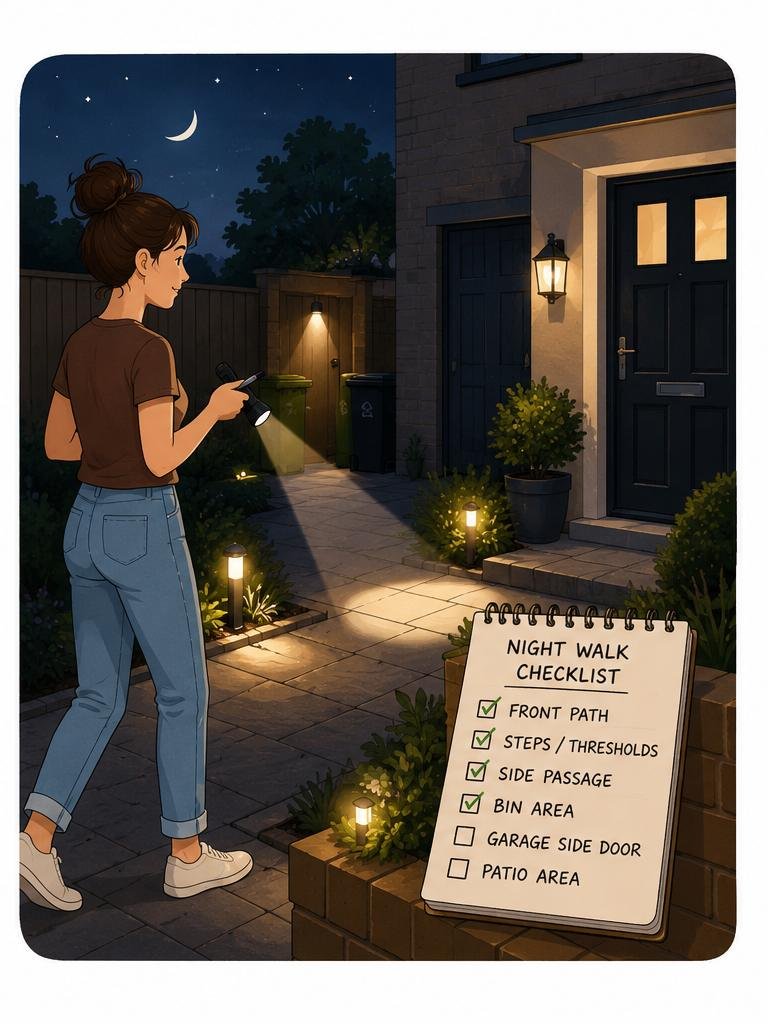
The most useful thing I did cost nothing. I waited until it was properly dark, walked a slow circuit of the property, and paid attention to where I hesitated.
The hesitations are the brief. Mine were the step down from the back door that I misjudged in wet weather, the side passage where the recycling boxes live, and the last two metres of the front path where the light from the street gave out, and the light from the porch had not yet begun. Yours might be a garage side door, an awkward turn onto a drive, or a patio that felt marooned from the house.
Note where you slow down, where you reach for a phone torch, and where you feel slightly uneasy. Then note the places you never go after dark at all. Those go on the do-not-light list, and that list is as valuable as the other one. Most over-lit gardens are the result of an owner treating every wall as an opportunity rather than a question.
Give Every Fitting a Job
Exterior wall lights are not one product. They are half a dozen different tools that happen to share a mounting position, and the effect you get depends far more on which type you choose than on how many lumens it puts out.
A traditional lantern throws a soft, roughly spherical glow and suits a porch or a period doorway. A downward-facing fitting puts a controlled pool on a step or threshold and almost nothing anywhere else. Up-and-down fittings send two narrow beams along the face of the wall, which is decoration rather than illumination. Wall washers spread an even sheet of light across a surface. Motion-activated units earn their place at a side gate or bin store where light is needed occasionally and briefly.
Browsing a broad Outdoor Wall Lighting range side by side is genuinely clarifying at this stage, not because you should buy the first thing you like, but because seeing the formats grouped makes the distinction between decorative and functional obvious in a way that a single product page never does. Work out which of those five jobs you need doing at each location. Then, and only then, start thinking about finish and style.
Framing a Front Door Without Overdoing It
A matched pair either side of a front door is the classic move, and it works for a practical reason as well as an aesthetic one. Light arriving from two sides at roughly face height fills in the shadows that a single overhead fitting carves under the brow and nose. Visitors look like people rather than suspects. If you have a video doorbell, the same evenness usually gives it a far more usable image.
But a pair is not compulsory, and on the typical Victorian terrace or narrow bay-fronted semi there is not the wall for it. One fitting, positioned on the lock side so the handle and keyhole are lit rather than shaded by your own body as you approach, beats two crammed in for symmetry’s sake. Check that it will not foul an outward-opening door, a storm porch or a gate on the swing.
Getting the Scale Right on a British Facade
Outdoor fittings look reliably smaller in situ than they do in a product photograph. A lantern that seems substantial on screen can vanish on a wide expanse of red brick. Equally, an oversized fitting on a modest 1930s semi crowds the door and starts competing with the bay window.
Measure the available wall before ordering, and measure the backplate as well as the body. The backplate has to sit flat on the surface, cover the existing electrical entry point, and ideally conceal the shadow left by whatever was there before. On pebbledash, render or uneven stonework, a small backplate on a large old footprint is a permanently visible compromise.
The cardboard test is worth the five minutes. Cut a rectangle to the fitting’s overall dimensions, tape it up, then look at it from the pavement and from the front gate. That viewing distance is the one that matters, and it will tell you more than any dimension in a specification table.
Height, Aim and the Swing of a Gate
Mounting height is where most installations quietly go wrong. Too high and the door furniture and the step stay in shadow while the light spills uselessly across the garden. Too low and the source sits in the eyeline of anyone walking up the path, which produces glare and, counter-intuitively, makes it harder to see.
The right position depends on the fitting’s beam shape, the door height and where people actually stand. The principle that professional lighting designers in the UK work to is set out in the Institution of Lighting Professionals’ guidance on reducing obtrusive light, and it comes down to putting the right light, in the right place, at the right time, controlled properly. Shielded fittings, frosted diffusers and downward aim all serve that end.
Before you drill, check the swing of everything nearby. Shutters, gates, outward-opening doors and wheelie bin lids have all met an expensive glass lantern at some point. Where you are fitting a pair, mark both positions, step back to the street, and check them by eye. Brickwork courses on older houses are rarely as level as a tape measure suggests.
Warmth Does More Than Wattage
A garden does not need kitchen light levels. It needs pools. Push the brightness too high, and two things happen at once: the lit area flattens out and loses all its texture, and the unlit surroundings drop away into a darkness that feels deeper than before. The contrast works against you.
Colour temperature is the lever most people never touch, and it makes more difference than output. Warm white sits comfortably against red brick, timber, York stone and green planting, and it matches the light spilling from your own windows. Cooler light can suit a very contemporary render-and-glass elevation, but mixing temperatures across one facade almost always reads as accidental.
It also helps to shop by lumens rather than watts, since modern LEDs decouple the two entirely. The Energy Saving Trust’s guide to lighting and colour temperature sets out the equivalences and explains why anything around 2700K to 3000K is described as warm white. For most porches and patios, a modest lumen figure in a warm tone beats a high one every time.
Let the Wall Do Some of the Work
The effect I have come to like most is grazing: light travelling almost parallel to a textured surface, catching every arris and hollow. On handmade brick, weathered stone or rough render, it turns a flat elevation into something with depth. Up-and-down fittings do this well and add a rhythm along a long boundary wall or between the columns of a porch.
It is worth being honest about what this reveals, though. Grazing light is unforgiving. Patched repointing, spalled brick, a badly matched render repair and the ghost of an old satellite bracket will all announce themselves. Test one fitting before you commit to a run of six. Smooth modern surfaces generally take a broader, softer wash better than a raking beam.
Turning a Patio Into a Room
The instinct with a patio is to put one bright fitting above it and be done. That produces a stage set: harsh in the middle, black at the edges, and nobody’s idea of a relaxed evening. Ringing the space with several low-output fittings on the surrounding walls works far better. People can see their plates and each other without feeling floodlit.
Think about the view from inside too, because in a British spring you will spend more evenings looking at the garden through glass than sitting in it. A softly lit wall, a lit shrub or a grazed fence gives the window something to hold after dark instead of a black mirror reflecting your own living room. Just check that the fittings themselves do not appear as bright points in the glazing, and that nothing shines into a bedroom.
If you eat outside, split the circuits. Serving food wants more light than lingering over a drink does, and one switch cannot serve both.
Fittings That Survive a British Winter
Even a fitting tucked under a deep porch is outdoors. Driving rain on an exposed western gable, salt air on the coast, weeks of damp and repeated freeze-thaw cycles all take their toll on seals, gaskets and finishes.
Match the fitting to the exposure rather than to the mood board. Electrical Safety First’s advice on outdoor lighting makes the point that the area, the power source and the IP rating all need considering together, that fittings should be bought from a reputable stockist, and that anything mains-supplied should be installed to BS 7671. A sheltered porch and an open garden wall are genuinely different environments, and a rating adequate for one may be marginal for the other.
Maintenance access matters more than people expect. If you cannot open the fitting to clean the glass without dismantling half of it, you will not do it, and cobwebs, leaf litter and dead insects are dramatically more visible once the light is on.
Controls That Match How You Actually Live
Very few gardens need lighting from dusk until dawn. Timers and photocells cover the useful evening hours and then stop. Motion sensors suit the side gate, the bin store and the garage door, which are visited briefly and unpredictably.
Sensor placement repays fussing over. A unit that triggers on passing headlights, a swaying branch or next door’s cat becomes an irritant to you and everyone within sight of it. Aim it down the approach rather than across it, and reduce the range until it only catches what you want.
Keep a manual override as well. When guests arrive or a job outside runs long, you want light that stays on without waving at a sensor. It is also worth reading the police-backed Secured by Design guidance on keeping a home secure while you are away, which covers timer plugs, photosensitive lamps and activating external lighting before a trip. Occupancy signals matter more than raw brightness.
The Neighbour Test
In a country of terraces, semis and close-set new-build estates, your lighting lands on somebody else’s property whether you intend it to or not. This is not merely a courtesy question. Artificial light from premises can amount to a statutory nuisance under the Environmental Protection Act 1990, and the Defra guidance on how councils assess artificial light complaints lists domestic security lighting and decorative building lighting among the common causes. There is no fixed brightness threshold. Councils weigh how often it happens, how long it lasts, when it happens and whether the setting is urban or rural.
In practice, the fix is dull and effective. Aim downwards, shield the source, keep output modest, and switch off late. Then go and stand in your neighbour’s front garden, or ask them to tell you honestly what it looks like from their landing window. Five minutes of that is worth more than any amount of after-the-fact correspondence.
Sharing the Garden With Bats and Moths
British gardens are working habitat, and light changes the behaviour of the things using them. Moths and other night-flying insects are drawn to lit fittings and away from the plants they would otherwise be pollinating, and the animals that feed on them follow the disruption.
Bats deserve particular care, and not only for sentimental reasons. All UK bat species are legally protected, and the Bat Conservation Trust is direct on the point in its advice on keeping a garden dark: lighting a roost or its access points can constitute an offence, because it may cause the bats to abandon it. If you have bats using your eaves, a soffit gap or an outbuilding, that section of wall is off limits, and their feeding routes and commuting lines are best left unlit too.
Warm colour temperatures, tight beam control, low mounting heights and a curfew all reduce the impact considerably. None of them cost you anything in atmosphere. If anything, they improve it.
Older Houses Deserve a Lighter Touch
A great deal of British housing stock is old, and a fair amount of it is listed or sits within a conservation area. Fixing anything to the exterior of a listed building can require listed building consent, so a conversation with the local authority’s conservation officer comes before the drill, not after.
Historic England’s guidance on external lighting of historic buildings is written with larger schemes in mind. Still, two of its principles apply just as well to a semi-detached Edwardian villa. First, it is rarely necessary to light every elevation, and selecting a feature or two usually gives a better result than a general wash. Second, fixings should respect the historic fabric and leave no permanent scarring, which in domestic terms means drilling into mortar joints rather than the face of a soft brick or an ashlar block, and routing cable where it can be removed cleanly.
There is also a daytime consideration. A fitting that looks superb at eleven at night and clumsy at eleven in the morning has only half succeeded.
Getting the Electrics Done Properly
Swapping a fitting on an existing point is one thing. Running a new circuit out to a garden wall is another, and the rules differ across the UK.
The Planning Portal’s summary of the building regulations covering domestic electrical work explains that installing a complete new circuit is notifiable, and that alterations to existing circuits are notifiable in special locations, which in England means the spaces around baths and showers, while in Wales the definition also takes in kitchens and outdoors. Using an installer registered with a competent person scheme is the simplest route, since they can self-certify the work. Everything, notifiable or not, still has to meet BS 7671.
Get the certificate and keep it with the house papers. A future buyer’s solicitor will ask.
A Garden That Feels Like Somewhere You Live
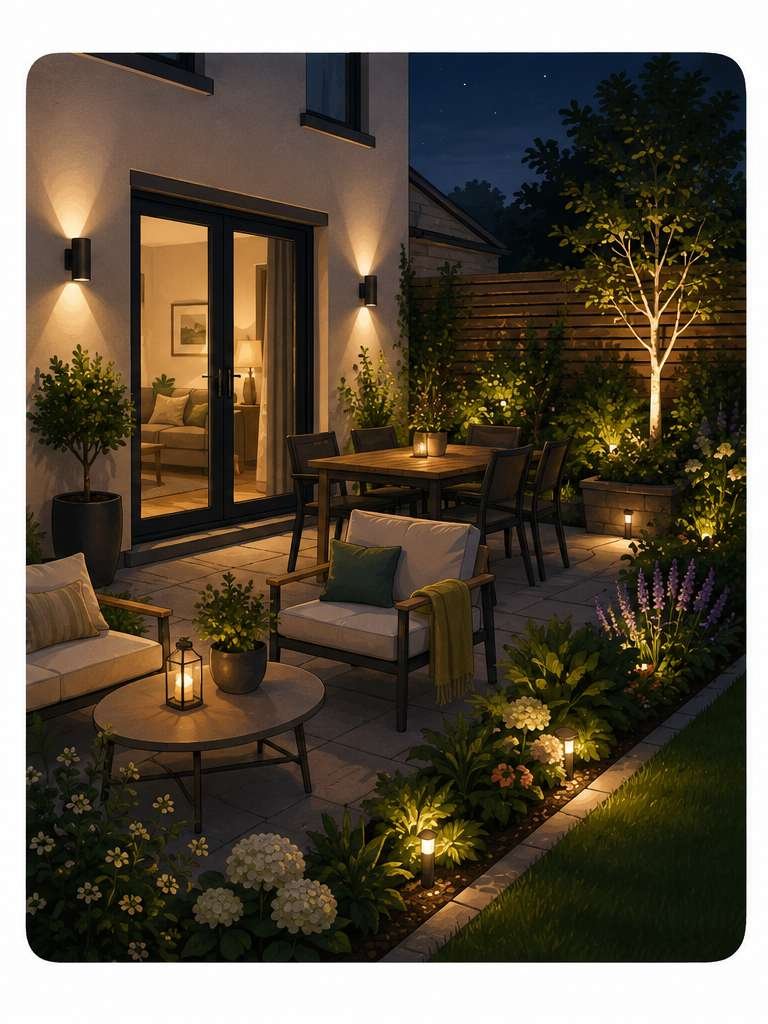
None of this requires lighting the whole plot. Three or four well-chosen fittings, aimed properly and kept warm and modest, will do more for the character of a house than a dozen bright ones scattered about.
Start with the places your household actually uses on a wet Tuesday in November. Choose fittings that suit those specific jobs. Then go outside after dark and look, from the gate, from the patio, from your neighbour’s side of the fence, and adjust. Get the balance of brightness, position and restraint right, and the outside of your home stops being a place you pass through on the way in. It becomes somewhere you would happily stand for a minute in the cold, just because it looks good.