



For decades, Britain treated France as the country next door. You could enrol at a French university with a passport, a bank statement and a reasonable command of the language, and nobody asked you to explain yourself. That arrangement ended with Brexit. Since 2021, people resident in the United Kingdom, whatever passport they hold, have sat inside the same administrative system as applicants from India, Nigeria and Brazil.
That system is called Campus France, and it runs on a platform named Études en France. It is not difficult. It is simply unforgiving about sequence, and a surprising number of British applicants find out too late that the door they were walking towards has a queue in front of it.
Where Britain Now Sits In The French System
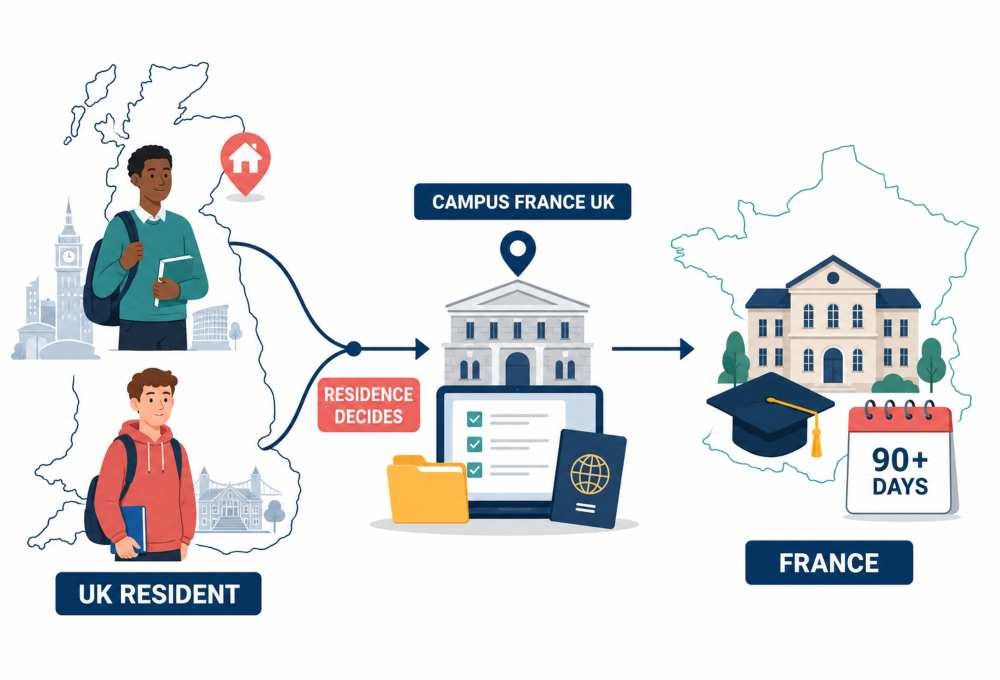
The Études en France procedure applies to residents of a defined list of countries and territories, and the United Kingdom is on it. If you live in Britain and want to do a full degree in France lasting more than ninety days, you go through Campus France UK, which operates from the French Embassy in London. Your nationality does not decide this. Your country of residence does. A Nigerian student finishing an MSc in Manchester and a British sixth-former in Bristol follow the same route.
Anyone weighing up whether to study in France should understand this before looking at a single prospectus, because it changes the shape of the year ahead. The good news is that the French system is unusually explicit about what it wants. Campus France UK publishes a detailed guide for residents of Britain, and it is worth reading in full rather than skimming.
What Campus France Is, And What It Is Not
Campus France is an agency of the French state. Its job at this stage is to check that your academic background, your chosen programme and your finances hold together as a coherent proposition, and then to pass a report on you to the institutions you applied to.
It is not an admissions body. It does not accept or reject you. It does not issue visas either, though the consulate will not look at your file without it. Think of it as a verification layer that sits between you and everything else, and treat it accordingly.
Which Platform Applies To You
This is where most confusion begins. France has three main application routes and British applicants only really use one of them.
Parcoursup and MonMaster, the platforms you will hear about from French friends, are built mainly for EU and EEA nationals and for people who have been living in France. Most UK-based applicants will not touch either. Études en France is your platform, whether you are applying for the first year of a bachelor’s at a public university (the DAP procedure) or for anything else.
There is a wrinkle. Not every institution participates. Sciences Po, Institut Polytechnique de Paris and most of the private business schools run their own recruitment, and some universities use the platform for certain programmes and not others. If you are admitted through one of those parallel routes, you still return to Études en France for the visa stage. Doctoral candidates apply directly to doctoral schools and only use the platform once accepted.
The practical implication: check every programme on your shortlist individually. Assuming they all behave the same way is the single most common planning error.
Calendar Is Fixed, And It Opens In October
Applications for first-year bachelor’s places at public universities run from 1 October to 15 December. Everything else runs from 1 October to 15 February. Late files may be looked at, but that is a discretionary favour, not a right, and it can be refused without explanation.
Files are processed as they arrive rather than in a batch at the deadline, so applying in November is materially better than applying on 14 February. Institutions then work to their own internal timetables, and all of them must give you an answer, positive or negative, by June.
Choosing Programmes That Actually Fit
You can apply to up to three programmes under the DAP procedure, and up to seven at licence 2, licence 3 and master’s level. That is a reasonable spread, and it is enough to be strategic rather than scattergun.
UK qualifications travel well. French institutions generally recognise A-levels, Scottish Highers and British degrees, though each one assesses your background against its own requirements and none of them owes you a place. What tends to matter more than reputation is fit: whether the modules genuinely connect to what you have already studied, whether the teaching language matches your actual ability rather than your aspirational one, and whether the qualification leads somewhere concrete afterwards. French institutions are quite good at spotting a candidate who picked a course because they recognised the city.
Documents: The Standard Set, And The One That Helps Most
The mandatory set is short. A clear scan of your passport identity page, an up-to-date CV, and your official transcripts and diplomas, or current-year transcripts if you are still studying.
Translation into French is not compulsory, but it is strongly advised, particularly for French-taught programmes where the person reading your file may not be comfortable in English. Individual programmes can also request extra material through their own channels, so read each course listing rather than assuming the core set covers you.
The document nobody makes you provide, and the one that quietly does the most work, is a statement of comparability from ENIC-NARIC France. This sets out how your British qualification maps onto the French system, sparing an admissions tutor the guesswork of interpreting a BTEC or a 2:1. You can request the attestation online through France Éducation International, and it is one of the few genuinely optional steps that repays the effort.
On language, English test scores are not required if you have been educated in the UK or another English-speaking country. For programmes taught partly or wholly in French, you will usually need TCF, TEF, DELF or DALF, with B2 the common threshold. Alliances Françaises and French Institutes across Britain run these tests, and slots fill up, so book early.
Motivation Statement Is Not A Personal Statement
British applicants tend to arrive at this box with the wrong instincts. You write the motivation statement directly on the platform; you get 2,000 characters, and you write a separate one for each programme.
That is a different exercise from a UCAS personal statement, which stretches across all your choices at once and rewards a certain amount of narrative build. The French version wants directness. Name the modules that interest you. Say what in your existing work connects to them. Leave the anecdote about the school trip that sparked everything for your CV, or for nothing at all. Anything generic enough to fit three programmes will be read as exactly that.
Fee, The Interview, And The Report
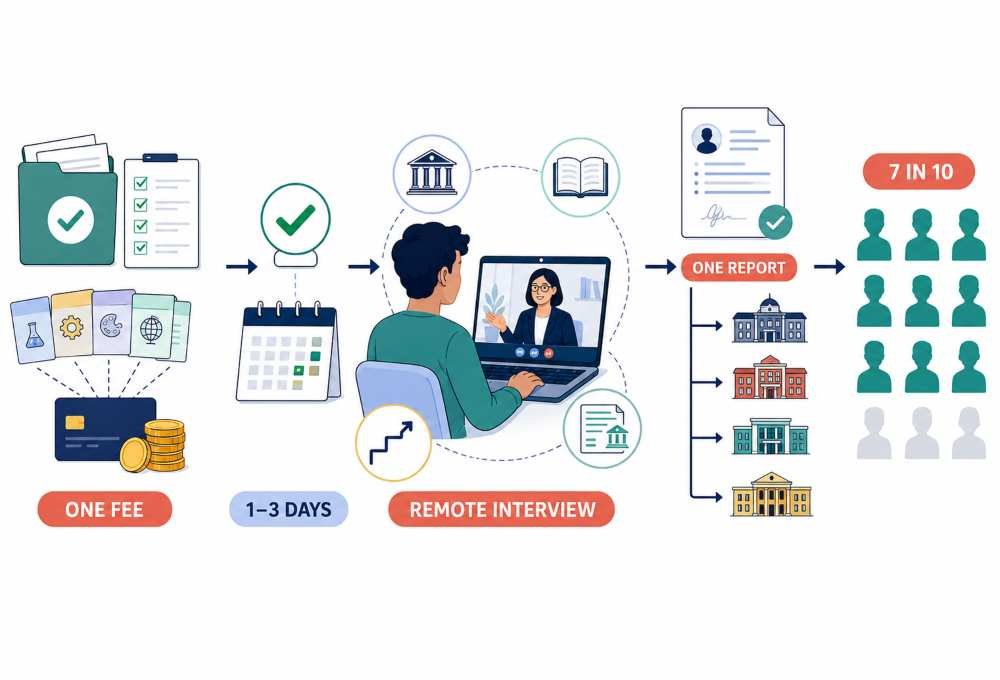
Once a Campus France officer has confirmed you are eligible and your documents are properly uploaded, you are asked to pay a processing fee. The amount is set annually and confirmed to you at that point. One fee covers your whole application, however many programmes it contains, and it also covers the visa stage later, which means there is little downside to applying through the platform even for a long-shot course.
Nothing moves until the payment clears. After it does, you should receive instructions about the interview within one to three working days, and you are normally expected to sit it within about a fortnight. For UK applicants, it is conducted remotely, on behalf of every programme you applied to, so you do it once.
Rehearsed answers do not survive this format. The officer is looking for whether you understand the French academic structure, why this course, what you plan to do afterwards, and whether your funding is real. Afterwards they write a report summarising your file and the conversation, and send it to each institution on your list. Roughly seven in ten applicants receive at least one positive response, which is a more forgiving ratio than most people expect going in.
Visa Stage
A positive answer plus your admission letter takes you to the consular stage. You complete the application on France-Visas, the French government’s official visa portal, then book an appointment with TLScontact, which handles French visa appointments in the UK. Note that it is TLScontact here, not VFS Global, which is the provider used in several other countries and a detail that trips people up when they read generic guidance.
You attend in person for biometrics and to have your original documents checked. Applications generally open around three months before your programme starts, and summer is the slow season, so book as early as the window allows.
Money Has Changed This Year
Two changes landed in 2026, and both hit non-EU applicants, which now includes British nationals.
First, the minimum resources you must evidence rose from €615 a month to €877.50 from 1 August 2026, a figure now pegged at 47 per cent of the gross monthly minimum wage and indexed rather than fixed. Over a twelve-month year, that is roughly €10,530, to demonstrate, against about €7,380 under the old rule. The previous threshold had sat untouched since 2002, so the jump is steeper than a normal uprating.
Second, housing benefit is no longer available to non-European students without a social-criteria scholarship as of 1 July 2026. For a student paying €600 a month in Lyon, losing APL removes something in the region of €100 to €200 monthly from the budget. Students in apprenticeships or with professional activity keep their entitlement.
Tuition is the third piece. Campus France publishes the differentiated rates for non-EU students, which for 2026 to 2027 are €2,902 a year for a bachelor’s and €3,950 for a master’s, against €178 and €255 for EU nationals. Doctoral fees are not differentiated. Institutional fee waivers still exist, though a decree of 19 May 2026 tightened the rules around them, with transitional protection for students already enrolled. Private business schools sit in a different bracket entirely, commonly €6,000 to €18,000 and upwards.
Set against UK tuition, French public universities remain cheap. Set against what British applicants were paying in 2019, they are not, and budgets built on older guides will be short.
After You Land
The long-stay visa you receive, the VLS-TS, doubles as your residence permit, but only once you activate it. You must validate it online through the Interior Ministry’s ANEF portal within three months of arriving. It is a short digital process; it is easy to lose in the noise of enrolment week, and skipping it puts your legal residence in question.
While you are dealing with paperwork, look at Visale, the free rental guarantee run by Action Logement. French landlords routinely demand a French guarantor, which is an obvious problem when your entire family is in Kent. Visale is open to tenants aged 18 to 30 regardless of employment status, CROUS residences accept it, and you can arrange it before you travel. Your visa also permits up to 964 hours of work a year, roughly twenty hours a week.
Erasmus+, Turing, And The Next Two Years
One piece of context worth holding. The Department for Education has confirmed that from 2027 UK providers will seek funding for international placements through Erasmus+, with 2026 to 2027 the final year of the Turing Scheme.
This does not change the visa position or remove the Études en France requirement for a full degree. What it may change, over time, is the volume of structured exchange between British and French institutions, and the funding available to students moving between them. If you are choosing between a full degree in France and an exchange organised through your UK university, the landscape in two years will not be the one you see now.
A Realistic Timeline For A UK Applicant
Eight to ten months before your intake is the sensible starting point, and it is not padding.
Spring and early summer go on shortlisting programmes and checking which of them actually run through Études en France. Summer is for language tests if you need them, and for requesting your ENIC-NARIC attestation, which takes time to come back. The platform opens on 1 October. Aim to submit in October or November rather than sitting on it. Interview instructions follow the fee, offers arrive between then and June, and the visa process starts once you have an admission letter in hand.
The applicants who struggle are rarely the weakest ones academically. They are the ones who left a translation, a test booking, or a bank letter until a month when everything else was also due.
Where This Leaves You
There is nothing mysterious in the French admissions system. It is bureaucratic in the ordinary sense: it rewards people who read the instructions, keep their documents consistent and start early enough that a single delay does not collapse the whole plan.
The part that catches British applicants is not complexity but assumption. Habits carried over from UCAS, from pre-Brexit freedom of movement, or from guides written for a different country’s process are what create the problems. Applicants working from Indian qualifications, or applying from India to sit alongside a UK-based cohort, face their own version of the same issue and often work through it with a specialist counsellor such as Jamboree India for programme selection and interview preparation.
Read the current rules rather than last year’s. Then start in the autumn, not in February.
This article is provided for general information only and does not constitute immigration, financial or legal advice. Immigration rules, fee levels and financial thresholds change frequently and vary by individual circumstances. Always confirm current requirements with Campus France UK, France-Visas and the relevant French institution before making decisions or commitments.