



There was a time when visiting a news website felt like walking into a packed supermarket with no signage. Everything was there: politics, celebrity news, football scores, financial updates, but finding something genuinely useful required patience most readers don’t have.
That model is breaking down. Across the UK and beyond, digital audiences are moving away from sprawling general-interest portals and gravitating toward focused, specialist publications that treat them as knowledgeable adults rather than passive scroll-through traffic. This isn’t a marginal shift. It’s a fundamental change in how people consume information online, and for publishers, ignoring it is increasingly costly.
Why British Readers Are Abandoning Generalist News Portals

The UK has long had a robust broadsheet tradition, with titles like The Guardian, The Times, and The Telegraph commanding loyal readerships. But even these institutions face pressure from hyper-focused alternatives that cover one subject area with far greater depth than any general newsroom can afford.
The evidence is hard to dispute. Research from the Reuters Institute for the Study of Journalism at the University of Oxford found that reader engagement and willingness to pay for content are closely tied to perceived relevance and expertise. When a publication speaks directly to a reader’s specific interest, whether that’s UK property investment, motorsport, fintech regulation, or regional entertainment markets, trust builds quickly, and retention follows.
By contrast, when readers feel they’re being served recycled wire copy padded out to fill a content calendar, they leave. Often permanently.
Rise of the Specialist Vertical
Niche publishing isn’t new in print. Farmers Weekly, Autocar, and Which? have existed for decades precisely because depth sells. What’s changed is the economics. Digital publishing has dramatically lowered barriers to entry, meaning specialist editorial voices no longer need the backing of a major media group to reach a meaningful audience.
Today, some of the most trusted information online comes from tightly focused platforms covering everything from HMRC self-assessment guidance to regional gaming markets. A useful example of this editorial approach can be seen in how specialist entertainment sites handle complex consumer decisions, such as the way Australian casinos reviewed on The Sun Papers present granular, country-specific breakdowns that serve readers looking for genuinely localized analysis rather than generic overviews.
That level of specificity, built around real reader intent rather than broad keyword volume, is precisely what modern audiences respond to.
What Makes Niche Publishing Work
Three structural qualities tend to separate high-performing specialist platforms from the rest.
- Contextual relevance. Readers arrive with a specific question and leave with a clear answer. There’s no need to filter through tangential content to find what matters. Every article earns its place because it serves a defined purpose within a defined subject area.
- Editorial depth. Writers covering a single beat develop genuine expertise over time. They understand the regulatory nuances, the industry politics, the historical context. That knowledge shows in the work, and readers can feel the difference immediately.
- Community trust. Specialist platforms attract readers who share a common interest or professional focus. Newsletters and communities built around these sites tend to be far more engaged than those attached to general news portals, because the conversation is actually worth having.
Building a Niche Editorial Architecture That Holds Up
For UK publishers considering a pivot toward focused content or building a new specialist platform from scratch, the structural decisions made early on will determine whether the editorial model scales or collapses.
The strongest specialist sites tend to operate across three editorial layers. The first is the macro overview, which provides industry-wide context and trend analysis. This establishes authority quickly for new visitors who need orientation before they go deeper. The second is in-depth analysis case studies, investigations, and detailed breakdowns that serve the core enthusiast or professional reader who already knows the subject and wants genuine insight. The third is comparative content: side-by-side evaluations of services, tools, or providers that help readers make informed, data-backed decisions rather than guessing.
Getting all three layers right matters. A platform that only publishes top-level overviews will struggle to retain readers who want real detail. One that only publishes deep-dive content risks losing the casual visitor who needs orientation first.
Problem With Shallow Review Content
Perhaps nowhere is the quality divide more visible than in the review vertical. Specialist review content, done properly, is one of the most valuable things a niche publisher can produce. Done poorly, it actively damages credibility.
British consumers have grown increasingly skeptical of review content that reads like a product brochure. If a writer cannot clearly articulate the downsides, limitations, or friction points of a product or service, they are not practicing journalism; they are practicing marketing. The distinction matters, and experienced readers know it.
Strong specialist review content sets transparent testing criteria upfront, uses real data rather than impressions, and acknowledges trade-offs honestly. When that standard is maintained consistently, the platform becomes a genuine consumer resource rather than just another content site chasing affiliate clicks.
What UK Publishers Should Focus On Next
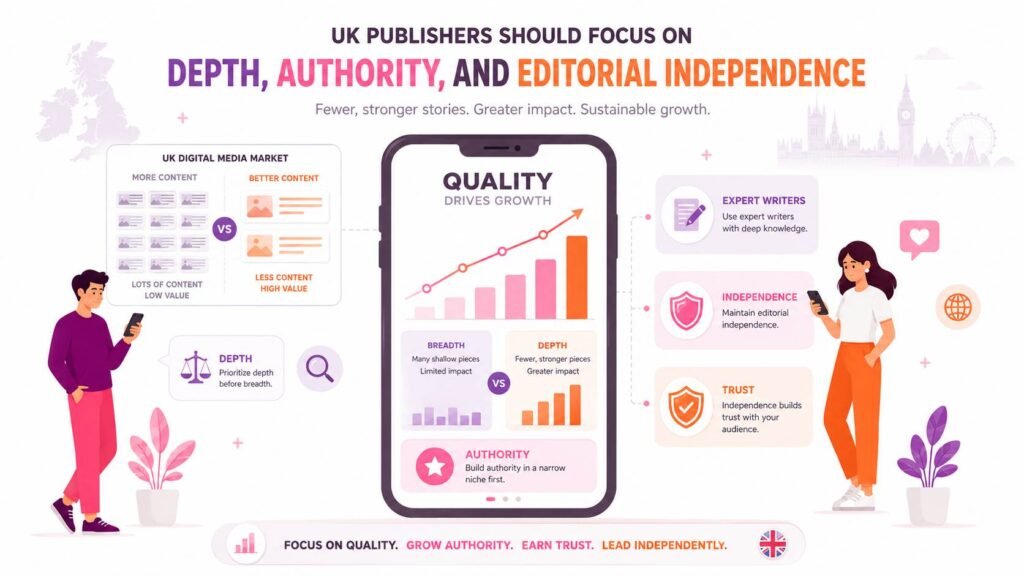
The digital media landscape in the UK is not short of content. It is short of content worth reading. The platforms that will matter in five years are not the ones publishing the most, but the ones that have staked out a specific territory and covered it with genuine rigor.
If you are building or refining a specialist publication, prioritize depth before breadth. Establish authority in a narrow area first, then expand only once that foundation is solid. Invest in writers who actually know the subject, rather than generalists who can cover anything adequately but nothing exceptionally well.
Editorial independence is non-negotiable. Readers forgive gaps in coverage. They do not forgive the sense that a publication’s conclusions are shaped by commercial relationships rather than honest analysis. In a niche space where your audience is often experts themselves, that credibility gap will not go unnoticed for long.
Disclaimer
This article is for general editorial and informational purposes only. It does not provide legal, financial, media investment, or publishing business advice. Any examples of specialist markets, review platforms, or entertainment sectors used to explain wider digital publishing trends should not be treated as recommendations or endorsements.
Where a website publishes reviews, comparisons, affiliate content, sponsored material, or content related to age-restricted sectors, it should comply with relevant UK advertising, consumer protection, and editorial transparency rules. Readers should always check local laws, age requirements, commercial disclosures, and independent sources before making decisions based on online review content.
References
- Newman, N., Fletcher, R., Robertson, C. T., Ross Arguedas, A., and Nielsen, R. K. (2025). Reuters Institute Digital News Report 2025. Reuters Institute for the Study of Journalism, University of Oxford. Published 17 June 2025.
- Egan, J. (2025). United Kingdom: Digital News Report 2025 Country Profile. Reuters Institute for the Study of Journalism, University of Oxford. Published 17 June 2025.
- Ofcom. (2025). News Consumption in the UK 2025: Research Findings. Office of Communications, London. Published 21 July 2025.
- Competition and Markets Authority. (2025). Fake Reviews Guidance: How Businesses Should Comply With Consumer Protection Law on Consumer Reviews. CMA208. Government of the United Kingdom. Published 4 April 2025.
- Advertising Standards Authority and Committee of Advertising Practice. (2023). Online Affiliate Marketing: AdviceOnline. ASA and CAP, London. Published 22 March 2023.
- Independent Press Standards Organization. (2021). Editors’ Code of Practice. IPSO, London. Updated version effective from 1 January 2021.