


Skincare trends cycle in and out of fashion with depressing regularity, but a handful of practices have survived centuries, and those are usually worth paying attention to. The hammam scrub is one of them. Heat, water, soap, and a vigorously applied mitt. No devices, no twelve-step routine, no serum that costs more per millilitre than petrol.
It has also quietly come back into British life, which is less of a novelty than it sounds. Britain had an enormous appetite for this sort of bathing once, built hundreds of places to do it in, and then forgot about nearly all of them. That history is worth knowing before you book anything, partly because it explains why a British “Turkish bath” and an actual hammam are not quite the same thing.
Where The Ritual Actually Comes From
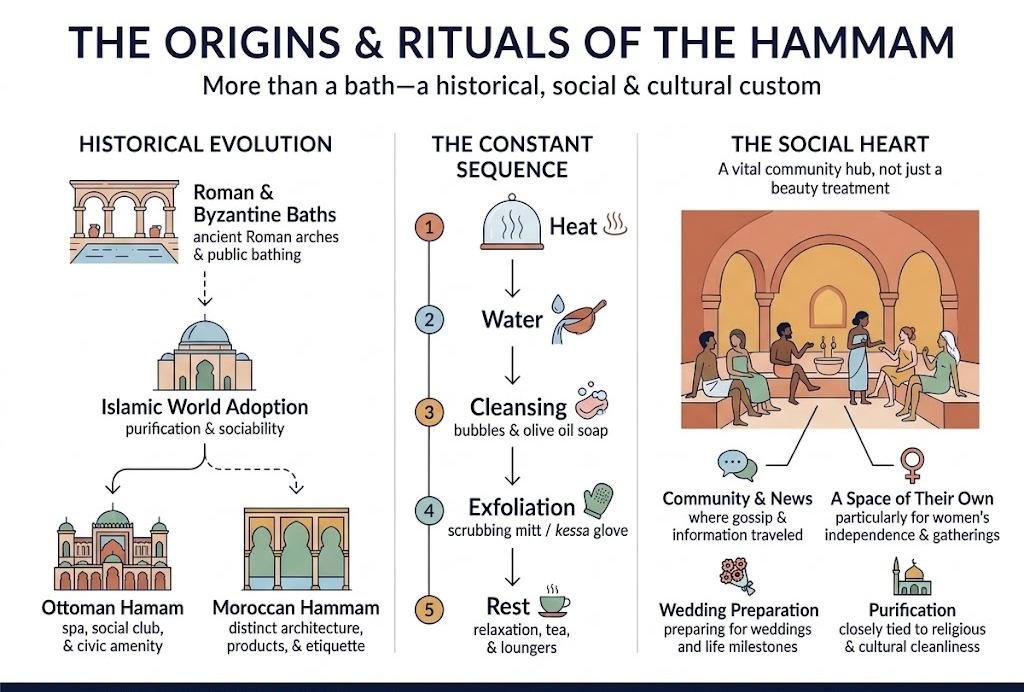
The hammam descends from Roman and Byzantine public bathing, which spread and adapted as bathing culture developed across the Islamic world. Bathhouses became community infrastructure, tied up with cleanliness, sociability and religious customs around purification. They were not simply places to get clean. They were where you went.
The Ottoman Empire expanded that culture considerably, and Istanbul in particular filled up with elaborate public bathhouses that functioned as something between a spa, a social club and a civic amenity. Separately, distinct traditions developed across Morocco and the rest of North Africa, with their own architecture, products and etiquette. The Moroccan hammam and the Turkish hamam are relatives rather than twins.
What stayed constant across all of them was the sequence: heat, water, cleansing, exfoliation, rest. Everything else varied.
The social function matters more than it might appear. Hammams were where weddings were prepared for, where news travelled, where women in particular had space of their own. Treating the practice as a beauty treatment that happens to be old rather misses what it was actually for.
Victorian Craze Britain Forgot About
Here is the part that tends to surprise people. Britain did not import hammam culture in the 2010s along with flat whites and sourdough. It imported it in the 1850s, enthusiastically, and at scale.
The chain of events is almost comic. David Urquhart, a Scottish diplomat and briefly the MP for Stafford, travelled through Spain and Morocco and wrote a book about it in 1850 called The Pillars of Hercules, in which he described the hot-air baths he had found. Dr Richard Barter, an Irish physician running a hydropathic establishment at St Ann’s near Blarney in County Cork, read it and, by his own account, was electrified. He invited Urquhart over to help him build one.
The first attempt failed. Barter persevered, sent his architect to Rome to study the ruins of the Roman thermae, and in 1856 opened what became the first modern hot-air bath in the British Isles. Manchester got the first public one on the British mainland the following year, the first since the Romans left. London followed in 1860, on Bell Street near Marble Arch.
After that it became a genuine movement. Somewhere between 600 and 700 Victorian Turkish baths opened across the British Isles over the next 150 years, many of them built by municipal authorities alongside swimming pools, on the reasoning that hot-air bathing cleaned people more effectively and more cheaply than filling individual tubs. Malcolm Shifrin’s research archive documents the whole phenomenon in forensic detail and lists the handful still operating, which is somewhere around sixteen.
Barter made one significant change, and it is the reason British and Turkish bathing went separate ways. He decided the baths Urquhart had described were too humid, and that dry heat was both more tolerable and more useful. His version, patented in 1859, was a dry hot-air bath modelled on the Romans rather than a steamy one modelled on the Ottomans. In Germany these are still called Roman-Irish baths, which is a more honest name.
| Traditional Hammam | Victorian Turkish Bath | |
| Heat | Humid, steam-heavy | Dry hot air, several rooms of increasing heat |
| Origin of the design | Ottoman and North African bathhouse tradition | Roman thermae, reinterpreted in 1850s Ireland |
| The scrub | Central, performed with a kessa mitt | Often optional, sometimes a soap massage |
| Social role | Community institution over centuries | Municipal amenity, then a Victorian health fashion |
The decline started after the First World War and accelerated after the Second. Most of the buildings were demolished, converted or quietly left to rot. Muslim Museum UK covers how thoroughly this chapter dropped out of the national memory, which is a pity, because it is one of the more unlikely examples of cultural exchange in British history.
So when a British hammam opens today, it is not quite a new arrival. It is a return.
What Actually Happens During A Scrub
The structure is consistent wherever you go. You spend time in a hot, humid room first, which is not a warm-up so much as preparation. Heat and moisture soften the outermost layer of skin and make the dead cells on the surface considerably easier to shift. Skipping this and going straight to scrubbing is both less effective and more uncomfortable.
Cleansing comes next. In the Moroccan tradition this usually means beldi, a soft olive-based black soap, left on the skin for several minutes to do its work before being rinsed.
Then the scrub itself. A hammam scrub is performed with a kessa, a coarse textured mitt, and the exfoliation comes from friction rather than from grit in a product. A therapist works systematically across the body, and the standard reaction from first-timers is mild horror at how much material comes off. Rolls of it. This is normal, it is dead skin rather than live tissue, and watching it happen is a significant part of why people find the experience satisfying.
Technique is what separates a good scrub from an irritating one. The mitt and the softened skin do the work; pressing harder does not remove more, it just inflames things. A therapist who knows what they are doing will adjust across different areas, because the skin on your shins is not the skin on your inner arm.
The session usually ends with rinsing, often a rhassoul clay mask or an oil, and then a period of sitting down doing nothing. That last part is not padding.
A few practical things about booking one in Britain, because the experience here differs from the one in Marrakech or Istanbul in ways nobody warns you about:
- Swimwear is normally expected, and usually required. Traditional hammams are far less clothed, and British venues have almost universally adapted
- Many places run single-sex sessions or have separate areas. Check before booking if that matters to you either way
- A scrub is physical and reasonably brisk. If you were expecting a spa massage, you will be surprised for the first ten minutes
- Allow longer than the treatment time on the booking. The heat phase and the cooling-down phase are both part of it, and leaving immediately afterwards defeats the purpose
- Eat something beforehand but not immediately beforehand, and drink water afterwards. Extended heat does what you would expect
The other difference is that a traditional hammam is a communal place where people talk, and most British versions are quiet treatment rooms. Neither is wrong, but if you have been to one abroad, the silence can feel oddly clinical by comparison.
Why The Skin Feels Different Afterwards
The mechanism is unglamorous. Your skin constantly sheds cells from its outer layer, but it does not always shed them evenly, and when they build up the surface feels rough and looks dull. Mechanical exfoliation removes some of that accumulation, which is why skin feels smoother immediately afterwards. It is a real effect and a temporary one, because the build-up starts again straight away.
Two honest caveats are worth stating, because the wellness industry tends not to.
First, exfoliation does not moisturise. It removes a layer; it does not add anything. Skin often feels better afterwards partly because people apply oil or moisturiser to freshly scrubbed skin, and that combination works well. The scrub creates a better surface for whatever goes on next, but it is not a substitute for the next step.
Second, more is not better. Dermatologists are consistent that mechanical exfoliation needs matching to your skin, and the American Academy of Dermatology’s guidance on exfoliating safely is blunt about it: mechanical methods can be too irritating for dry, sensitive or acne-prone skin, and people with deeper skin tones or a tendency to mark after spots or bites should be cautious with aggressive scrubbing, because it can trigger lasting dark patches. That is a genuine risk rather than a disclaimer, and it is the single most useful thing to know before booking.
A sensible frequency for most people is somewhere between fortnightly and monthly, adjusted to how your skin actually responds. If it is still pink and tight two days later, you went too hard or too often.
There is a specifically British complication here, and it affects a majority of the country. Around 60% of UK households live in hard or very hard water areas, covering most of England including London, the South East, East Anglia, the Midlands and Yorkshire, with London tap water running at roughly 250 to 300 mg of calcium carbonate per litre. Research led by the University of Sheffield and King’s College London found that washing in hard water leaves more surfactant residue on the skin, raising surface pH towards alkaline and increasing water loss through a weakened barrier. Soap plus hard water is harder on skin than soap alone.
Which means that if you live in London or Birmingham and you have just had your stratum corneum thoroughly scrubbed, your skin barrier is in a more vulnerable state than the ritual’s North African origins would suggest. Moisturise properly afterwards, and consider going gentler than you would on holiday in Marrakech.
Some people should approach the whole thing with more care, or ask a GP or dermatologist first:
- Anyone with eczema, psoriasis, rosacea or an active flare-up of any inflammatory skin condition
- Anyone currently using prescription retinoids, acid treatments or isotretinoin
- Anyone who has recently waxed, shaved closely, had laser treatment or caught the sun
- Anyone with diabetes or reduced skin sensation, where small breaks in the skin matter more
- Anyone who scars easily or develops dark marks after minor skin trauma
- Anyone with open cuts, infections or anything that is already sore
The British Association of Dermatologists publishes patient information on most of these conditions, and it is a better starting point than a spa’s FAQ page.
Part That Has Nothing To Do With Skin
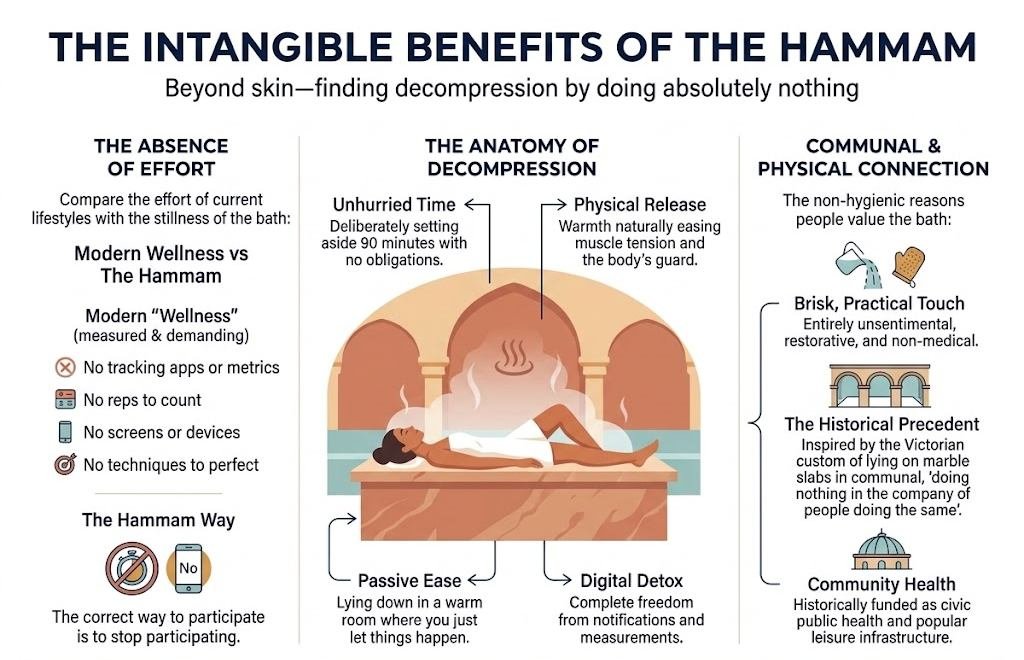
Ask people who go regularly what they get out of it and the exfoliation usually comes second.
Warmth, an hour with no obligations, and a slow sequence of cleansing produces a particular kind of decompression that is hard to manufacture any other way. The useful feature is that it asks almost nothing of you. There are no reps to count, no technique to get right, no app tracking whether you did it properly, and crucially no screen. You lie down in a hot room and things happen to you.
That is unusual. Most modern wellness involves effort and measurement, which is fine but is also a second job. A hammam is one of the few remaining activities where the correct way to participate is to stop participating.
Heat probably contributes something physiological to the sense of release, and muscles do feel less guarded when they are warm. That does not make any of this a medical treatment for stress, pain or anything else, and nobody should sell it as one. The value is simpler and does not need inflating: deliberately setting aside ninety minutes for something unhurried is, in itself, increasingly rare.
The Victorians, for what it is worth, understood this part perfectly well and wrote about it at length. The appeal of their baths was never purely hygienic. It was the hours spent lying on a marble slab in a warm room, reading nothing, doing nothing, in the company of people doing the same. Municipal authorities funded them partly as public health infrastructure and partly because they were popular, which is a combination that has largely stopped existing.
There is also something worth noticing about being touched in a purely practical, non-medical way, which most adults in Britain experience almost never. A scrub is brisk and impersonal and entirely unsentimental, and a surprising number of people find that is precisely what makes it restorative rather than awkward.
Why An Old Idea Keeps Working
The staying power probably comes down to how little there is to it. Heat prepares the skin. Soap lifts dirt and oil. Friction removes dead surface cells. Then you cool down and drink something. Four steps, all of which make obvious physical sense, none of which require a subscription.
That simplicity translates well into a culture that has started taking recovery as seriously as exertion. People who already think about sleep, training load and nutrition tend to find a centuries-old bathing ritual slots in without much explanation needed. It is built around spending time rather than saving it, which is the opposite of nearly everything else being sold as self-care.
It is also worth taking the cultural history seriously rather than treating this as a newly invented trend with an exotic name. These practices developed across generations, in specific places, with their own etiquette and social meaning, and a hammam in Fez is not a spa treatment with better branding. Britain’s own Victorian chapter is a reminder that borrowing goes both ways and has been going on a long time.
Before You Book One
If you have never had one, go in knowing three things.
It is more physical than a massage and less relaxing in the moment than the photographs suggest, at least during the scrub itself. The payoff arrives afterwards. Say something if the pressure is too much, because a competent therapist will adjust immediately and would far rather you spoke up. And leave the rest of the day fairly empty if you can, because rushing off afterwards wastes most of the point.
A hammam scrub will leave your skin smoother for a while. That is the smallest thing it does. The rest is heat, time, and an hour where nothing is asked of you, which is an old idea that has outlasted an awful lot of newer ones.
Disclaimer
This article is provided for general information only and does not constitute medical advice. It is not a recommendation of any particular treatment, venue or product. Anyone with a diagnosed skin condition, diabetes, reduced skin sensation, a tendency to scar or pigment after minor injury, or who is pregnant, taking prescription skin treatments, or recently had waxing, laser treatment or sun exposure, should consult a GP, pharmacist or dermatologist before undergoing intensive physical exfoliation. Stop any treatment that causes pain, and seek medical advice for skin that remains red, broken or sore afterwards. Research findings cited reflect the samples and conditions described in the original publications; readers should note that the water hardness study referenced was funded in part by a commercial water softening company. Figures cited were accurate at the date of the sources listed below.