


Walk through the wellness aisle of any online marketplace in Britain right now, and you will find small devices promising to calm your nervous system by stimulating the vagus nerve. Some clip onto your ear. Some press against the side of your neck. Some sit inside the outer ear like an earbud. They tend to share a phrase on the packaging: non-invasive vagus nerve stimulator, and that shared phrase does a lot of quiet work hiding how differently they actually behave.
They do not reach the nerve in the same place. They do not use the same electrical settings. And they do not feel the same to wear. If you are trying to decide between two of them, the ear-or-neck question is the wrong place to start. The better question is which stimulation route, device design, evidence base, and daily routine actually make sense for what you want to use it for.
A Quick Anatomy Lesson Worth Having
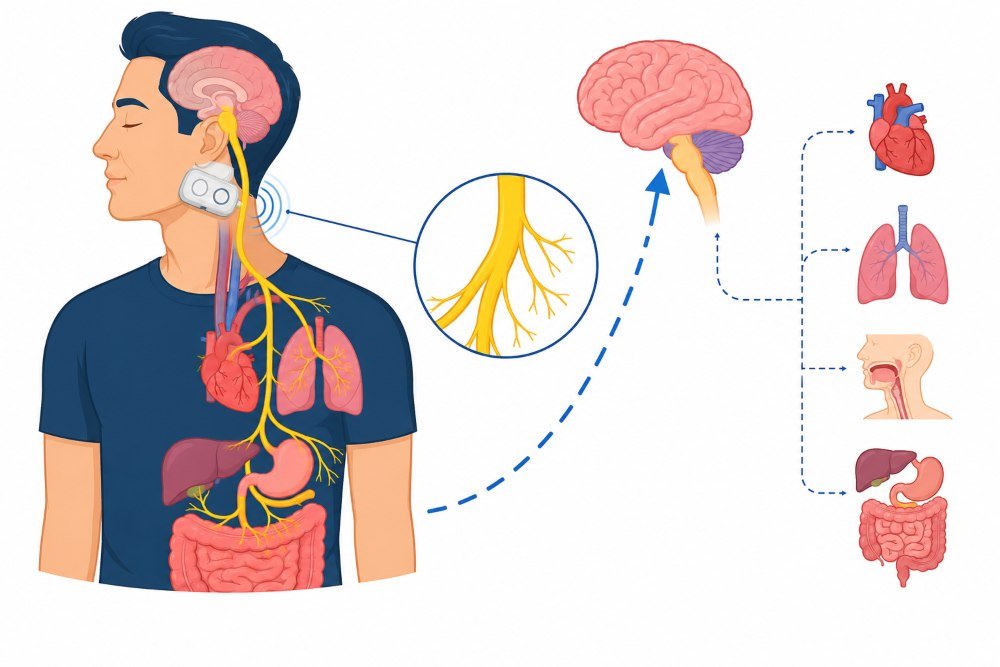
The vagus nerve is the tenth cranial nerve, and it is one of the longest communication routes in the body. It leaves the brainstem, runs down through the neck alongside major blood vessels, and branches out into the chest and abdomen, touching the heart, lungs, throat and digestive system on the way.
Two details matter for anyone shopping for a device. First, most of the nerve’s fibres are afferent, meaning they carry signals from the body up towards the brain rather than the other way round. So stimulation is not simply the brain telling your organs to relax. Much of the interest is in changing the sensory traffic heading up into the brainstem and higher networks. Second, the vagus is a central part of the parasympathetic nervous system, the branch associated with rest, digestion and recovery, which is why these devices are so often discussed alongside sleep, focus and stress. The NHS overview of the nervous system is a reasonable starting point if the biology is unfamiliar.
The nerve is not a switch, though. What stimulation does depends entirely on which fibres are reached and how the signal is delivered.
What Non-Invasive Actually Means Here
The original form of vagus nerve stimulation is surgical. A pulse generator is implanted under the skin of the chest and wired to the cervical vagus nerve, then programmed by a clinical team. In the UK, this implanted form is used for specific conditions and is nothing like a consumer purchase.
Non-invasive VNS skips the surgery and delivers current through electrodes on the skin. There are two broad approaches, and the abbreviations are worth learning because product pages use them freely. Transcutaneous auricular VNS, or taVNS, uses selected parts of the outer ear. Transcutaneous cervical VNS, sometimes written tcVNS or nVNS, is applied to the side of the neck.
Here is the trap. Non-invasive and consumer are not synonyms. Some neck devices are prescription-grade medical technologies with condition-specific clearance and a clinical evidence file behind them. Others sharing the VNS label are general wellness gadgets. The intended use and regulatory status belong to the specific product, not to the category.
How the Ear Route Works
Ear-based stimulation aims at the auricular branch of the vagus nerve, which supplies part of the external ear. Devices deliver mild pulses through a clip, a shaped earpiece or an earbud-style electrode. The areas most discussed in Research are the cymba conchae and the tragus, the small flap in front of the ear canal.
The important caveat is that the whole ear is not vagal territory. Other sensory nerves supply the outer ear too, and the exact map varies from person to person. So a tingle somewhere on your ear does not prove the vagal fibres are being engaged. It might just be a different nerve responding.
The appeal is practical. The auricular branch sits close to the surface, so the hardware can be compact and often hands-free, worn while you read, meditate or wind down before bed. The difficulty is contact. Ear anatomy differs enormously, and fit, pressure, moisture and positioning all affect whether the session is comfortable and consistent. If you have ever fought to keep a particular brand of earbud in place, you already understand the problem.
Most of the auricular vagus nerve stimulators on the consumer market are built around this hands-free promise, so contact quality is worth scrutinising before you buy.
How the Neck Route Works
Cervical VNS is applied to the outside of the neck, but the nerve there runs deeper, bundled with major vascular and neural structures. So a neck device is not touching an exposed nerve. It is pushing an electrical field through skin and tissue towards a target it cannot see.
Neck products take a few forms: a handheld unit pressed against one side, a wearable collar, paired contact surfaces, usually with a conductive gel to improve the connection. Some sessions are deliberately brief. The prescription device gammaCore, for instance, is held against the neck for stimulations lasting around two minutes within its defined protocol. As the clinical practice guideline on non-invasive VNS for cluster headache describes, the standard use is two consecutive two-minute doses over the cervical vagus, with the user increasing intensity until they feel a slight pull at the corner of the mouth.
That two-minute figure is specific to that device and its dosing. It is not a universal rule, and a consumer neck wearable with a different waveform should not borrow it.
Depth is the real limitation. Reaching the vagus through the neck is technically harder than stimulating superficial ear fibres, and a stronger skin sensation can mean you are stimulating surface muscles or other nerves rather than achieving better vagal engagement. This is exactly why the intuition that neck stimulation must be stronger or more direct deserves suspicion.
Ear vs Neck at a Glance
| Feature | Ear-based VNS | Neck-based VNS |
| Technical term | taVNS or auricular VNS | tcVNS, cervical VNS or nVNS |
| Stimulation location | Selected region of the outer ear | Side of the neck |
| Intended target | Auricular branch of the vagus nerve | Cervical vagus nerve |
| Common form | Ear clip, earpiece or earbud-style wearable | Handheld unit, contact device or collar |
| Typical session | Often hands-free and longer | Often shorter and deliberately positioned |
| Main fitting issue | Ear shape and electrode contact | Accurate placement and stable neck contact |
| Common sensation | Tingling or pulsing in the ear | Tingling, vibration or mild muscle twitch in the neck |
| Regulatory examples | Research, prescription and wellness devices exist | Prescription and wellness devices exist |
Is the Ear Route Safer Than the Neck?
It is tempting to crown one location as safer, but safety depends on more than placement.
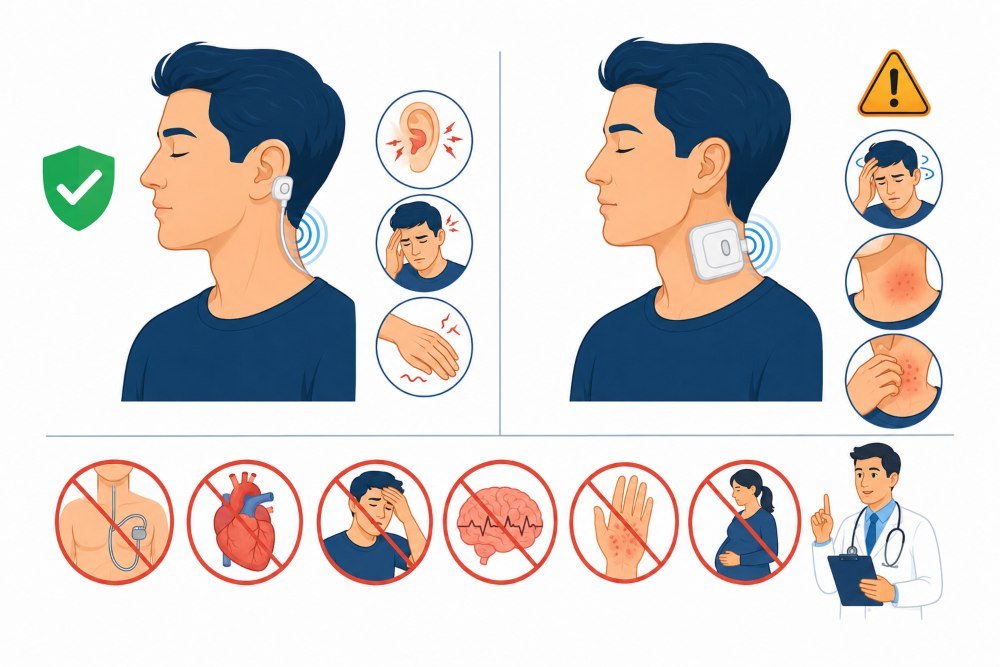
On the ear side, a large systematic review pulled together 177 studies covering 6,322 participants and found no significant difference in adverse-event risk between active taVNS and control groups. The most commonly reported effects were ear pain, headache and tingling. The authors were candid that safety reporting was patchy, with more than half the studies not mentioning adverse events at all, so this is reassuring rather than definitive. And a good research safety record does not make every consumer ear gadget risk-free. Poor electrode contact can cause sharp or irritating sensations, an earpiece that presses too hard can hurt, and improvised placement can stimulate somewhere the designer never intended.
Neck devices carry a different profile. The NICE evaluation that led to gammaCore being recommended on the NHS for cluster headache, published as medical technologies guidance, records effects such as dizziness, local discomfort and skin reactions among some users. Regulated neck products come with defined designs, output limits, instructions and contraindications. A generic electrical stimulator planted on the neck offers none of those safeguards.
Some people should get professional advice before using any electrical neurostimulation at all: anyone with an implanted electrical device such as a pacemaker, a significant heart condition, a history of fainting, a seizure disorder, active skin problems at the contact site, or who is pregnant. The device’s own warnings always take priority over anything you read online, including this article.
Which Route Has Better Evidence?
This depends entirely on the outcome you care about, which is precisely why the blanket question is unhelpful.
Cervical VNS has the clearer regulatory track record for defined medical uses. Specific neck devices hold clearance for particular headache indications, and gammaCore’s NHS adoption for cluster headache is the obvious British example. That history does not extend to every neck wearable on sale.
Auricular VNS, meanwhile, has been investigated across a genuinely wide spread of areas: mood, sleep, cognition, rehabilitation, pain and autonomic function among them. The field is active, but the studies vary in almost every parameter that matters, including electrode placement, frequency, pulse width, current, duty cycle, session length, population and how outcomes were measured. A frequently cited critical review concluded there is no firm evidence pointing to one optimal location or setting for every purpose.
So when a product page boasts a long list of references, apply a few filters. Was the exact commercial device tested, or just the general technique? Did the study electrode sit where the marketed one sits? Was it randomised and controlled, with an adequate sham? Did it measure a real clinical outcome or a short-term biomarker that may not translate into anything you would notice? A wall of citations is not the same as evidence for the thing in your basket. The Cochrane Library is a good neutral place to double-check what high-quality evidence actually exists for a given claim.
Comfort, and Why It Is Personal
Comfort resists generalisation. An ear clip that one person forgets they are wearing will drive another to distraction, depending on cartilage thickness, skin sensitivity, piercings and electrode pressure. Concha-style earpieces spread contact more broadly but do not fit every ear. Neck devices spare the ear entirely, but some people dislike the throat sensation or the mild muscle response, and the conductive gel adds a preparation and cleanup step.
Please weigh whether the device offers adjustable intensity, whether the ear component comes in more than one size, whether electrode pressure can be changed, whether gel is needed, whether you have to hold it throughout, and whether movement shifts the contact point. A technically impressive device is useless if the experience is too unpleasant to repeat, and consistency is where any benefit would come from.
Which Fits Real Life Better?
Ear-based devices tend to suit people who want a hands-free routine, plan to use it while reading or meditating, prefer a longer low-disruption session, want something compact for travel, or dislike holding something against their throat.
Neck-based devices tend to suit people who prefer a short deliberate session, do not want an electrode on the ear, are happy positioning a handheld unit precisely, want a device built around a specific cervical protocol, and do not mind the gel step.
Neither has to run continuously to earn a place in your day. Some people benefit from a short, intentional pause; others find a hands-free wearable easier to keep up. The best design is the one that removes friction without inflating expectations.
Slower Session, Weaker Effect? Not Necessarily
Do not confuse session length with strength. An ear device might suggest twenty minutes while a cervical device runs for a couple, but that does not make the neck device four or five times more powerful. Systems differ in current amplitude, pulse width, frequency, electrode size, tissue path and duty cycle. Total stimulation dose cannot be read off the clock. A short session can use a deliberately intense waveform; a long one can use gentle intermittent pulses. Follow the schedule designed for your specific product rather than importing a timing from something unrelated.
How to Actually Compare Two Devices
Skip past the ear-versus-neck headline and interrogate the specifics.
Look at the stimulation route and whether the company names an anatomical target or hides behind vague talk of activating your nervous system. Check the exact placement, tragus versus concha for an ear device, precise contact instructions for a neck one. Ask whether the cited evidence used the actual product or just the category. Read the regulatory language carefully, because in the UK a device legitimately placed on the market carries a UKCA or, during the ongoing transition, a CE mark, and genuine medical devices must be registered with the Medicines and Healthcare products Regulatory Agency. A wellness gadget marketed only for relaxation may carry neither a medical claim nor medical clearance, and that is a meaningful distinction rather than a technicality.
Then weigh the practical realities: session length and frequency, whether contact is stable without excessive pressure, whether it needs gel or replacement electrodes, whether it works without a phone or leans on an app that mostly harvests data and pushes a subscription, what the product is actually positioned to do, whether contraindications are visible before purchase, and what the ongoing cost looks like once you factor in gel, electrodes, accessories and app tiers. A cheap device with expensive consumables is not cheap. If you want a worked example of that kind of side-by-side thinking, this breakdown that helps you compare vagus nerve stimulation devices runs through several popular models against these criteria.
What Stimulation Should Feel Like
A non-invasive session is usually described as gentle tingling, mild pulsing, light buzzing or a faint warmth at the contact point, and it should stay tolerable throughout. Pain, burning, a severe headache, marked dizziness, chest discomfort, breathlessness or faintness are not signs it is working better. They are signs to stop and reassess.
If the sensation turns sharp, check placement and contact first. Dry or incomplete contact can funnel current into a tiny area and make it bite. Turning up the intensity is rarely the fix, because more current can mean a stronger skin or muscle sensation without any more vagal engagement.
Can You Use a TENS Machine?
Plenty of British households already own a TENS unit, often bought for back pain or labour, so the question is natural. The honest answer is no, not safely, unless the manufacturer explicitly supports it. A standard TENS device is designed for peripheral pain relief. Research TAVNS setups may use stimulators that resemble TENS hardware, but they pair it with defined ear electrodes, controlled parameter ranges and laboratory procedure. Clipping a cheap electrode onto a general TENS unit does not reproduce a validated protocol, and using one on the neck raises real placement concerns given the muscles, blood vessels and other nerves crowded into that area. The British Pain Society is a sober source on what electrical stimulation can and cannot do for pain, which is worth reading before improvising.
Six Myths Worth Retiring
- Neck devices hit the main nerve, so they must work better. The cervical vagus is deeper, and delivering a field to the right target is not automatically easier than reaching superficial ear fibres. A strong sensation does not confirm selective vagal activation.
- Ear devices only touch a tiny branch, so they must be weaker. That branch feeds sensory information into central pathways, and its relevance cannot be judged by its physical size.
- Non-invasive means safe for everyone. It does not. Non-invasive products can still cause unwanted effects and may be unsuitable for people with certain conditions.
- A registered company means an approved device. Registration, clearance and approval are different regulatory concepts, and the wording should be checked rather than assumed.
- More intensity means better results. Intensity is one variable among several. Placement, waveform, pulse width, frequency and duration all matter.
- One device can fix every stress-related problem. Poor sleep, anxiety, fatigue, digestive trouble and difficulty concentrating have many possible causes, and a wearable is no substitute for proper assessment.
Bottom Line
Ear and neck VNS are two distinct routes to the vagus without surgery. Auricular devices offer a superficial ear target, compact hardware and the possibility of hands-free use. Cervical devices offer a neck route that can support brief, deliberate sessions and includes some genuinely validated medical applications.
Neither wins by default. A neck device is not automatically more effective for sitting over the main trunk, and an ear device is not automatically safer or more convenient for everyone. Design, electrical parameters, contact quality, evidence, intended use and how well it fits your day all shape the outcome.
Before you buy, look for a clearly defined stimulation site, realistic claims, transparent safety guidance, comfortable contact, an achievable schedule, evidence relevant to the actual product, honest regulatory language and a design that fits your life. The best wearable is not the one with the strongest jolt or the boldest promise. It is the one whose technology, evidence and routine are explained clearly enough for you to make an informed decision.
Medical disclaimer: This article is for general information only and is not medical advice. It is not intended to diagnose, treat, cure or prevent any condition. Vagus nerve stimulation devices vary widely in their regulatory status and intended use, and consumer wellness products should not be treated as medical treatments. If you have a health condition, take medication, are pregnant, or have an implanted electrical device such as a pacemaker, speak to a GP, pharmacist or other qualified healthcare professional before using any electrical neurostimulation device. Always follow the manufacturer’s instructions and contraindications, and stop use if you experience pain or other concerning symptoms.
References
- Redgrave J and others. Safety of transcutaneous auricular vagus nerve stimulation (taVNS): a systematic review and meta-analysis. Scientific Reports, 2022. https://www.nature.com/articles/s41598-022-25864-1
- Goadsby PJ and others. Non-invasive vagus nerve stimulation in cluster headache: a clinical practice guideline. Pain Practice, 2025. https://onlinelibrary.wiley.com/doi/10.1111/papr.70084
- National Institute for Health and Care Excellence. gammaCore for cluster headache (Medical technologies guidance MTG46), 2019. https://www.nice.org.uk/guidance/mtg46
- Medicines and Healthcare products Regulatory Agency. https://www.gov.uk/government/organisations/medicines-and-healthcare-products-regulatory-agency
- Cochrane Library. https://www.cochranelibrary.com/
- NHS. Peripheral nervous system and related conditions. https://www.nhs.uk/conditions/peripheral-neuropathy/
- British Pain Society. https://www.britishpainsociety.org/