



There was a time when proxies were a niche tool tucked away in a developer’s toolkit. That is no longer the case.
In 2026, choosing the right proxy provider has become as strategically important as choosing a CRM or a cloud hosting platform. For UK businesses especially, the stakes are high: websites are growing smarter at detecting automated traffic, geo-restrictions are tightening, and data privacy laws such as the UK GDPR are demanding cleaner, more accountable ways of operating online.
Residential proxies sit right at the intersection of all of this. They do not just help businesses “get around” obstacles. They help companies move through the modern web the way a real user would, quietly, naturally, and without friction.
What Are Residential Proxies?

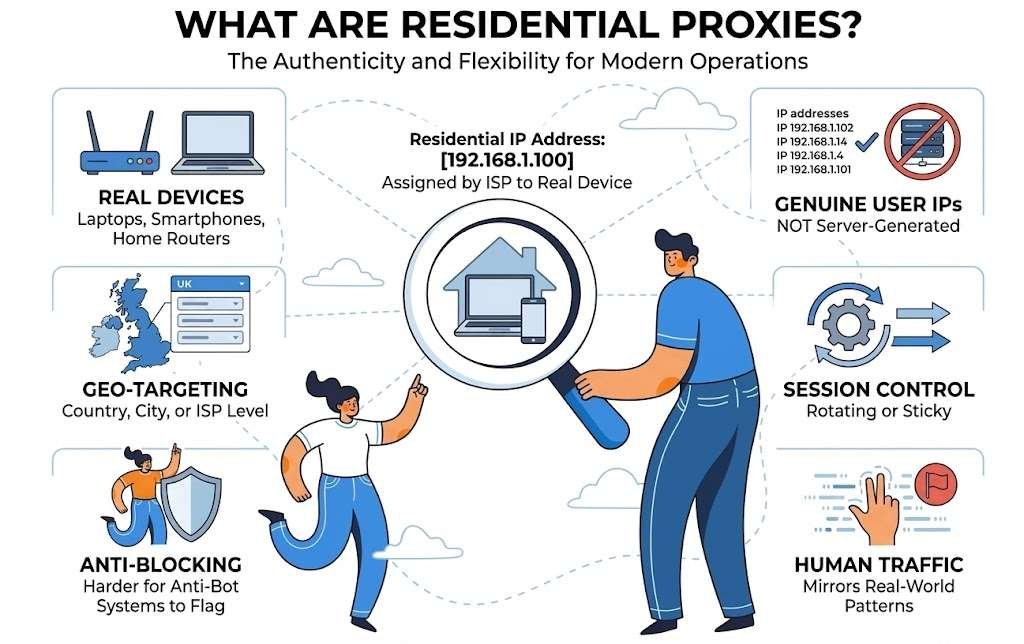
At their core, residential proxies are straightforward in concept but powerful in practice.
They are IP addresses assigned by Internet Service Providers (ISPs) to real physical devices: laptops, smartphones, and home routers. When your traffic routes through one of these IPs, it blends in with ordinary browsing behavior. To any website or platform receiving that request, it looks entirely human.
That subtle difference changes everything.
What sets residential proxies apart from other proxy types:
- They use genuine user IP addresses, not server-generated ones
- You can target specific locations, right down to the city or ISP level
- Sessions can rotate automatically or stay consistent, depending on your workflow
- They are significantly harder for anti-bot systems to flag or block
- They mirror real-world browsing patterns, avoiding the red flags that datacenter proxies routinely trigger
For UK businesses gathering public data, running ad verification, managing multiple accounts, or expanding into international markets, this combination of authenticity and flexibility is exactly what modern operations require.
Why Residential Proxies Matter More Than Ever in 2026
The internet is not as open as it once felt.
Behind the scenes, tracking and detection systems have become considerably more sophisticated. They analyze behavior over time, detect patterns, and filter out anything that feels automated or non-human.
At the same time, several pressures have converged for UK businesses in particular:
- Tighter geo-restrictions across media, pricing, and data platforms
- Data accuracy has become business-critical, especially in eCommerce and market research.
- Regulatory complexity is growing, with the UK Online Safety Act (which came into force in July 2025) adding new layers of compliance for platforms handling user data.
According to research highlighted by Decodo, the UK has seen a 65% rise in proxy users and an 88% increase in proxy-generated traffic over the past year alone, driven by businesses seeking greater control, reliability, and confidence in compliance.
Residential proxies answer that challenge not by forcing access, but by fitting in naturally.
Key Benefits of Using Residential Proxies
1. Higher Anonymity and Genuine Trust
There is a meaningful difference between being hidden and being believable.
Residential proxies do not just mask your identity. They make your activity look legitimate from the moment the first request is sent. That means fewer blocks, fewer CAPTCHA interruptions, and smoother workflows overall.
In high-protection environments, success rates with residential proxies can reach 85-95%, far outpacing traditional datacenter proxy setups. For UK businesses running time-sensitive data operations, that difference in reliability translates directly into cost savings and fewer disruptions.
2. Reliable Web Scraping and Data Collection
Web scraping is one of the most widespread applications of residential proxies, and for good reason. Approximately 34.1% of all residential proxy usage is tied directly to data collection activities.
For businesses whose decisions depend on reliable, high-volume public data, residential proxies make the difference between smooth, consistent collection and an endless cycle of failed requests and blocked sessions.
Key advantages for data teams include:
- Stable session management across long collection runs
- Reduced failed requests, saving engineering time and infrastructure costs
- Ability to rotate IPs intelligently when detection signals degrade
- Access to geo-specific data without distortion from server-based routing
Whether you are monitoring competitor pricing, scraping property listings, or gathering market intelligence, the Stability that residential proxies provide is genuinely valuable.
3. Accurate Geo-Targeting for UK and International Markets
One of the most practical benefits for UK-based teams is the ability to see the web exactly as a real customer in a specific location would.
With residential proxies, businesses can:
- Check localized pricing on competitor websites
- Test regional marketing campaigns before launching
- Validate how search results appear across different UK postcodes or international markets
- Verify that localized content, offers, and landing pages are displaying correctly
Because the IPs are tied to real-world geography and genuine ISP assignments, the data you get back reflects reality rather than a filtered or averaged version. This is especially useful for UK retailers expanding into EU markets post-Brexit, where pricing and content can vary significantly by country.
4. Ad Verification and Brand Protection
Digital advertising is not always as transparent as it looks.
Fraudulent impressions, misplaced ads, and competitor monitoring are persistent problems for UK marketing teams. Residential proxies help by allowing teams to:
- Verify that ads are appearing in the correct placements and regions
- Spot fraudulent or bot-driven impressions before the budget is wasted
- Monitor competitor ad strategies from multiple geographic vantage points
- Confirm that brand guidelines are being respected across affiliate networks
This is less about chasing problems after the fact and more about maintaining clear visibility into where your budget is actually going.
5. Scalable Multi-Account Management
Managing multiple accounts across platforms can quickly become complicated without the right infrastructure.
Without proper IP separation, platforms flag accounts, restrict access, or shut operations down entirely. Residential proxies make it possible to:
- Run multiple accounts safely with clean IP identities
- Keep accounts separate and stable over the long term
- Automate account actions without triggering detection systems
This is particularly relevant for UK businesses operating in:
- Social media management (multiple client accounts)
- E-commerce (multiple seller accounts across platforms like Amazon UK or eBay)
- Automation-heavy workflows where consistent identity management is essential
6. Stronger Security and Compliance Alignment
The proxy space is undergoing a genuine shift in 2026. Performance alone is no longer enough. Increasingly, UK businesses are paying close attention to the origins of proxy IPs and how they are sourced.
The key questions being asked now include:
- Is this provider operating a consent-based IP network?
- Are data practices transparent and auditable?
- Does the provider align with UK GDPR and responsible usage frameworks?
According to the ICO (Information Commissioner’s Office), UK businesses have a legal obligation to ensure that any third-party data tool they use is compliant with applicable data protection law. Choosing a residential proxy provider that sources IPs ethically and transparently is no longer just good practice; it’s essential. In many cases, it is a compliance requirement.
Residential Proxies vs Traditional Proxies: A Full Comparison
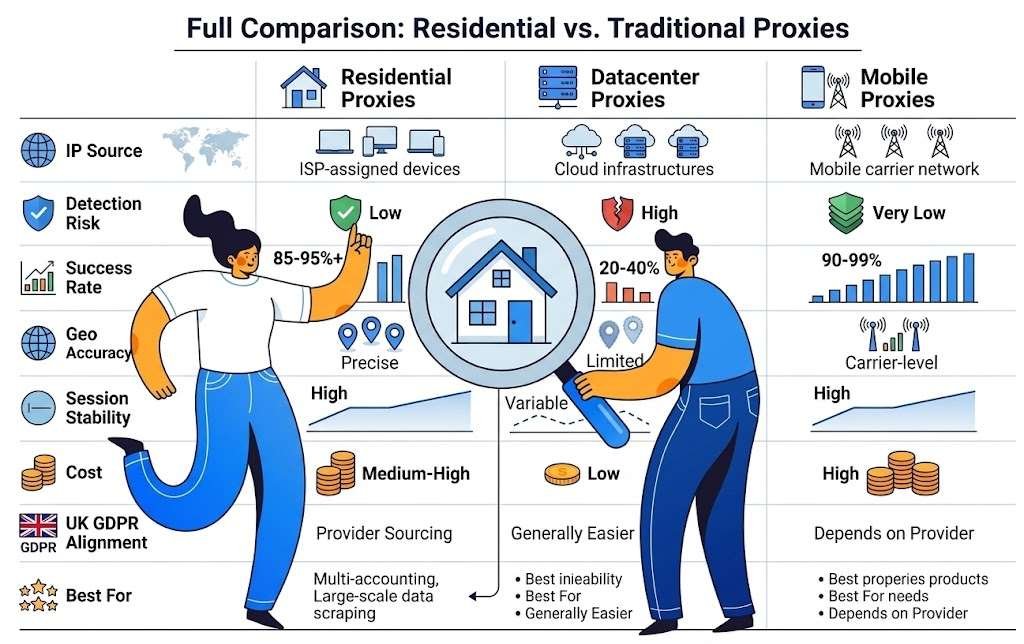
| Feature | Residential Proxies | Datacenter Proxies | Mobile Proxies |
|---|---|---|---|
| IP Source | Real ISP-assigned devices | Cloud infrastructure | Mobile carrier networks |
| Detection Risk | Low | High | Very Low |
| Success Rate | 85–95%+ | 20–40% | 90–99% |
| Geo Accuracy | Highly precise | Limited | Carrier-level precision |
| Session Stability | High (sticky or rotating) | Variable | High |
| Cost | Medium to High | Low | High |
| UK GDPR Alignment | Depends on provider sourcing | Generally easier | Depends on provider |
| Best For | Data collection, ads, multi-accounting, research | Basic tasks, low-risk requests | Mobile app testing, verification |
The table above makes clear that residential proxies hit the right balance for most UK business use cases. Mobile proxies offer even higher trust levels but at a higher cost. Datacenter proxies remain useful for simpler, lower-risk tasks where detection is not a major concern.
How UK Businesses Are Actually Using Residential Proxies
Residential proxies are not theoretical infrastructure. They are deeply embedded in day-to-day operations across UK industries.
By sector:
- eCommerce: Price monitoring, competitor stock tracking, review scraping, multi-account seller management
- Digital marketing: Localized ad verification, SEO rank tracking across regions, campaign validation
- Finance and fintech: Market data collection, compliance monitoring, fraud detection
- Cybersecurity: Penetration testing with local IP footprints, threat intelligence gathering, dark web monitoring
- Media and publishing: Content access verification, geo-compliance checking, licensing validation
As highlighted by Business Matters magazine, UK firms across eCommerce, finance, digital marketing, fintech, and cybersecurity are leading the shift toward proxy infrastructure. In many cases, these tools have moved from “nice to have” to core business infrastructure.
For those of us managing the practical side of online business in the UK, this connects closely to the broader question of how to work smarter and more efficiently online.
UK Regulatory Picture in 2026
UK businesses face a more complex regulatory environment than many other markets. Two pieces of legislation are particularly relevant when considering residential proxy use:
- UK GDPR: Any data you collect through automated means, including via proxies, must comply with UK GDPR principles. Publicly available data is generally fair game, but how it is stored, processed, and used matters enormously.
- The Online Safety Act 2025: Platforms operating in the UK must now implement stricter user verification and content moderation. Businesses using proxies for platform access or data gathering need to ensure their methods remain within the Act’s provisions.
The ICO’s guidance on web scraping and automated data collection is worth reviewing for any UK business that relies heavily on residential proxies for data collection.
Choosing a proxy provider that is transparent about IP sourcing, maintains consent-based networks, and operates within GDPR-aligned frameworks is not just a best practice recommendation. It is the responsible foundation for any UK business operating at scale.
Market Growth and Where Things Are Heading
The residential proxy market is not slowing down. It is maturing.
What was once a “bigger pool is better” market is now shifting toward:
- Quality of IPs over sheer quantity
- Better session stability under load
- Transparent, ethically sourced networks
- GDPR-aligned operational frameworks
Some providers are now reporting success rates approaching 99% in optimized environments, reflecting just how far the technology has advanced. And as National World’s tech coverage has noted, the UK is emerging as one of the most sophisticated and demanding markets for enterprise-grade proxy technology globally.
Best Practices That Actually Make a Difference
Using residential proxies well is less about the tools themselves and more about how you deploy them. A few principles that consistently improve results:
- Rotate IP addresses when detection signals degrade, not on a fixed, random schedule
- Keep sessions stable for login-based or account-sensitive tasks
- Avoid aggressive request bursts that mimic bot behavior, even when using residential IPs
- Monitor success rates and failure patterns, not just raw traffic volume
- Always work with providers that prioritize ethical IP sourcing and comply with UK data protection expectations
- Keep your use case within the terms of service of the websites you are accessing
Small operational adjustments in these areas consistently lead to meaningful improvements in performance and longevity.
Frequently Asked Questions
Are residential proxies legal in the UK?
Yes, when they are sourced ethically and used in compliance with UK GDPR, the Online Safety Act, and the terms of service of the platforms being accessed. Always verify your use case with a legal professional if you are unsure.
Why do they outperform datacenter proxies?
Because they look like real users. That single factor reduces detection rates significantly and improves access reliability across protected or bot-sensitive websites.
Are they slower than datacenter proxies?
Slightly, in some cases. But the trade-off is far fewer blocks, fewer CAPTCHA, and significantly fewer interrupted sessions. For most business use cases, the net efficiency is higher.
Who benefits most from residential proxies?
UK teams working in SEO, data analytics, eCommerce, digital marketing, cybersecurity, and market research see the clearest returns.
Are they suitable for smaller UK businesses?
Increasingly yes. Pricing has become more flexible across providers, and the availability of pay-as-you-go and starter plans makes them accessible well beyond large enterprise budgets.
What should I look for in a UK-facing proxy provider?
Stable uptime under load, a clean and diverse IP pool, smart rotation controls, transparent compliance practices, and clear documentation on how IPs are sourced.