


Starting a fat-loss journey can feel exciting at first. You may be hoping to feel healthier, move better, feel stronger in your clothes, or build more confidence in your body. But after a few weeks or months, some people notice something they did not expect: their glutes start looking flatter.
This can feel frustrating, especially when you are putting effort into workouts, food choices, and daily movement. The good news is that this does not always mean you are doing something wrong. In many cases, it is simply your body changing shape as fat levels, muscle fullness, training style, and recovery all shift at the same time.
For people in the UK balancing work, commuting, gym sessions, home workouts, and a busy family life, this is a very common issue. Let’s look at why it happens and what you can do in a healthier, more realistic way.
Why Glutes Can Look Flatter During Fat Loss
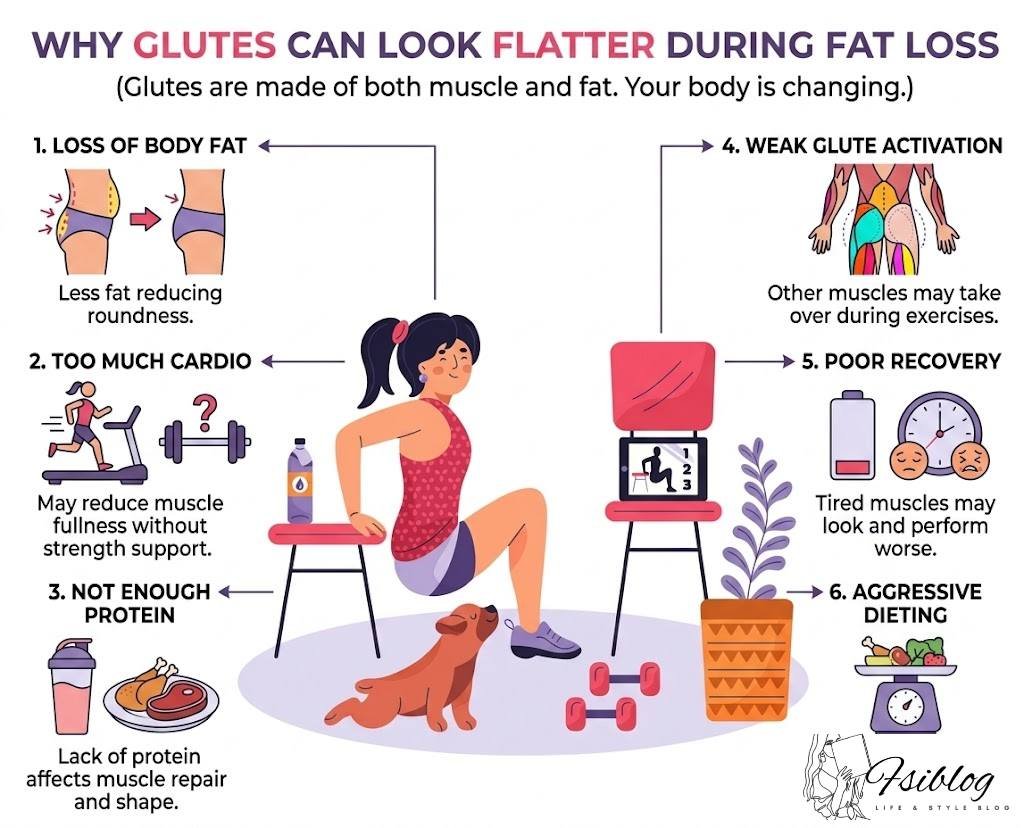
Your glutes are made up of muscle and fat. When you lose body fat, the fat around your hips, thighs, and bum may also reduce. If you are not strength training properly or eating enough to support muscle, your glutes can look smaller, softer, or less lifted.
That does not mean your progress has failed. It simply means your body is changing, and your training plan may need adjusting.
Common Reasons Glutes Look Flatter
| Possible Reason | What It Means |
|---|---|
| Loss of body fat | Less fat around the hips and glutes can reduce roundness |
| Too much cardio | Excessive cardio without strength training may reduce muscle fullness |
| Not enough protein | Muscles need protein to repair and maintain shape |
| Weak glute activation | Other muscles may take over during lower-body exercises |
| Poor recovery | Tired muscles may look and perform worse |
| Aggressive dieting | Eating too little can affect strength, energy, and muscle retention |
Your Body May Be Trying to Save Energy
When you eat less for a long period, your body becomes more careful with energy. If your diet is too restrictive, you may notice lower energy, weaker workouts, slower recovery, and less muscle fullness.
This is why crash dieting often leads to a smaller body, but not necessarily a stronger or more shaped one.
Signs You May Be Under-Recovering
- Your lower-body strength is dropping
- You feel tired before workouts
- Your glutes feel flat or less firm
- You are sore for longer than usual
- You feel weaker during squats, lunges, or hip thrusts
- You are relying on more cardio instead of better strength training
A more balanced approach usually works better than trying to rush fat loss.
Your Body Proportions Change During Fat Loss
Fat loss can change how your body looks from different angles. Sometimes your waist gets smaller, your thighs reduce, or your hips look different. These changes can make your glutes appear less projected, even when your body is still progressing.
This is especially common when people compare their current shape to gym photos, edited social media images, or old pictures taken in different lighting.
What Might Be Happening
| Change | How It Can Affect Appearance |
|---|---|
| Smaller waist | Can change how your lower body looks overall |
| Reduced thigh fat | May alter the balance of your legs and hips |
| Less muscle pump | Glutes may look flatter after rest or low-carb days |
| Different posture | Pelvic position can affect how glutes appear |
| Lower training volume | Muscles may look less full over time |
The key is not to panic. Instead, look at strength, consistency, and how your body feels over several weeks.
Lazy Glutes Are More Common Than People Think
Many people in the UK spend long hours sitting at a desk, commuting, studying, or relaxing on the sofa after work. Sitting itself does not “ruin” your glutes, but it can make it harder to activate them properly during workouts.
When your glutes do not switch on well, other muscles often take over.
Signs Your Glutes May Not Be Activating Properly
- Your lower back works harder during squats
- Your hamstrings cramp during glute bridges
- You feel lunges mainly in your quads
- Hip thrusts feel awkward or uncomfortable
- One side feels stronger than the other
- You struggle to feel a squeeze at the top of movements
Simple Glute Activation Exercises
Before your main workout, you can add a few light activation drills.
- Glute bridges
- Banded side steps
- Frog pumps
- Bodyweight hip thrusts
- Single-leg kickbacks
- Clamshells
- Slow step-ups
You do not need to exhaust yourself before training. The goal is to wake the muscles up so they work better during heavier exercises.
Chasing Sweat Is Not the Same as Building Shape
A sweaty workout can feel satisfying, but sweat does not always mean you are building muscle. Glutes usually respond better to controlled strength training, progressive overload, and enough recovery.
Instead of only trying to burn calories, focus on making your lower-body workouts more intentional.
Better Glute Training Habits
| Instead of Only Doing This | Try This Instead |
|---|---|
| Fast random circuits | Slower controlled reps |
| Endless cardio | Strength training with good form |
| Very light weights forever | Gradually increasing resistance |
| Rushing hip thrusts | Pausing and squeezing at the top |
| Training glutes every day | Allowing proper recovery between sessions |
Exercises That Help Maintain Glute Shape

You do not need a complicated plan. The basics work well when they are done consistently and with good technique.
Useful Glute-Focused Exercises
- Hip thrusts
- Romanian deadlifts
- Bulgarian split squats
- Step-ups
- Cable kickbacks
- Glute bridges
- Walking lunges
- Leg press with a glute-focused stance
If you train at a local gym, leisure centre, or at home with dumbbells and bands, you can still make progress. The main aim is to challenge the muscles gradually rather than constantly changing exercises.
Nutrition Matters More Than People Realise
During fat loss, many people eat too little and then wonder why their shape starts disappearing. Your body still needs enough nutrients to repair tissue, support training, and maintain muscle.
Protein is especially important because it helps with muscle repair and recovery. Some people find whey protein useful as a convenient option when they struggle to get enough protein from regular meals.
That does not mean supplements are essential. Foods like eggs, Greek yoghurt, chicken, fish, tofu, beans, lentils, cottage cheese, and lean meats can all support a balanced diet.
Simple Protein-Friendly Meal Ideas
- Greek yoghurt with fruit
- Eggs on wholegrain toast
- Chicken or tofu salad wrap
- Tuna jacket potato
- Lentil soup with bread
- Salmon with rice and vegetables
- Cottage cheese with oatcakes
- Turkey, bean, or veggie chilli
Your Strength Gives You Useful Feedback
If your glutes are getting weaker week after week, it may be a sign that your body is struggling to maintain muscle during fat loss. Strength does not need to improve every single session, but big drops can be a warning sign.
Strength Markers to Watch
- Hip thrust performance
- Squat control
- Lunge stability
- Step-up strength
- Lower-back comfort
- Balance between both sides
- Ability to recover between sessions
Some active adults also use creatine to support high-intensity training performance, particularly during strength-focused phases. However, anyone with health concerns, medical conditions, or uncertainty about supplements should speak to a GP, pharmacist, or registered dietitian first.
What to Do If Your Glutes Look Flatter
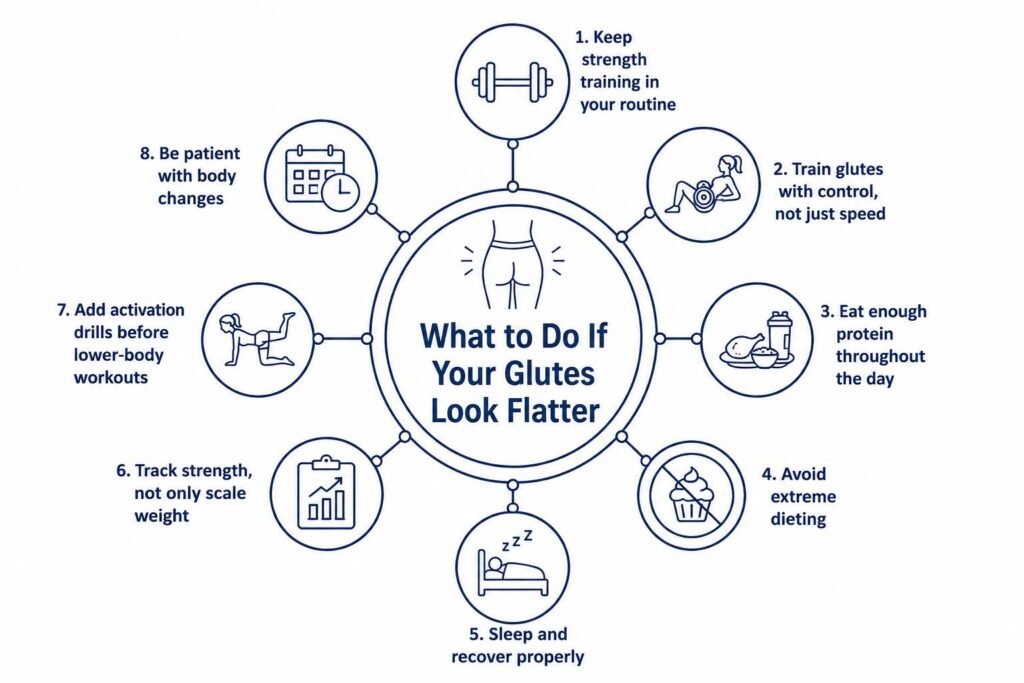
If you are worried your glutes are flattening, avoid jumping straight into more cardio or stricter dieting. That may make the problem worse.
A Smarter Checklist
- Keep strength training in your routine
- Train glutes with control, not just speed
- Eat enough protein throughout the day
- Avoid extreme dieting
- Sleep and recover properly
- Track strength, not only scale weight
- Add activation drills before lower-body workouts
- Be patient with body changes
A More Balanced Way to Think About Progress
Body changes are not always linear. Some weeks you may feel leaner but flatter. Other weeks, you may feel stronger but not see visible changes. This is normal.
Instead of judging progress only by appearance, look at the full picture.
Better Progress Signs
| Progress Sign | Why It Matters |
|---|---|
| You feel stronger | Suggests better muscle retention |
| Clothes fit more comfortably | Shows practical body changes |
| Energy is stable | Suggests your routine is more sustainable |
| Workouts feel controlled | Shows improved movement quality |
| Recovery is better | Helps long-term consistency |
| You feel healthier | Matters more than short-term appearance |
Conclusion
Flat-looking glutes during fat loss can feel discouraging, but it is usually not a sign that you have failed. Your body may be losing fat, changing proportions, holding less muscle fullness, or responding to a training plan that needs more strength work and recovery.
The answer is not to punish yourself with extra cardio or a harsher dieting. A better approach is to focus on controlled glute training, enough protein, sensible recovery, and patience.
Your body is not a quick project. It changes gradually, and it responds best when you support it properly. If your goal is to feel stronger, healthier, and more confident, build your plan around consistency rather than pressure.
Disclaimer: This article is for general fitness and wellbeing information only. It is not medical advice. If you are under 18, pregnant, breastfeeding, managing a health condition, recovering from an eating disorder, or unsure about supplements or weight loss, speak with a GP, registered dietitian, or qualified healthcare professional before making major changes to your diet or training.
References
- Lopez, P., Taaffe, D. R., Galvão, D. A., Newton, R. U., Nonemacher, E. R., Wendt, V. M., Bassanesi, R. N., Turella, D. J. P., & Rech, A. (2022). Resistance training effectiveness on body composition and body weight outcomes in individuals with overweight and obesity across the lifespan: A systematic review and meta-analysis. Obesity Reviews, 23(5), e13428. DOI: 10.1111/obr. 13428.
- Morton, R. W., Murphy, K. T., McKellar, S. R., Schoenfeld, B. J., Henselmans, M., Helms, E., Aragon, A. A., Devries, M. C., Banfield, L., Krieger, J. W., & Phillips, S. M. (2018). A systematic review, meta-analysis and meta-regression of the effect of protein supplementation on resistance training-induced gains in muscle mass and strength in healthy adults. British Journal of Sports Medicine, 52(6), 376–384. DOI: 10.1136/bjsports-2017-097608.
- Nunes, E. A., Colenso-Semple, L., McKellar, S. R., Yau, T., Ali, M. U., Fitzpatrick-Lewis, D., Sherifali, D., Gaudichon, C., Tomé, D., Atherton, P. J., Robles, M. C., & Phillips, S. M. (2022). Systematic review and meta-analysis of protein intake to support muscle mass and function in healthy adults. Journal of Cachexia, Sarcopenia and Muscle, 13(2), 795–810. DOI: 10.1002/jcsm.12922.
- Tagawa, R., Watanabe, D., Ito, K., Otsuyama, T., Nakayama, K., Sanbongi, C., & Miyachi, M. (2022). Synergistic effect of increased total protein intake and strength training on muscle strength: A dose-response meta-analysis of randomized controlled trials. Sports Medicine – Open, 8, 110. DOI: 10.1186/s40798-022-00508-w.
- Kreider, R. B., Kalman, D. S., Antonio, J., Ziegenfuss, T. N., Wildman, R., Collins, R., Candow, D. G., Kleiner, S. M., Almada, A. L., & Lopez, H. L. (2017). International Society of Sports Nutrition position stand: Safety and efficacy of creatine supplementation in exercise, sport, and medicine. Journal of the International Society of Sports Nutrition, 14, 18. DOI: 10.1186/s12970-017-0173-z.
- Mills, S., Candow, D. G., Forbes, S. C., Neary, J. P., Ormsbee, M. J., & Antonio, J. (2020). Effects of creatine supplementation during resistance training sessions in physically active young adults. Nutrients, 12(6), 1880. DOI: 10.3390/nu12061880.
- Calbet, J. A. L., Ponce-González, J. G., de la Calle-Herrero, J., Pérez-Suárez, I., Martin-Rincon, M., Santana, A., Morales-Alamo, D., & Holmberg, H.-C. (2017). Exercise preserves lean mass and performance during severe energy deficit: The role of exercise volume and dietary protein content. Frontiers in Physiology, 8, 483. DOI: 10.3389/fphys. 2017.00483.
- Schoenfeld, B. J., Ogborn, D., & Krieger, J. W. (2017). Dose-response relationship between weekly resistance training volume and increases in muscle mass: A systematic review and meta-analysis. Journal of Sports Sciences, 35(11), 1073–1082. DOI: 10.1080/02640414.2016.1210197.