



There is a particular kind of quiet that arrives about forty minutes into a solo drive, once the motorway has given way to something narrower and you have stopped checking whether anyone else is bored. Nobody is asking where you are stopping for lunch. Nobody has opinions about the playlist. For a small island, the UK holds an unreasonable amount of good driving, and a fair bit of it is better done on your own.
Driving alone as a woman does change the planning, though not really in the ways most guides suggest. The things that actually ruin solo trips are dull. A soft tyre nobody checked. A phone with full battery and no signal. An overnight stop booked from a photograph rather than a recent review. A minor shunt on an unfamiliar A road, followed by three days of phone calls from a hotel room 300 miles from your own front door.
This guide is built around those problems, with the detail that usually gets left out.
What The Casualty Figures Say About Where Risk Actually Sits
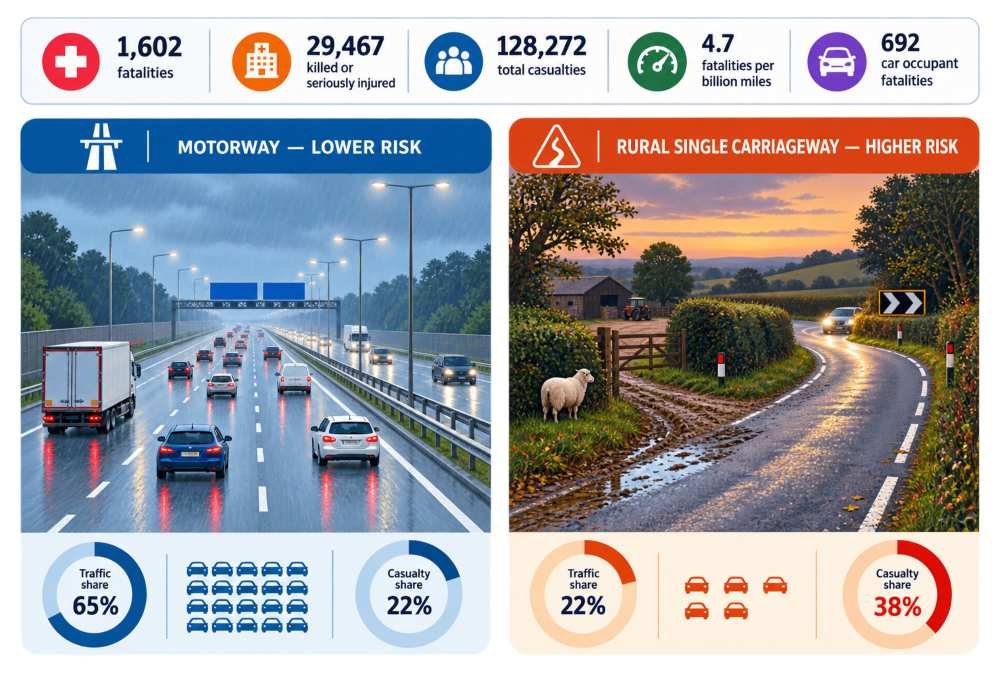
Most nervousness about long drives points at motorways. The data points somewhere else entirely. The Department for Transport publishes the definitive count each autumn, and the 2024 annual report on reported road casualties in Great Britain gives a clear picture of the scale.
| Measure, Great Britain, 2024 | Figure | Change On 2023 |
| Fatalities | 1,602 | Down 1% |
| Killed or seriously injured | 29,467 | Down 1% |
| Casualties of all severities | 128,272 | Down 4% |
| Fatalities per billion vehicle miles | 4.7 | Down 3% |
| Car occupant fatalities | 692 | Down 5% |
The pattern underneath those totals matters more than the totals themselves. Motorways carry roughly a fifth of Britain’s traffic and produce a small fraction of its casualties. Rural single carriageways carry far less traffic and produce a great deal more harm, because they mix 60mph national speed limits with blind bends, farm entrances, standing water, mud, sheep and oncoming drivers who know the road far better than you do.
That reverses the usual worry. The M6 in the rain is the boring, well-lit, heavily patrolled part of your trip. The unclassified lane you take at dusk because the sat nav promised it was eleven minutes quicker is the part that deserves your attention.
Choosing A Route That Suits The Driver, Not The Photograph
Route choice is where most first solo trips go slightly wrong. People pick the drive that looks best on a phone screen and then find themselves reversing a hire car a quarter of a mile downhill to a passing place while a Highland cattle lorry waits. There is nothing wrong with an ambitious route. There is something wrong with an ambitious route chosen without knowing what it asks of you.
| Route | What It Actually Asks Of You | Good First Solo Trip? |
| North Coast 500, Inverness loop | Long single track sections, confident reversing, patience with passing places, fuel planning between stops | Better as a second or third trip |
| Causeway Coastal Route, Belfast to Derry-Londonderry | Steady coastal A roads, heavy summer traffic, frequent stopping points | Yes |
| Atlantic Highway, the A39 through north Devon and Cornwall | Fast in parts, then narrow and hedged, tight village centres, seasonal congestion | Yes |
| Snake Pass, the A57 across the Peak District | Exposed moorland, fog, standing water, regular winter closures | Only in settled weather |
| Cotswolds A roads around Stow and Broadway | Gentle distances, good phone signal, plenty of daytime stops | Ideal for a first attempt |
| Bealach na Bà, the pass to Applecross | Steep gradients, hairpins, no barriers, unsuitable in ice or low cloud | No |
Northern Ireland deserves more attention than it gets from mainland drivers. The roads are well surfaced and well signposted, the distances between highlights are short, and the official tourism guide to the coastal drive from Belfast to the Giant’s Causeway is unusually honest about how long each leg really takes.
Whatever you pick, share it. Send a friend or family member your rough route, your overnight stops and a sense of when you expect to arrive each day, then send a pin when you get there. It costs nothing and removes the low hum of worry at both ends.
Your Phone Is The Weakest Part Of The Plan
Almost every solo trip plan quietly assumes a working phone. That assumption is shakier than most drivers realise. Ofcom’s most recent snapshot of network coverage found that good outdoor 4G coverage from all four mobile operators reaches 84% of the UK landmass. In contrast, coverage from at least one operator reaches 96%, according to the regulator’s Connected Nations update for spring 2026.
Read that the other way round. Across roughly a sixth of the country, somebody’s network works and yours may not. That sixth is not evenly spread. It sits in exactly the places a good road trip goes: the Highlands, mid Wales, the North Pennines, the far edges of Cornwall.
Plan for the gap rather than hoping around it.
- Download offline maps for every region you will cross, not just the destination, and check they have actually downloaded rather than queued for Wi-Fi.
- Save the what3words reference or the postcode of each overnight stop somewhere that does not need data to open, including a note in your car.
- Carry a charger that plugs into the 12V socket, plus a separate power bank. A cable alone is useless if the car will not start.
- Write down your breakdown provider’s number and policy reference on paper. Recovering it from a dead phone is not possible.
- Agree on one check-in time a day with someone at home, so a missed message means something rather than nothing.
Twenty Minute Check That Prevents Most Roadside Trouble
You do not need to know how an engine works. You do need to spend twenty minutes with the car before a long trip, because the failures that strand people are overwhelmingly the simple ones. Tyre defects alone account for around one in five breakdowns on England’s motorways and major A roads, and the safety charity TyreSafe records more than 51,500 tyre–related breakdowns in a single year, a rise of 14% on the year before.
Tread depth is the part people underestimate. The legal minimum across the central three-quarters of the tyre is 1.6mm. On a wet road at 50mph, stopping distance stretches from roughly 25.9 metres on a new 8mm tyre to about 37.8 metres on one worn to that legal limit. Twelve metres is the length of a bus, and it is the difference between a fright and a claim.
| Check | What Good Looks Like | How Long |
| Tyre pressure | Checked cold, set to the figure in the handbook or door sill, not the sidewall maximum | 5 minutes |
| Tread depth | Above 3mm ideally, never below 1.6mm; the outer band of a 20p coin should sit hidden in the tread | 3 minutes |
| Spare or inflation kit | Actually present, inflated and with the locking wheel nut key | 2 minutes |
| Oil and coolant | Between minimum and maximum on a level surface, engine cold | 3 minutes |
| Screenwash | Full, with a winter mix in the colder months | 1 minute |
| Lights and indicators | All working, checked against a garage door or a shop window | 3 minutes |
| Wipers | No smearing, no split rubber, no chattering | 1 minute |
| Breakdown cover | In date, covers your car rather than only you, includes onward travel | 2 minutes |
If a service is due within a month or so, bring it forward rather than pushing it back. A garage appointment near home is an inconvenience. The same fault on a Sunday evening on the A835 is a different problem entirely.
What Actually Earns Its Space In The Boot
Emergency kits tend to be either non-existent or absurd. The useful version fits in one crate and is built around two scenarios: waiting somewhere cold for recovery, and being visible while you do it. National Highways found that winter breakdowns on motorways and major A roads rose sharply over five years, with a striking share of drivers setting off on long journeys carrying no food, water or warm clothing at all.
| Item | Why It Is In There |
| High visibility vest, kept in the cabin not the boot | You may need it before you open the boot |
| Warning triangle | For ordinary roads only, never for motorways |
| Torch with spare batteries | Phone torches drain the battery you need for the recovery call |
| Foil blanket and a proper fleece or coat | Waiting outside the car in February is genuinely cold |
| Two litres of water and long life snacks | Recovery on rural routes can take hours |
| 12V charger and power bank | The single most useful item on this list |
| Ice scraper, de icer, small folding shovel in winter | Cheap, and occasionally the whole solution |
| Any regular medication, in the cabin | Not something to retrieve from a recovery lorry at midnight |
| Printed insurance and breakdown details | Works without signal, battery or a working screen |
Reading The Forecast Before It Reads You
British weather does not usually cancel a road trip. It reroutes one. Snake Pass and the moorland A roads across the Pennines close in snow, coastal routes get closed to high-sided vehicles in gales, and Highland passes become genuinely dangerous in ice and low cloud long before anyone posts a warning sign.
The Met Office issues warnings up to seven days ahead across eight weather types, and its guide to how the warning system works is worth reading once properly rather than glancing at a colour on an app.
| Warning | What It Means For A Solo Driver |
| Yellow | Go, but build in extra time and check whether your specific pass or coastal road is affected |
| Amber | Change the plan. Move the overnight stop, take the lower route, or shift the leg by a day |
| Red | Do not drive it. Reroute entirely or stay put and rebook |
Two habits help more than any app. Check the forecast the night before each leg rather than only before the trip, and check the specific road rather than the region, because a yellow wind warning for Scotland tells you very little about whether the Skye Bridge is open.
Stops, Services And Where You Sleep
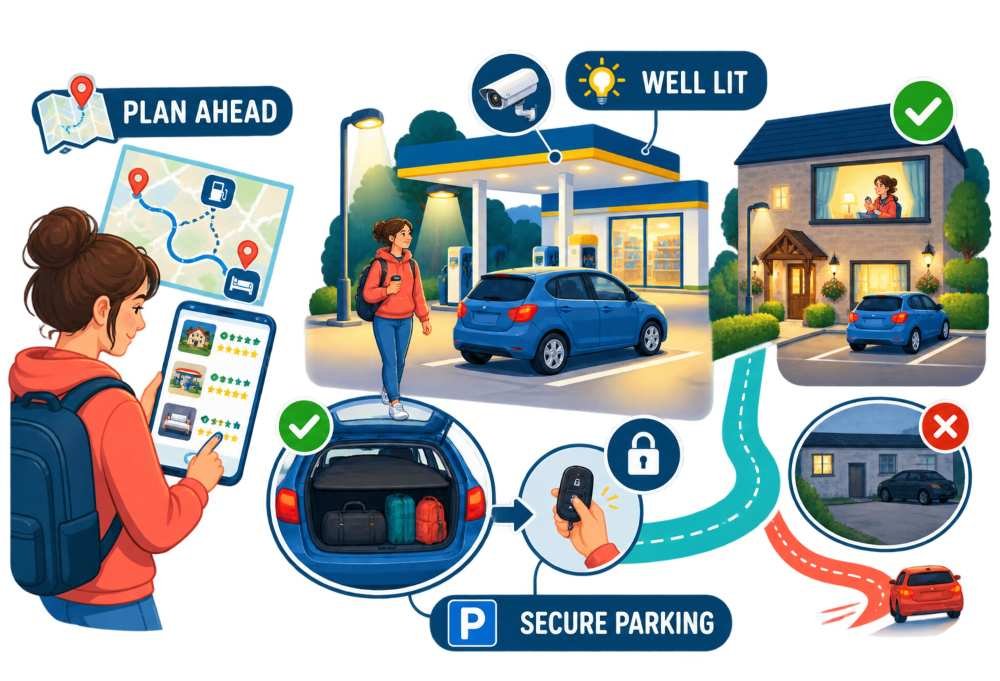
Personal safety advice for solo travel is often either patronising or so vague it is useless. The version that works is mostly about reducing the number of decisions you have to make while tired, in the dark, in an unfamiliar place. The personal safety charity Suzy Lamplugh Trust has been publishing practical guidance on exactly this since 1986, and its core principle is worth carrying: decide your exit before you need one.
- Park close to the entrance at service stations, under lighting, near other cars and within view of a camera or a window.
- Lock the doors as you get in, before you set the sat nav, sort the playlist or check messages.
- Keep bags, chargers and anything with a screen out of sight, including at fuel stations where you step away from the car for two minutes.
- Aim to arrive at overnight stops before dark wherever the schedule allows. Everything about assessing a place is easier in daylight.
- Read recent reviews rather than the top-rated ones, and look specifically for other solo travellers mentioning lighting, parking, and how the arrival was handled.
- Book somewhere with secure parking you can see from the building, particularly on campsites and rural B&Bs.
- If a place feels wrong on arrival, leave. Losing one night’s deposit is a cheap outcome.
None of this is about being frightened. It is about not spending your evening energy on decisions you could have made in advance.
First Ten Minutes After A Collision
This is the section nobody reads until it is relevant. Learn it once, and it stays with you.
If you break down or have a collision on a motorway or major A road, National Highways summarises the response in two words: go left. The full guidance on breakdowns and what to do if you cannot reach safety is short and worth reading before you travel. On ordinary roads, the Highway Code rules covering breakdowns and incidents set out what you must and must not do.
- Get to a place of relative safety. Leave at the next junction or service area if the car will still move, and put the hazards on.
- If you cannot leave, indicate left, move left, use an emergency area or hard shoulder, and get behind the barrier where there is one. Stay well away from the car and moving traffic.
- If you are stuck in a live lane or cannot get out safely, keep your seatbelt on, keep the hazards on, and call 999 or press the SOS button.
- Call National Highways on 0300 123 5000 on England’s motorways and major A roads, then your breakdown provider.
- On ordinary roads only, place a warning triangle at least 45 metres behind the car on the same side. Never use one on a motorway.
- Exchange names, addresses, vehicle registrations and insurer details. This is a legal duty, not a courtesy, and the same rules require reporting to the police within 24 hours where details cannot be exchanged at the scene.
- Photograph everything before anything moves: positions, damage, registrations, road markings, signage, skid marks, weather and the wider scene.
- Take witness names and numbers at the scene. Tracing them afterwards is close to impossible.
- Say what happened. Do not say whose fault it was, to anyone, at the roadside.
Recovery, Repairs And Injury When You Are 300 Miles From Home
A collision near home is an administrative nuisance. The same collision on the A82 with your car undriveable and a hotel booked 90 miles further north is a logistics problem, layered on top of shock, in a place where you know nobody.
Most drivers assume the only route is to ring their own insurer. That is one option, not the only one, and it is often not the fastest when the other driver was at fault. An accident management company handles the whole chain instead: recovery of the vehicle, a like-for-like replacement car so you are not stranded or paying for taxis, arrangement of repairs, and a referral to solicitors where someone has been hurt. Because the costs are recovered from the at-fault driver’s insurer, the service is typically free to the claimant, and your own policy and no-claims record are not the first thing on the table.
| What Needs Sorting | Doing It Yourself | Through An Accident Management Company |
| Vehicle recovery | You arrange it, often at cost | Arranged and coordinated for you |
| Replacement car | Courtesy car only if your policy includes it | Like for like replacement, arranged quickly |
| Repairs | You find and chase a garage in an unfamiliar area | Repairer arranged and managed |
| Getting home | Your problem | Onward travel usually part of the process |
| Injury | You approach solicitors separately | Referred to specialists as part of the same process |
If you have been hurt, even mildly, get checked before you drive anywhere. Whiplash and soft tissue injuries often present properly a day or two later, and a contemporaneous medical record is worth a great deal afterwards. From there, making a personal injury claim is considerably simpler when one specialist handles the paperwork, the medical evidence and the correspondence, rather than you fielding calls from three insurers, a garage and a recovery firm from a hotel lobby.
For a solo traveller a long way from home, that single point of contact is the difference between a ruined fortnight and an inconvenient week.
Checklist Worth Photographing Before You Leave
Take a picture of this on your phone before the first leg.
- Tyres, oil, coolant, screenwash, lights and wipers checked, spare or inflation kit present
- Full tank or a charging plan with two backup locations per leg
- Breakdown cover in date, number and policy reference written on paper
- Offline maps downloaded and confirmed for every region on the route.
- Boot kit packed, high visibility vest in the cabin
- Route, overnight stops and daily check-in time shared with someone at home.
- Accommodation booked in advance, recent reviews read, parking confirmed
- Weather warnings checked for the specific roads on tomorrow’s leg.
- Insurance details and the number of an accident management company saved and printed.
Road Is Still Yours
Preparation is not the same as apprehension. Everything above takes an evening and twenty minutes with the car, and the point of it is not caution for its own sake. It is that a checked tyre, a downloaded map and a saved phone number remove almost every decision you would otherwise have to make badly, in the dark, on your own.
What is left after that is the reason you wanted to go. The light on the water somewhere west of Ullapool. A layby with no name and a view that stops you for twenty minutes. A pub lunch you did not have to negotiate. The particular satisfaction, somewhere around day three, of realising you have not consulted anyone about anything since Tuesday.
That part is not complicated at all.
Disclaimer
This article is provided for general information only and does not constitute legal, medical, insurance or financial advice. Road conditions, coverage figures, statutory duties and claims processes change over time and vary between England, Scotland, Wales and Northern Ireland. Readers should consult a qualified solicitor, their insurer or an appropriate professional regarding their own circumstances, and should follow current guidance from the Highway Code, National Highways and the emergency services at the roadside. Figures cited were accurate at the date of the sources listed below.
References
- Department for Transport. Reported Road Casualties Great Britain, Annual Report: 2024. Published 25 September 2025. GOV.UK. Available at: https://www.gov.uk/government/statistics/reported-road-casualties-great-britain-annual-report-2024/reported-road-casualties-great-britain-annual-report-2024
- Driver and Vehicle Standards Agency and Department for Transport. The Highway Code: Breakdowns And Incidents, Rules 274 To 287. GOV.UK. Available at: https://www.gov.uk/guidance/the-highway-code/breakdowns-and-incidents-274-to-287
- National Highways. Breakdowns: If You Get Into Trouble On A Motorway, Go Left. Available at: https://nationalhighways.co.uk/road-safety/breakdowns/
- Ofcom. Connected Nations Update: Spring 2026. Published 2026. Available at: https://www.ofcom.org.uk/phones-and-broadband/coverage-and-speeds/connected-nations-update-spring-2026
- TyreSafe. Tyre Safety Statistics And Infographics. Available at: https://www.tyresafe.org/resources/tyre-safety-infographics/
- Met Office. Weather Warnings Guide: A Guide To The National Severe Weather Warning Service. Available at: https://weather.metoffice.gov.uk/guides/warnings
- Suzy Lamplugh Trust. Personal Safety Guidance And Resources. Registered charity number 802567. Available at: https://www.suzylamplugh.org/
- Tourism Northern Ireland. Causeway Coastal Route. Available at: https://discovernorthernireland.com/blog/causeway-coastal-route
- Note on digital object identifiers: the sources above are official statistical releases, statutory guidance and public safety publications rather than journal articles, and are not assigned DOIs. They are cited by publisher, title, publication date where stated, and permanent URL.